

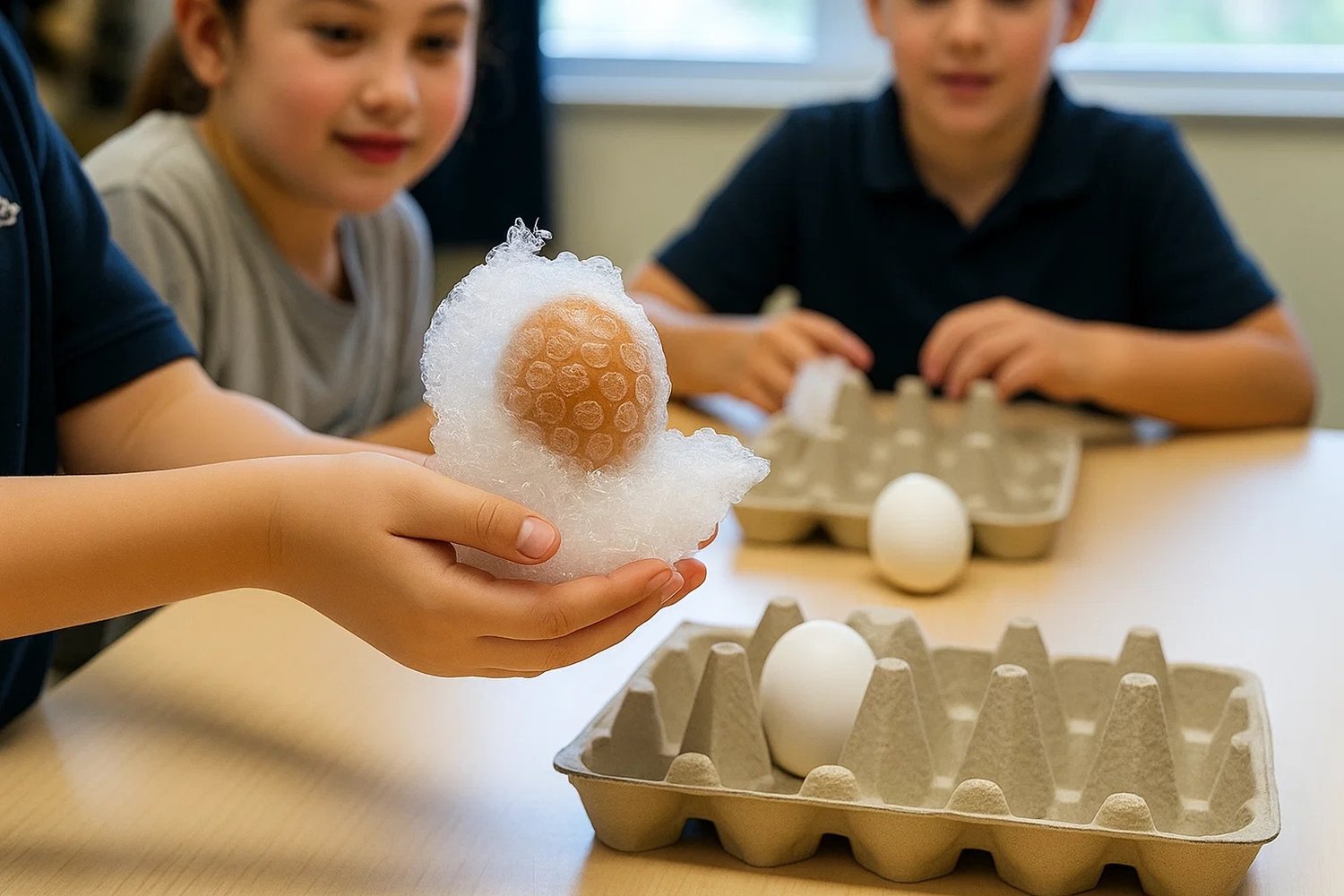
Testing Ideas Through the Egg Drop STEM Challenge
Drop an egg from a height and something surprising happens — not just to the egg, but to the way learners think.
The Egg Drop Challenge is a focused investigation into protection, impact, and thoughtful design. Whether working alone or in teams, learners are asked to solve a problem:
Use the Egg Drop STEM Challenge to teach this topic in class.
Can you stop an egg from breaking?
How will you test your design fairly?
What will you change next time?
Every drop becomes a data point. Every crack — or bounce — tells a story.
Why It Works
This challenge is about thinking in systems. Learners test how materials absorb force, how structure affects outcome, and how small tweaks can make a big difference. Instead of passively observing physics, they’re applying it.
It supports:
- Practical application of forces and energy transfer.
- Iteration and redesign based on real results.
- Methodical recording and control of variables.
- Scientific reasoning and reflection.
It builds persistence and critical thinking.
The Role of Structure
The investigation is flexible — but it benefits from clear framing. With the right scaffold, learners are guided to:
- Write a clear method.
- Keep key variables constant.
- Test under consistent conditions.
- Reflect on what made their design more (or less) successful.
A structured leaderboard, evaluation prompt, and results table help educators turn this into a high quality STEM task.
No Specialist Equipment Needed
The Egg Drop Challenge can be run using everyday materials:
- Boxes, tubs, paper straws
- Bubble wrap, cotton wool
- String, bags, elastic bands
It’s ideal for:
- Science lessons at school or home
- STEM days
- Open evenings
- Transition sessions
- Science club investigations
Educators can tailor the drop height, materials, or time constraints to suit different settings.
Connected Learning
This challenge connects to multiple learning goals:
- Forces and how they act on objects.
- Scientific enquiry through method writing, testing, and evaluating.
- Properties of materials and their uses.
- Resilience and problem-solving, through redesign and reflection.
It also naturally opens discussion about real-world applications: packaging, sports safety, landing spacecraft, or crash testing.
Support Available
To make this easier to run, there’s a fully editable bundle available with:
- Visual presentation
- Scaffolded method sheet
- Printable leaderboard and results table
- Guided evaluation prompts
- Certificate for reflective participation
👉 Buy the Egg Drop STEM Challenge Kit
👉 View the full STEM challenge collection
Hands-on investigations like this shift the focus from getting it right to figuring it out.
Comments ()