

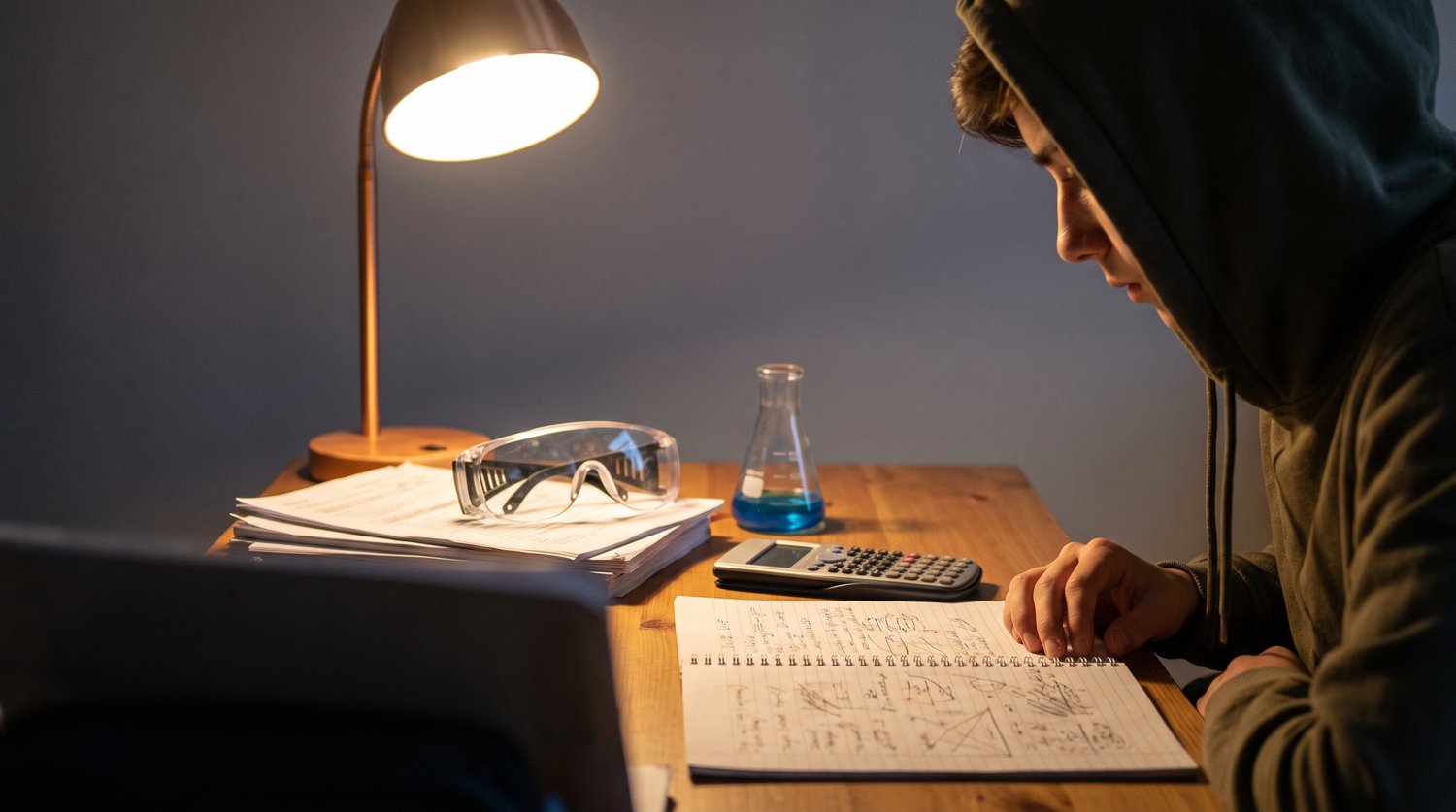
Ask any GCSE student which science paper worries them most and chemistry usually wins. After more than 25 years teaching science, and now tutoring one to one, I see the same handful of topics cost students the most marks, for AQA, Edexcel and OCR alike. Here are the five hardest GCSE chemistry topics, the mistake I see on each, and the fix that works.
1. Moles and quantitative chemistry
The mistake: memorising equations without understanding what a mole actually is, then freezing when a hard calculation question combines two steps. The fix: set out every calculation in full lines with units on every number. When the units cancel correctly, the answer is usually right. Then practise the same question type three times in a row, not once.
2. Electrolysis
The mistake: reciting "positive ions go to the negative electrode" without being able to explain why, so any unfamiliar electrolyte throws them. The fix: anchor everything to charge attraction, then learn the two rules for aqueous solutions (hydrogen at the cathode unless the metal is less reactive, oxygen at the anode unless a halide is present). Half equations become predictable once the rules are secure.
3. Bonding, structure and properties
The mistake: mixing up the properties of giant ionic, simple molecular and giant covalent structures, and writing "strong bonds" for everything. The fix: in the exam, always name the particles and the forces between them. "Weak intermolecular forces need little energy to overcome" earns the mark; "weak bonds" often does not.
4. Rates of reaction and equilibrium
The mistake: describing what happens ("it gets faster") instead of explaining with collision theory, and reversing Le Chatelier's principle under pressure. The fix: every rates answer needs frequency of successful collisions in it. For equilibrium, write down what the change does first, then ask which direction opposes it.
5. Titrations and concentration calculations
The mistake: knowing the practical but losing the 6-mark method marks for missing steps like rinsing the burette or adding the indicator. The fix: learn the method as a numbered sequence and practise writing it out in full, then drill the concentration calculation that follows it.
How to revise the hardest chemistry topics
Real exam questions beat rereading notes every time. If your child wants to see these topics taught quickly and clearly, my free walkthroughs cover whole papers in about half an hour: AQA Combined Chemistry Paper 1 in 30 minutes and Chemistry Paper 2 in 30 minutes, with the rest of the papers on the Advisory Science YouTube channel. Teachers are welcome to share them with classes too.
If chemistry is the subject holding your child back
One parent told me chemistry went from her daughter's worst subject to her most confident one. That is what one-to-one attention does: it finds the exact gaps and fixes them, patiently, on real exam questions. I offer online GCSE science tuition for AQA, Edexcel and OCR, Combined and Triple, all tiers. I am an enhanced DBS checked qualified teacher, you get a feedback note after every session, and my tutees improve by two grades on average. A Level Biology, Chemistry and Physics tuition is coming soon.
Which chemistry topic does your child, or your class, dread the most? Tell me in the comments and I will point you to the best free resource for it.