


Gap-fills are one of the simplest tools for adaptive learning in KS2 science - and one of the most effective. In this post, discover how these scaffolded resources boost retrieval practice, support mixed-ability teaching, and help every learner master science vocabulary.
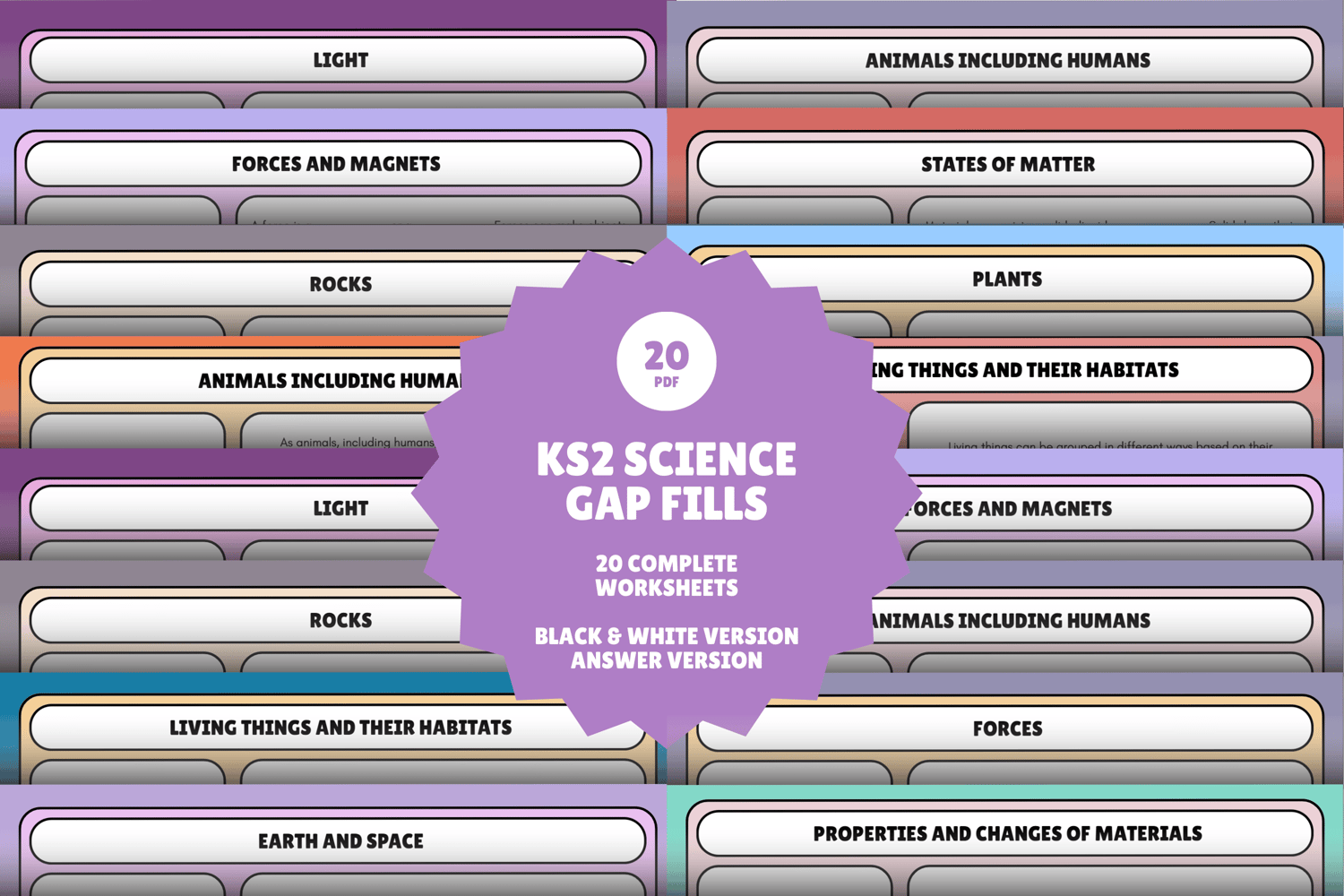
Save Time With the Complete Gap-Fill Collection - One for every unit!
Benefits of Gap-Fill Activities for Adaptive Learning in Primary Science
Gap-fills make adaptive teaching quick, practical, and inclusive.
- Flexible differentiation: Add a word bank for support or remove it for challenge.
- Vocabulary reinforcement: Strengthen essential KS2 science vocabulary in context.
- Instant feedback: Teachers can spot misconceptions or missing knowledge straight away.
- Memory strengthening: Every recall moment builds secure understanding.
Because they can be adapted easily, gap-fills are perfect for SEND, EAL, and mixed-ability classrooms.
5 Practical Ways to Use Gap-Fills in Your Classroom
1. Retrieval warm-up
Use short sentences such as “Plants need ___, ___ and ___ to grow.”
Perfect for lesson starters or quick checks. You can add small pictures beside key words, or remove the word bank altogether to challenge confident learners.
2. Assessment check
Example: “Evaporation happens when a ___ changes into a ___.”
These make brilliant mid-lesson quizzes. Try adding one or two distractor words in the word bank to stretch reasoning and identify misconceptions.
3. Independent task
Give learners a paragraph with eight blanks from a Year 6 science unit.
Provide the word bank near the text for support learners or remove it entirely for those ready to work independently.
4. Peer Practice
Work in pairs to fill in the gaps together.
Example: “The particles in a solid are packed ___ and can only ___ in place.”
Child A says, “I think the first gap is ‘tightly’.”
Child B replies, “Yes, and maybe the second gap is ‘vibrate’ because they don’t move around.”
They talk and agree on the answer. Research shows that pupils who discuss answers in pairs understand the topic better and remember more than when working alone.
5. Revision recap
Example: “Light travels in straight ___ from a source.”
These make excellent homework or end-of-unit recall tasks to keep vocabulary fresh.
Each activity reinforces retrieval practice and vocabulary recall in a simple, accessible way — adaptable for any topic or key stage.
When Gap-Fills Aren’t the Best Choice
Gap-fills are brilliant for retrieval and adaptive learning, but there are times when another format works better.
Learners still developing reading fluency
If a pupil is still decoding words, reading becomes the main barrier. In this case, try image-based sorting activities or oral recall instead.
Early EAL learners
When learners are new to English, sentence structure and vocabulary can feel overwhelming. Start with labelled diagrams or word–picture matching before introducing text-based gap-fills.
Learners with dyslexia or slower processing speed
Long passages with several blanks can overload working memory. Shorten the task or use one- or two-gap sentences. Present them in clear, accessible fonts and layouts.
High-attaining learners
Once vocabulary is secure, simple recall may not stretch their reasoning. Swap in explanation tasks, compare-and-contrast paragraphs, or concept maps to extend thinking.
Creative or reasoning-focused lessons
If the goal is to explore ideas or use imagination, gap-fills won’t fit. Choose open “What if…” prompts or short writing questions instead.
Adaptive teaching is about matching the tool to the need — not forcing one resource to fit every learner.
Time-Saving Ready-Made Gap Fill Resources
👉 Try our FREE editable Canva gap-fill templates for educators:
Quick Answers for Teachers
Can gap-fills help SEND learners?
Yes. When you include picture cues or shorter sentences, they strengthen confidence and vocabulary recall.
How often should I use gap-fills?
Once per topic or unit is a good balance. They’re ideal for retrieval starters, homework, or quick revision.
Are gap-fills only for lower-attaining learners?
Not at all. Removing the word bank or mixing in reasoning questions creates challenge and depth for higher-attaining pupils.
Final Thoughts
Gap-fills are small but mighty. They combine adaptive teaching with retrieval practice, turning tricky vocabulary into accessible, confidence-building learning. Whether you’re preparing for assessment, revising key concepts, or differentiating within a mixed-ability class, a gap-fill worksheet is one of the simplest ways to make learning stick.
Explore more Retrieval & Adaptive Learning Resources here:
Comments ()