

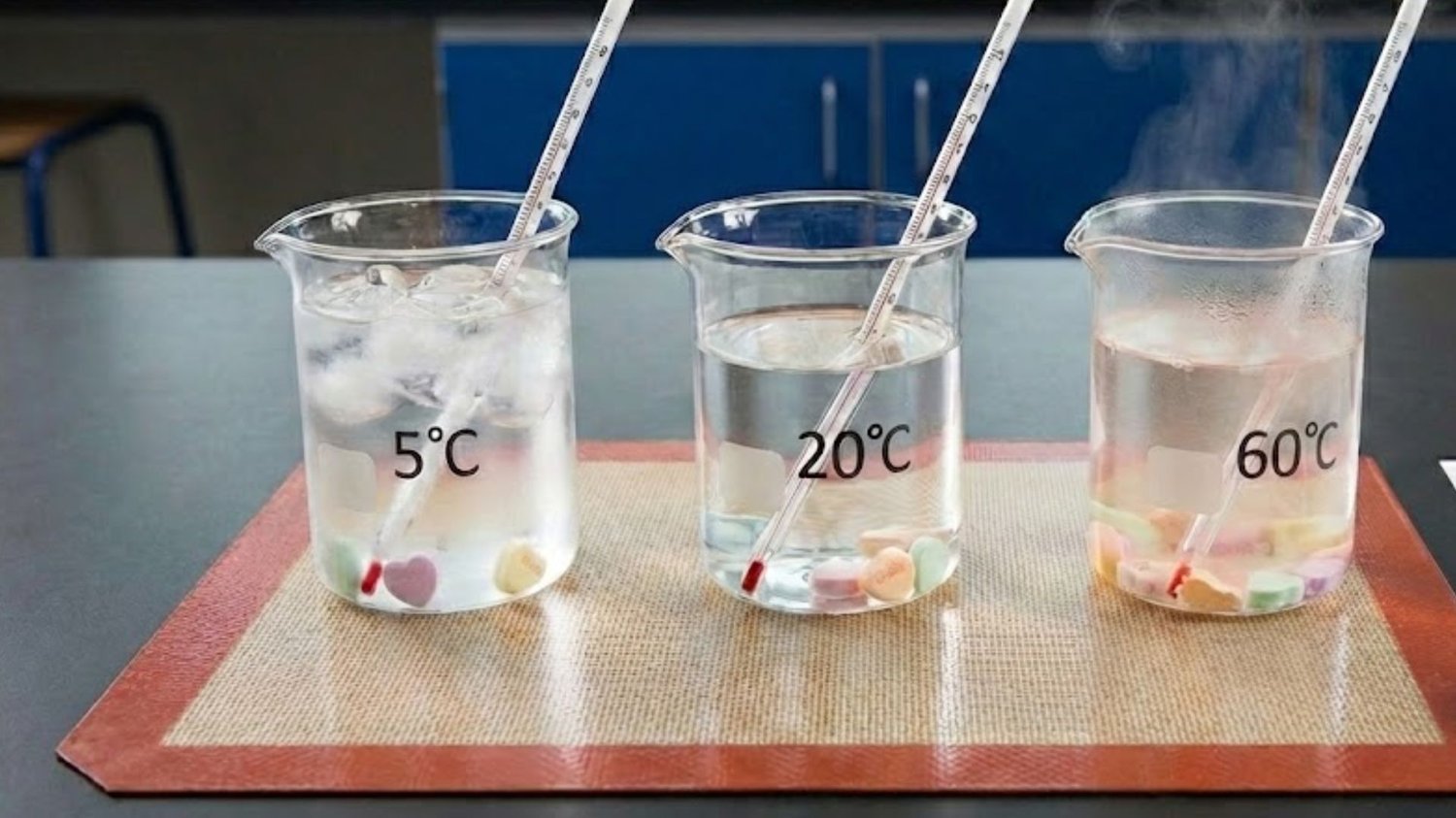
We know that love can fade, but does it happen faster in hot weather? Cupid needs a quick way to test his candy hearts, but he needs your students' help to prove the science behind the dissolve.
In this steamy investigation, your class will turn up the heat to see exactly how temperature controls the speed of a reaction.
The "Speedy Sugar" Race It’s a simple race against time that illustrates a powerful concept in physics.
- The Mystery: Does hot water actually destroy the hearts faster? And if so, exactly how much faster?
- The Experiment: Students will drop candy hearts into water at different temperatures, racing to see which condition breaks the bonds first.
- The Science: It’s all about Kinetic Energy. Students will visualize how heating water makes molecules move faster, leading to more frequent and forceful collisions that smash the sugar apart.
Curriculum Concepts You’ll Cover Connect this fun challenge to core particle physics:
- KS2 States of Matter: How temperature affects changes.
- KS3 Particle Model: The effect of energy on particle motion.
- KS4 Rates of Reaction: Demonstrating Collision Theory in action.
Ready to Turn Up the Heat? Don't let your planning dissolve. Download the full resource, including data recording sheets and a guide to explaining collision theory
👉 Get this investigation here
👉 Or get all 10 Valentine's investigations in the bundle
Comments ()