

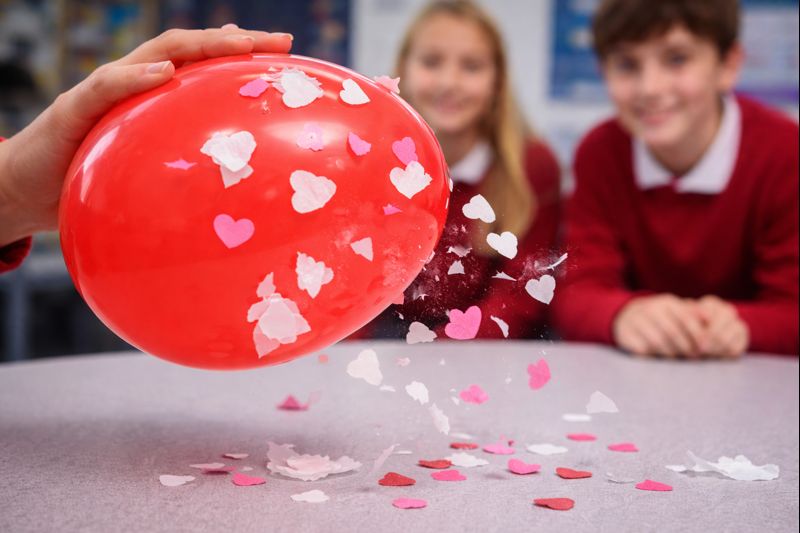
Cupid’s aim is usually perfect, but this year his decorations are causing chaos. Why are things sticking where they shouldn't? It’s not a love spell it’s an invisible force field that your students can control.
In this electrifying investigation, your class will discover why some materials "fall in love" instantly, while others play hard to get.
Sparks Will Fly (Literally!) Forget dry textbook diagrams; let your students see the power of electron transfer in action.
- The Scenario: Cupid's balloons are out of control. It's up to your class to investigate the chaos.
- The Experiment: Students will "charge up" and test the invisible reach of static electricity, measuring exactly how strong the pull is on different materials.
- The "Aha!" Moment: Watch as they discover that not all materials react the same way and that invisible electrons can move objects from a surprising distance.
Curriculum Concepts You’ll Cover: Turn a fun activity into a rigorous physics lesson covering:
- KS3 Static Electricity: Charging by friction, attraction, and repulsion.
- KS4 Physics: Electron transfer, electric fields, and real-world applications.
- Scientific Inquiry: Measuring variables and analyzing results.
Ready to Take Charge? Don't let your lesson plan fall flat. Download the complete resource, including extension tasks on electron transfer diagrams and durability of charge.
👉 Get the resource here
👉 Or get all 10 Valentine's investigations in the bundle
Comments ()