

A few years ago I started creating science resources for teachers: worksheets, revision cards, lesson bundles. What began as a side project is now a digital products business running through my own store at advisoryscience.com. Along the way I've learned that "selling digital products" sounds simple until you actually try it, at which point a dozen fiddly decisions start queueing up: what to sell, where to host it, how to price it, how to stop people pirating it, how to get anyone to buy it in the first place.
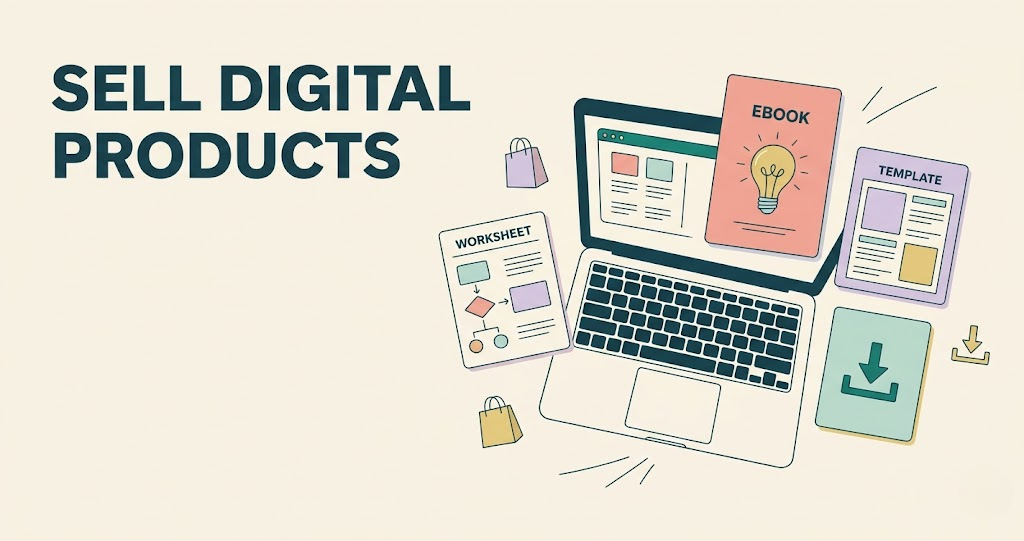
This is the step-by-step I wish I'd had when I started. It works for worksheets, ebooks, templates, printables, courses, stock images, music, anything you can deliver as a download or access link.
Step 1: Pick a niche you can speak to with authority
The digital products that sell aren't the ones chasing trends. They're the ones that solve a specific problem for a specific person. "Productivity templates" is too broad. "Notion templates for freelance designers tracking multiple client retainers" is a niche.
Pick something where you already have knowledge, a professional background, or at least genuine enthusiasm. Buyers can smell a tourist a mile off.
Step 2: Create one product, not ten
First-time sellers almost always try to launch with a whole catalogue. Don't. Pick the single most useful thing you could make for your niche and build that one thing properly. You'll learn more from shipping one product and watching how buyers actually respond to it than you will from agonising over a storefront full of things nobody wants.
Keep the quality bar high. A digital product has no physical presence. The file, the preview, and the sales page are the entire experience. If any of those feel amateur, the sale dies.
Step 3: Choose a platform that does the boring bits for you
This is where most people get stuck. You can host files yourself, handle payments yourself, deal with VAT yourself, chase failed deliveries yourself, or you can use a platform that handles all of it.
I use Payhip to sell digital products from my site. A few honest reasons why: setup took me under an hour, there's no monthly fee on the free plan, EU VAT and UK VAT are handled automatically (a genuine headache if you try to do it yourself), file delivery is secure with download limits and PDF stamping to deter piracy, and I can connect it to my own custom domain so buyers never leave my brand. It also handles discount codes, affiliate programmes, and email capture without me bolting on five different tools.
You can absolutely research alternatives. But if you want the shortest path from idea to paying customer, this is mine.
Step 4: Price it properly
New sellers underprice almost every time. The cheap-and-cheerful instinct is wrong for digital products because buyers associate low prices with low value, and you lose margin on every sale for no benefit.
Look at what similar products charge, then price at the higher end if your work genuinely deserves it. You can always run a launch discount. You cannot easily raise prices later without upsetting early buyers.
Step 5: Set up your store and sales page
The sales page is the product. Buyers can't flip through it, so your page has to do the flipping for them. Include: a clear headline stating what the product is and who it's for, a preview (screenshots, sample pages, a short video), three to five bullet points on what the buyer gets, social proof if you have it, an FAQ, and a clean buy button.
On Payhip, the store builder gives you this layout out of the box. Resist the urge to customise endlessly before you've launched. A live, imperfect store beats a perfect, unlaunched one every time.
Step 6: Launch small, loudly
Tell everyone you already have a connection with: email list, social followers, colleagues, your five most supportive friends. Don't wait until you have a big audience. Your first ten buyers usually come from people who already trust you.
For advisoryscience.com I announced on Instagram, Pinterest, and my YouTube channel simultaneously. The first week was the hardest because nobody's watching yet. Post anyway. Consistency compounds.
Step 7: Learn from the first 30 days
Once people are buying, listen. Which product sells most? Which sales page converts best? Which traffic source actually sends buyers? Payhip's built-in analytics give you this without needing a separate tool.
Use what you learn to make product two, then product three. This is where the compound effect kicks in. Each new product feeds the others, your catalogue grows, and your average order value climbs.
The unglamorous truth
Selling digital products isn't a passive income fairytale. It's a real business with real work. But it's also one of the most accessible businesses anyone with expertise can start. No inventory, no shipping, no staff. Just you, your knowledge, and a storefront.
If you're ready to stop planning and start selling, sign up on Payhip for free and get your first product live this week. Future-you will be glad you didn't wait.