

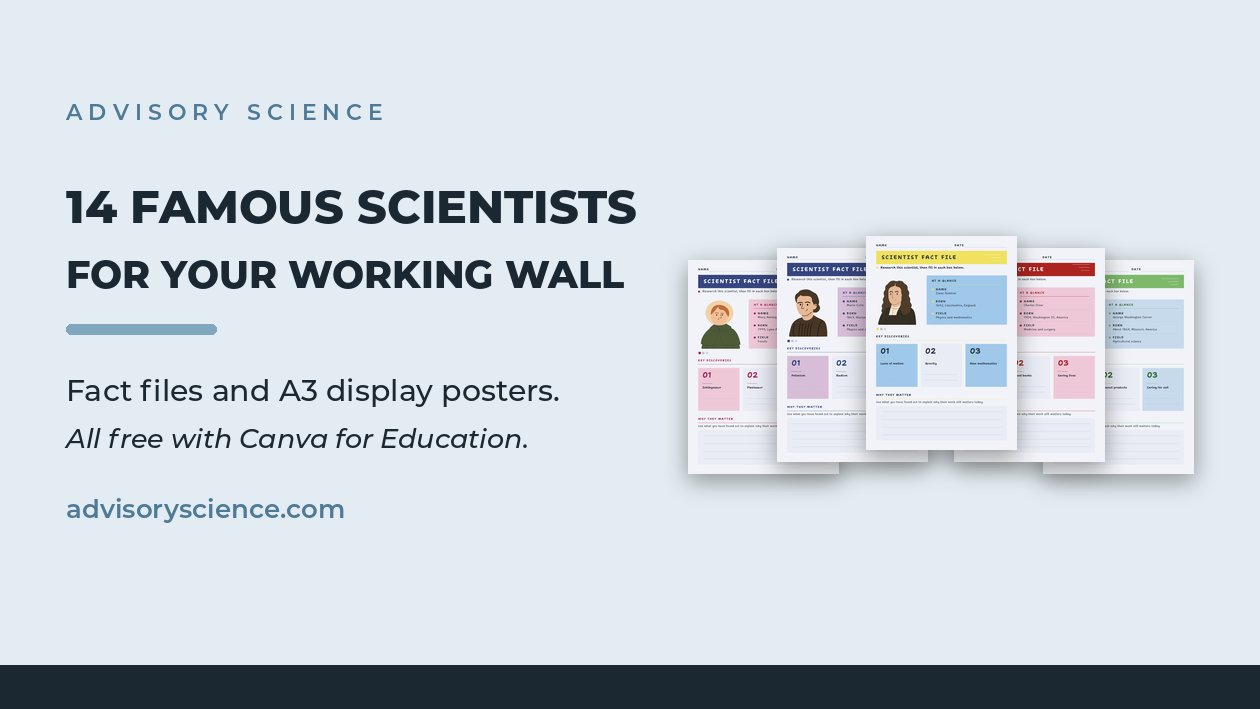
Fourteen scientists, each with an A4 fact file for children to fill in and a matching A3 display poster for the wall. All free and editable.
Who is in the set
From the ancient world: an Ancient Egyptian priest, Aristotle, and Alhazen, who wrote the Book of Optics and worked out how sight actually works six hundred years before Europe got there.
The familiar ones: Galileo, Copernicus, Isaac Newton, Charles Darwin, Carl Linnaeus, Dmitri Mendeleev, Marie Curie.
Four your class probably has not met: Mary Anning, who found the fossils that others took the credit for. Benjamin Banneker, who taught himself astronomy. George Washington Carver, who changed how a whole region farmed. Charles Drew, whose work on storing blood saved more lives than most surgeons ever will.
That last four is why the set is fourteen rather than ten. Their science stands up on its own, and children rarely get to hear about it.
Five ways to use them
1. Gallery walk

Put the fourteen A3 posters up round the room before the lesson. Give every child a fact file and start them at different posters, so nobody queues.
They read the poster in front of them, fill in the three key discoveries, then move on when you give the signal. Twenty minutes gets a class round six or seven scientists.
What you need: the posters printed at A3, one fact file each, and a signal to move.
2. Rank the discoveries by importance

Every scientist has three key discoveries written out on the A3 poster. Children copy them onto strips of paper, or cut them out, then put them in order of how much each one changed people's lives.
The order matters far less than the argument. Ask two children who disagree to explain their thinking, then let the class vote on it.
What you need: one poster per group, paper strips and scissors.
3. A day in the life
Children pick one scientist and write the diary entry for the day of the discovery. The fact file is their evidence: what the person found, where they were working, and what it changed.
It turns a research task into a piece of writing you can mark against your literacy objectives as well as your science ones.
What you need: a completed fact file and a page of lined paper.
4. Black History Month
Benjamin Banneker, George Washington Carver and Charles Drew go up in October. Print the three A3 posters and the three matching fact files and the display is done in an afternoon.
Mary Anning and Marie Curie do the same job in March for International Women's Day.
What you need: three posters, three fact files and a stapler.
5. Make the fifteenth
Ask the class who is missing. Children research a scientist who is not in the set and build the fifteenth fact file themselves, using the same three headings: name, born and field, then three key discoveries, then why the work still matters.
The strongest ones go on the wall next to the printed fourteen, which is the point. Their work earns the same space as the ones you handed out.
What you need: the fact file template, editable in Canva.
The templates
Every fact file below is free and editable with Canva for Education or Canva Pro. Each has a matching A3 display poster in the same collection.
- Ancient Egyptian Priest
- Aristotle
- Alhazen
- Copernicus
- Galileo
- Isaac Newton
- Carl Linnaeus
- Benjamin Banneker
- Mary Anning
- Charles Darwin
- Dmitri Mendeleev
- George Washington Carver
- Marie Curie
- Charles Drew
All 28 fact files and posters together
Making your own
There are also 18 scientist portrait elements, free in Canva, so you can build your own version of any of this. Drop a face onto a timeline, a flashcard, a quiz slide or a certificate. Search Advisory Science in the Canva elements bar.
When you want the whole topic planned

History of Science Year 4 Booklet, KS2 Famous Scientists, £4.99. The fact files give you fourteen people. This gives you the story that joins them up, from the Ancient Greeks to the discovery of DNA, as a booklet children work through.
History of Science Year 4 Booklet, KS2 Famous Scientists
Which scientist is missing from your wall? Tell me in the comments and I will look at adding them.