

From photosynthesis to genetics, GCSE Biology is full of tricky misconceptions that cost students marks. Here's how to tackle the most common ones before exam day.
Many students arrive at GCSE Biology with ideas that are almost right — but not quite. These half-truths are some of the most damaging misconceptions in science, because they feel correct. Students don't know to question them.
Here are some of the most common GCSE Biology misconceptions, and why tackling them early makes such a difference to exam performance.
"Plants get their food from the soil"
This is one of the most persistent Biology misconceptions at GCSE. Plants make their own food through photosynthesis, using light energy, carbon dioxide and water. Minerals are absorbed from the soil, but minerals are not food. Students who confuse these two ideas will struggle with questions on nutrition, ecosystems and plant biology.
"We only use 10% of our brain"
A classic misconception that appears in pop science and films. In reality, brain imaging shows that most of the brain is active most of the time. Different regions are active for different tasks, but there is no large dormant section sitting unused.
"Antibiotics kill viruses"
This misconception is extremely common and clinically important. Antibiotics target bacteria — they have no effect on viruses. Students who hold this belief will lose marks on questions about infection, treatment and antibiotic resistance.
"Evolution means animals try to adapt"
Evolution through natural selection is not a conscious process. Organisms do not try to adapt. Variation already exists in a population, and those individuals better suited to their environment are more likely to survive and reproduce. This distinction is critical for exam answers.
"The heart pumps blood to the lungs first, then the body"
The human circulatory system is double — the heart pumps deoxygenated blood to the lungs (pulmonary circuit) and oxygenated blood to the body (systemic circuit) separately. Many students picture a single loop, which leads to errors on questions about heart structure and blood flow.
Why misconceptions matter more than missing knowledge
Missing knowledge is easy to teach. Misconceptions are harder — students have to unlearn something before they can learn the correct version. That's why simply re-teaching content often doesn't work. Students need to be confronted with the misconception directly, see why it's wrong, and replace it with accurate understanding.
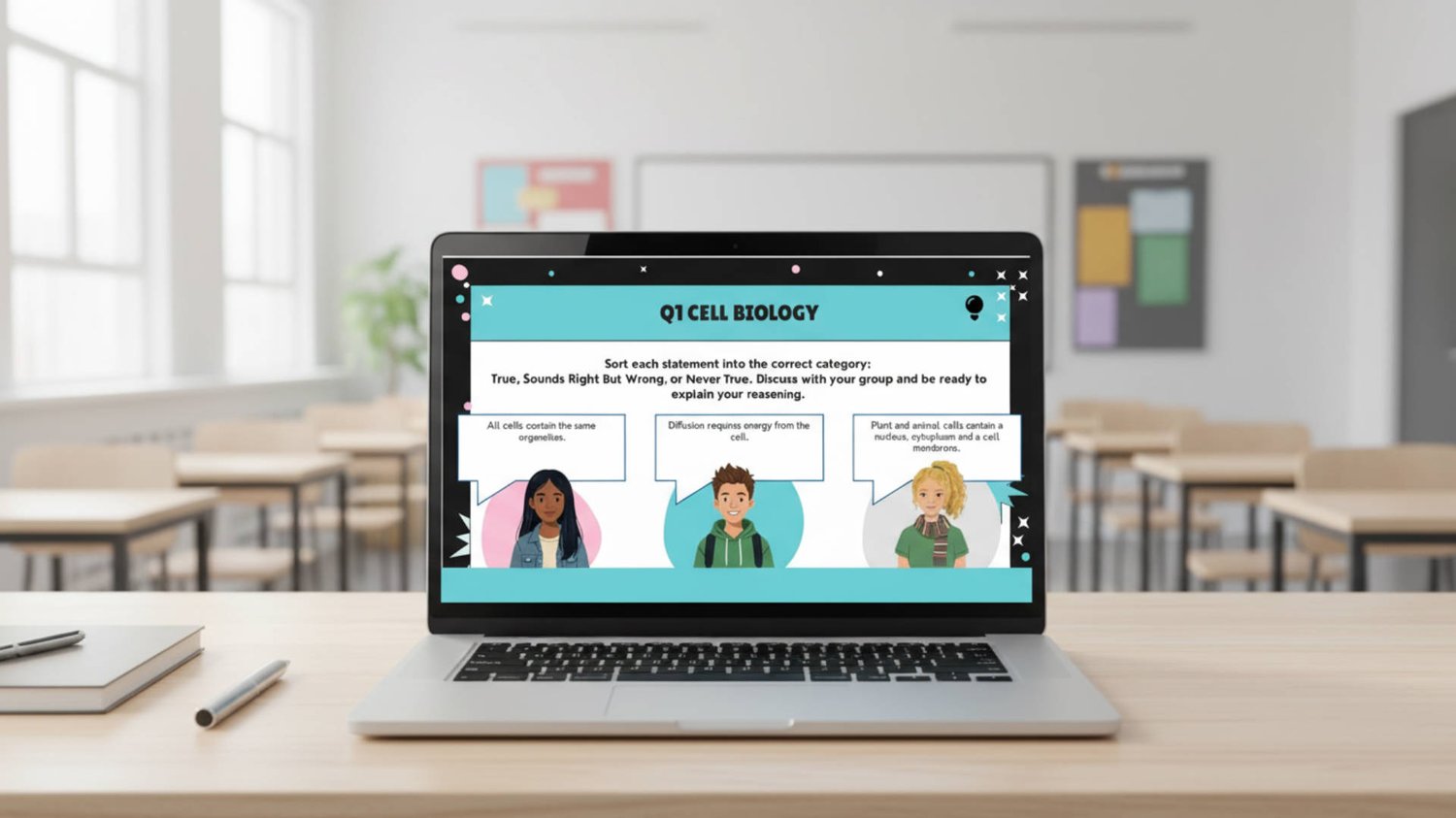
Activities that ask students to sort statements — deciding what's true, what sounds right but is wrong, and what's never true — are particularly effective for this. They force active engagement with the incorrect idea rather than passive absorption of the correct one.
Ready to tackle Biology misconceptions in your classroom?
Our GCSE Biology Misconceptions Pack covers the full AQA specification with sorting activities, answer reveals and Sticky Knowledge slides for every topic. Also available as part of the GCSE Science Misconceptions Bundle alongside Chemistry and Physics.