

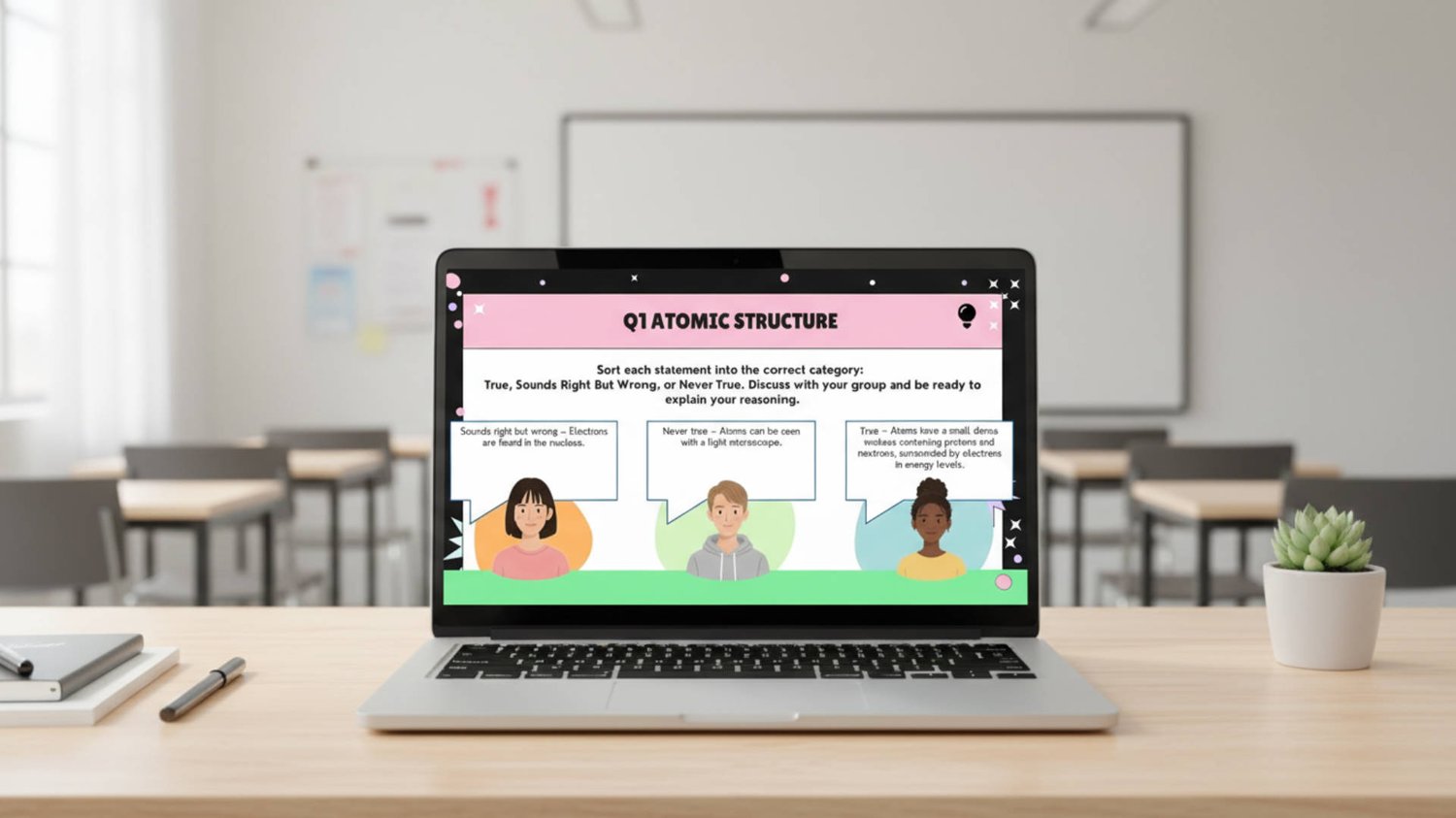
GCSE Chemistry is packed with concepts students get almost right — but not quite. Here are the most common Chemistry misconceptions and how to address them before exams.
Chemistry is a subject where small misunderstandings compound quickly. A shaky grasp of atomic structure affects bonding. Confusion about energy levels affects reaction profiles. At GCSE, misconceptions in early topics ripple through everything that comes after.
Here are some of the most damaging Chemistry misconceptions to address with your students.
"Electrons travel in circular orbits around the nucleus"
This is the Bohr model, which most students meet first — and it sticks. At GCSE, students need to understand that electrons exist in shells or energy levels, not defined circular paths. The Bohr model is a simplification, and students who cling to it too literally will struggle with questions about electron configuration and bonding.
"Dissolving means the substance has disappeared"
Many students believe that when something dissolves, it ceases to exist. In reality, the solute particles are still present — they are simply dispersed throughout the solvent. This misconception causes problems with questions about conservation of mass, filtration and reversible reactions.
"All acids are dangerous and all alkalis are safe"
Students often associate acids with danger and alkalis with safety. In reality, both can be hazardous depending on concentration. Bleach is alkaline. Concentrated sodium hydroxide causes serious burns. This misconception is worth addressing both for scientific accuracy and for practical safety reasons.
"Exothermic reactions always feel hot to touch"
Students understand that exothermic reactions release energy — but they sometimes assume this always means a noticeable temperature rise. The key is that exothermic reactions transfer energy to the surroundings. Whether something feels hot depends on the rate of reaction and the amount of energy transferred. This matters in questions about bond energies and reaction profiles.
"More bonds broken = more energy released"
Students often confuse bond breaking and bond making. Breaking bonds requires energy (endothermic). Making bonds releases energy (exothermic). The overall energy change depends on the balance between the two. Students who reverse this idea will get calculation questions on bond energies consistently wrong.
The problem with "close enough" in Chemistry
In Chemistry, precision matters. A student who believes dissolving destroys mass will get the wrong answer on a conservation question. A student who conflates bond breaking with energy release will lose marks on every bond energy calculation. Close enough is not close enough.
Effective revision needs to surface these ideas explicitly — not just re-present the correct information, but directly challenge the incorrect version students already hold.
Resources to help:
Our GCSE Chemistry Misconceptions Pack covers the full AQA specification, with sorting activities, answer reveals and Sticky Knowledge consolidation for every topic. Available individually or as part of the GCSE Science Misconceptions Bundle.