

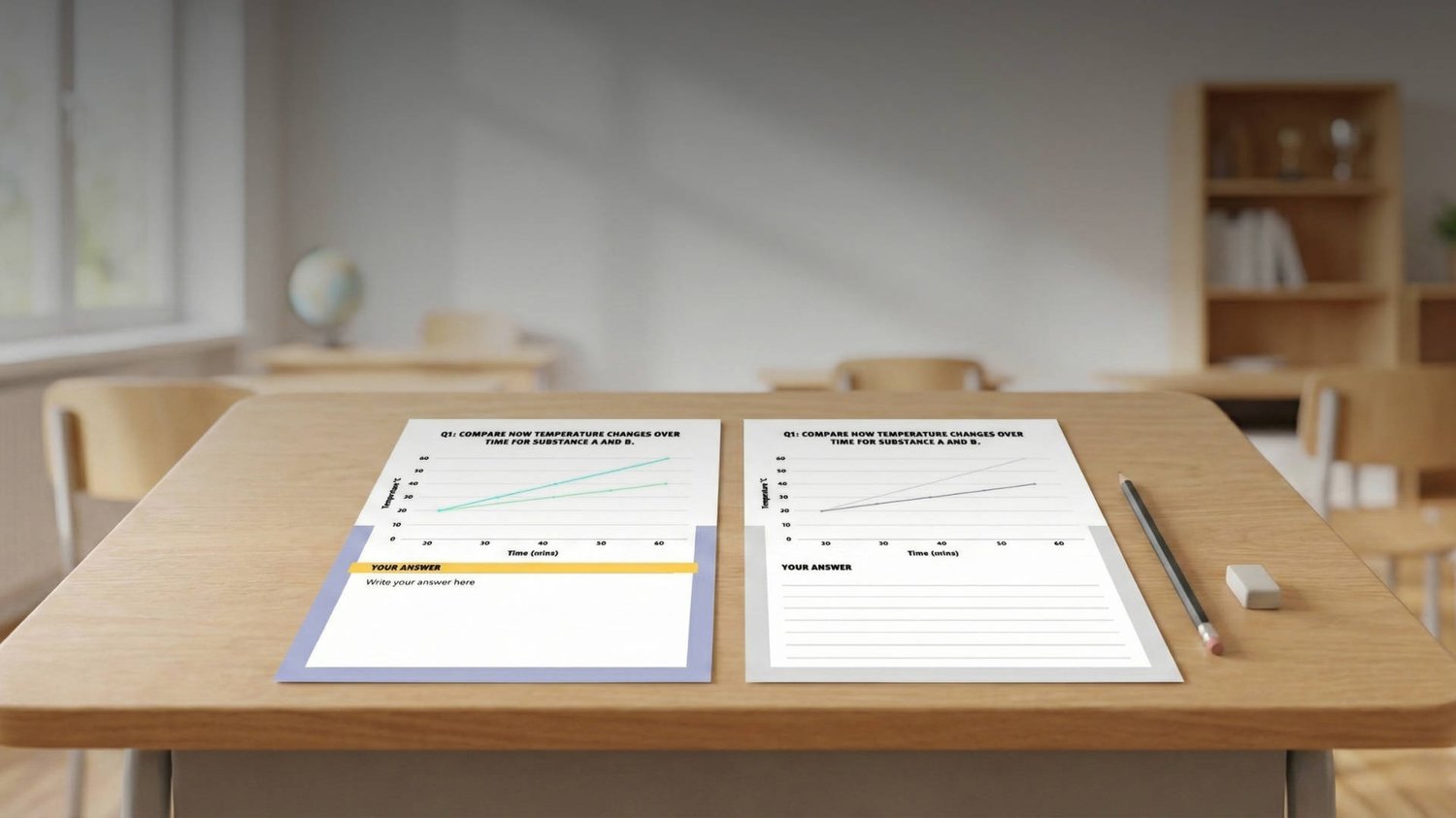
Across GCSE Science, graph skills are one of the most consistent sources of lost marks. This is not limited to Physics, and it is not confined to drawing graphs neatly. Examiner reports repeatedly highlight problems with interpreting data, describing trends, calculating gradients, and explaining what a graph actually shows.
These errors affect AO2 application and AO3 analysis across Biology, Chemistry and Physics.
Students often know the science. What they struggle with is using graphs as evidence.
What Goes Wrong With Graph Questions
Common issues seen in exams include:
- choosing inappropriate scales
- plotting points inaccurately
- reading values incorrectly
- confusing gradient with height
- describing a graph instead of interpreting it
- failing to link trends to scientific explanations
In many cases, students are taught how to draw graphs early in the course, but are not given enough structured practice in using graphs to answer exam questions.
This becomes a particular problem on Higher tier papers, where graph interpretation is used as a discriminator.
How Graph Skills Are Assessed in GCSE Science
Graphs are used by exam boards to assess:
- AO2: applying knowledge to data, identifying patterns, interpreting trends
- AO3: analysing results, evaluating reliability, explaining anomalies
Graph questions frequently appear in:
- required practical contexts
- six-mark questions
- questions combining maths and explanation
This means weak graph skills limit access to marks across multiple topics, not just one unit.
Why “Practising More Graphs” Is Not Enough
Simply giving students more graphs to draw does not solve the problem.
What students need is support with:
- selecting scales sensibly
- reading and using values as evidence
- describing trends accurately
- linking graph features to scientific meaning
Without this, graphs remain something students complete, rather than something they use.
Targeted Graph Skills Support
The GCSE Science Graph Skills Intervention Pack is designed to address these specific issues. It focuses on:
- drawing graphs correctly
- reading values accurately
- interpreting trends and patterns
- understanding gradients and rates
- explaining what graphs show using scientific language
The pack is suitable for:
- whole-class teaching
- small-group intervention
- targeted support after mocks
👉 GCSE Science Graph Skills Intervention Pack
https://advisoryscience.com/b/graph-comparison-worksheet
How Graph Skills Link to Other Exam Areas
Weak graph skills often appear alongside other exam issues, particularly in Physics and required practical questions.
You may also find the following useful:
- Physics Required Practicals
- [BLOG: AQA GCSE Physics Required Practicals – Using Data, Equations and Evaluation]
- https://advisoryscience.com/b/physics-required-practicals-presentation
- GCSE Science Command Words
- [BLOG: GCSE Science Command Words – What Exam Questions Are Really Asking]
- https://advisoryscience.com/b/command-words-presentation
- Physics Answer Improvement
- [BLOG: GCSE Physics Answer Improvement – Linking Maths, Graphs and Explanation]
- https://advisoryscience.com/b/physics-answer-improvement-pack
When to Focus on Graph Skills
Graph skills work is most effective:
- after mocks, when data handling weaknesses are clear
- alongside required practical revision
- when students can calculate correctly but struggle to explain results
Because graph interpretation cuts across topics, improving this one area can unlock marks in multiple parts of the exam.
Final thought
Graph questions are not about neatness. They are about thinking with data.
When students are taught how to use graphs as evidence, rather than just draw them, exam answers become clearer, more precise, and easier to mark.
That is why graph skills deserve focused attention, not a quick recap.