

With just four teaching weeks until GCSE science exams begin, both students and teachers are asking the same question: what should we focus on now? The answer is not to try and cover everything again. Instead, use a structured revision plan that prioritises the areas where marks are most commonly lost.
This four-week plan is built around what examiners report year after year: students lose marks through weak exam technique, not just missing knowledge. The plan below targets command words, required practicals, calculation methods, graph skills and extended writing — all areas where focused revision makes the biggest difference to final grades across AQA, Edexcel and OCR.
Week 1: Audit and command words
Start by identifying weak topics. Use recent mock papers or end-of-topic tests to find where marks were lost. Was it content gaps, or exam technique? In most cases, it is both — but exam technique is faster to fix.
Spend this week drilling command words. Students frequently describe when they should explain, or evaluate without referencing data. A dedicated command words session makes students aware of what each question is really asking, and how marks are allocated differently for "describe", "explain", "evaluate", "compare" and "suggest".
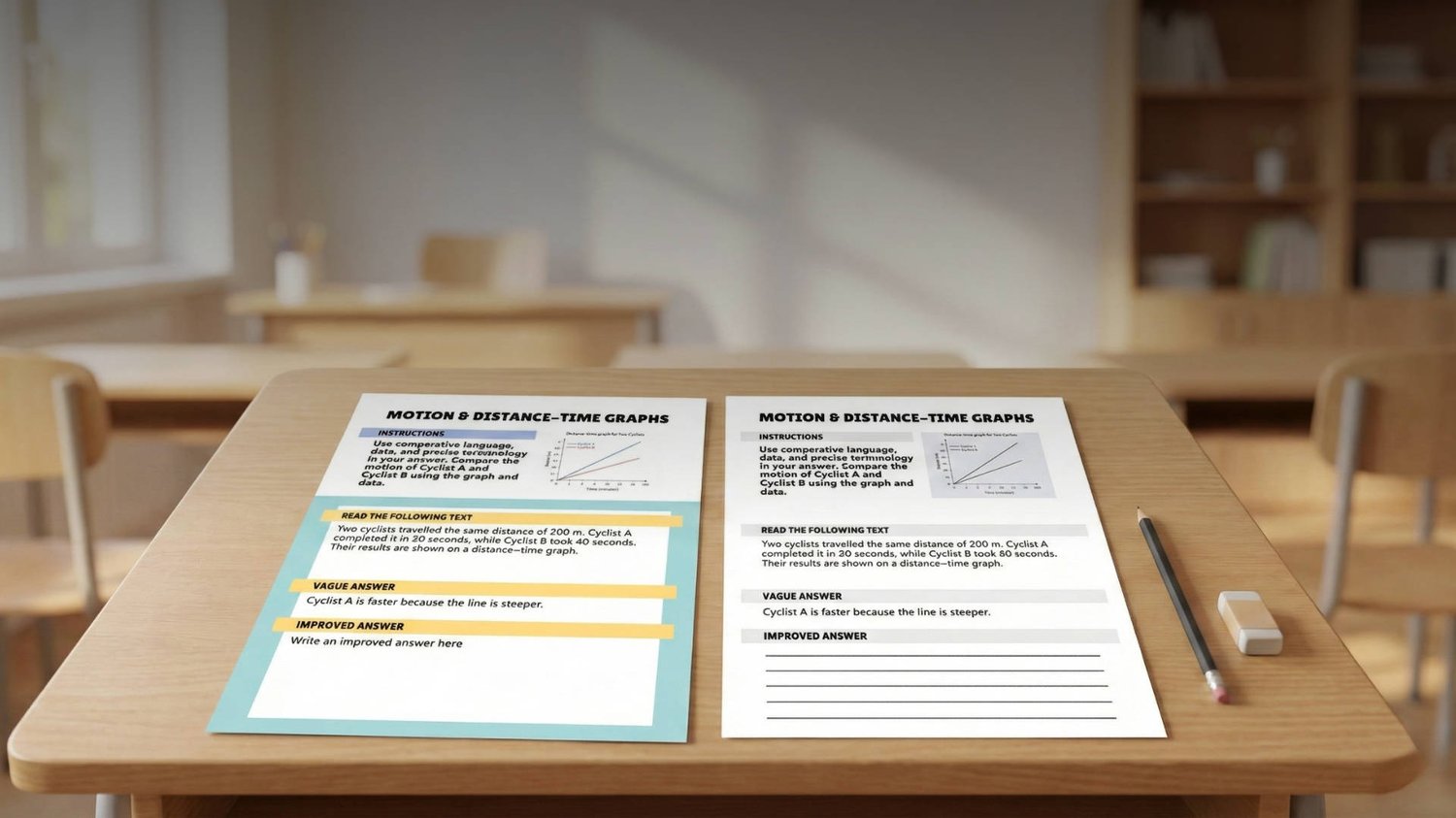
Pair this with answer improvement activities where students compare weak and strong responses side by side. This builds awareness of what examiners are looking for without requiring new content knowledge.
Week 2: Required practicals and AO3 skills
Required practicals appear every year across all three science papers, and students consistently underperform on them. The problem is not remembering the method — it is applying their knowledge to unfamiliar contexts, evaluating results, and suggesting improvements.
Focus this week on AO2 and AO3 skills through structured required practical revision. For each practical, students should be able to identify variables, explain the method, describe expected results, evaluate accuracy, and suggest improvements. These skills transfer across biology, chemistry and physics papers.
For AQA specifically, the required practicals carry significant weight and appear in predictable formats. Ensure students practise interpreting results tables and drawing conclusions from data they have not seen before.
Week 3: Calculations, graphs and data handling
Physics calculations are where many students lose the most marks per question. Even confident students make errors with unit conversions, rearranging equations, and showing clear working. A systematic approach to calculations — identifying the equation, listing known values, converting units, substituting, and solving — can recover several marks per paper.
Graph skills cross all three sciences. Students should practise drawing lines of best fit, calculating gradients, reading values from curves, and interpreting what graphs show about rates, trends and relationships. Chemistry titration curves and biology population graphs are commonly assessed and commonly answered poorly.
Spend time on the specific physics equations that students must recall from memory versus those provided on the equation sheet. Many students do not know which is which, and this costs marks in every physics paper.
Week 4: Extended writing and exam practice
The final week should focus on six-mark "level of response" questions. These questions require a different approach to shorter answers: students need to plan, structure their response logically, use correct scientific terminology, and ensure their answer directly addresses what was asked.
Practise timed six-mark questions across biology, chemistry and physics. Students should write a brief plan before answering, use paragraphs to organise their thinking, and check their response addresses the command word. The difference between Level 2 and Level 3 is often just structure and precision — not more knowledge.
In the final days, use past paper questions under timed conditions. Focus on papers from the last two years for the most relevant question styles. Mark using the official mark schemes so students can see exactly where marks are gained and lost.
Resources that support this revision plan
Each week of this plan maps directly onto targeted GCSE science revision resources. The GCSE Science Command Words Bundle covers Week 1 with a full presentation and practice worksheets. The Required Practicals revision packs for AQA Biology, Chemistry and Physics cover Week 2. The Physics Calculations Practice Workbooks and Graph Skills resources support Week 3. And the six-mark question scaffolds and answer improvement activities complete Week 4.
All resources are available as instant PDF downloads, ready to use in the classroom or for independent revision at home. Browse the full GCSE Science revision collection to find the resources that match your students' needs.