

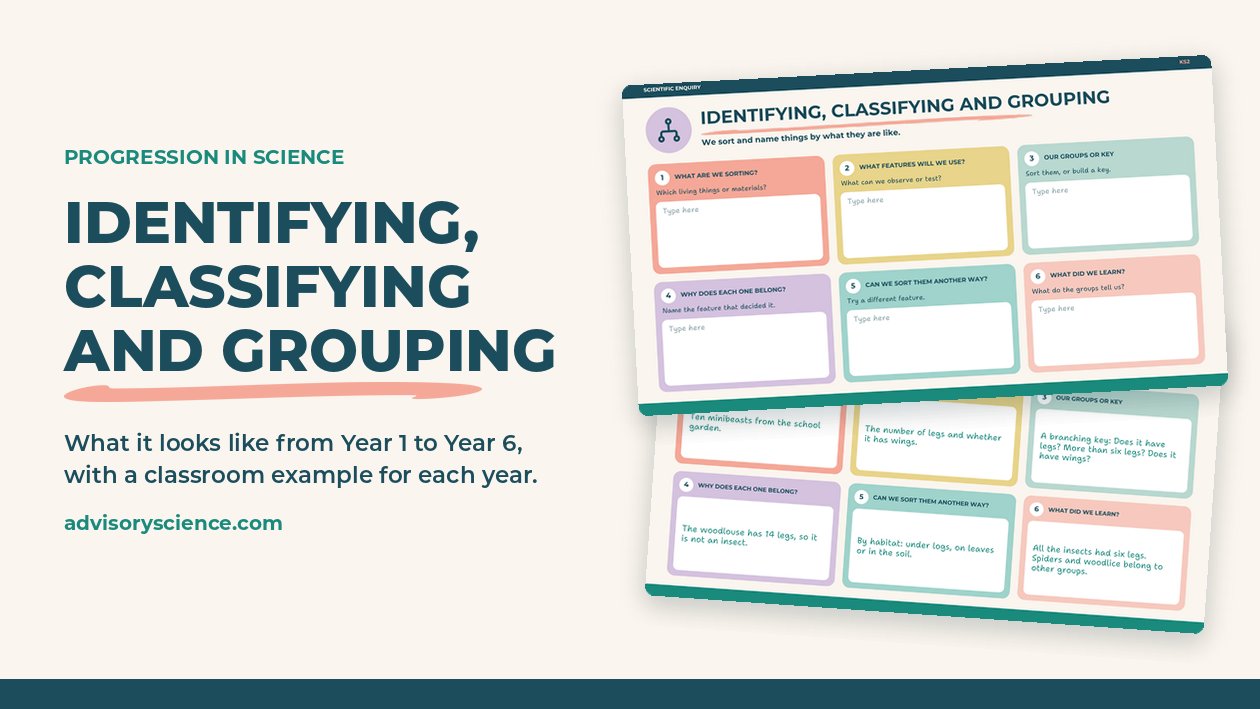
Classification begins very simply.
A child can put all the red objects together. They can put animals with wings in one group and animals without wings in another.
Scientific classification becomes much more sophisticated than sorting things according to what they look like. Scientists classify organisms and materials using characteristics that allow us to identify, compare and communicate about them.
What the National Curriculum says
The National Curriculum gives pupils opportunities to identify, classify and group throughout primary science. By Year 4, pupils are expected to recognise that living things can be grouped in different ways and to use classification keys. By Years 5 and 6, they should use and develop keys and other information records to identify, classify and describe living things and materials.
The progression therefore needs to go further than "children get better at sorting".
Year 1: noticing features
In Year 1, children are developing their ability to observe and describe features. They might compare different animals:
- fur or feathers
- wings or no wings
- four legs or two legs
- large or small
They can use these observable features to group animals.
The scientific knowledge is important. A learner needs to know the names of animals and the features they are looking for before they can classify them meaningfully.
Year 2: choosing a feature for grouping
By Year 2, learners can begin to decide how things should be grouped. They might sort animals according to what they eat. They might classify things as living, dead or never alive.
The interesting part is the reasoning. Two children may choose different ways to group the same collection of objects. That creates an opportunity to ask: why did you put these together?
The learner is beginning to understand that a classification depends on the characteristic being used.
Year 3: identifying characteristics
In Year 3, learners encounter classification in a more scientific context. They may compare rocks according to their appearance and physical properties. They might group animals according to whether they have skeletons.
The characteristics become more specific. Learners need to observe carefully and use appropriate scientific vocabulary to describe what they find.
They are moving from "These look similar" towards "These have similar characteristics."
Year 4: using classification keys
Year 4 is an important stage because pupils are expected to use classification keys to help group, identify and name living things.
A key works by asking questions that separate groups. For example:
Does it have wings?
Yes → go here.
No → go there.
The learner is now doing more than sorting. They are using a sequence of characteristics to identify something they may not already know.
They should also begin to make simple keys themselves. That requires them to think carefully about which characteristics will separate the organisms most effectively.
Year 5: classifying using scientific characteristics
By Years 5 and 6, classification becomes more systematic. Learners encounter scientific classification systems and increasingly use characteristics that go beyond appearance.
For example, when classifying living things, they need to use scientific characteristics to place organisms into groups. This requires secure knowledge. A learner cannot construct a useful classification system if they do not know the characteristics of the organisms they are classifying.
Year 6: explaining and justifying classification
By Year 6, learners should be able to use classification systems and keys to identify organisms and explain their choices.
They may encounter the work of Carl Linnaeus and understand that classification and naming give scientists a systematic way of communicating about living things.
The important progression is now in the reasoning. A learner should be able to say:
"I placed this organism in this group because it has these characteristics."
They can justify the decision as well as give the correct group.
What should progression look like?
The progression can be seen as:
noticing features → grouping by observable features → selecting characteristics → using keys → applying scientific classification systems → justifying classification
This is why classification deserves attention in a progression map. A Year 6 classification activity should draw on a much deeper body of scientific knowledge than a Year 1 sorting activity, and the learner should be using characteristics systematically.
A useful subject leader check
Look at a classification activity from each year group. Ask: what characteristic are learners using? Then ask: who decided that characteristic?
If the teacher has always chosen the categories and the learners simply place objects into them, there may be a missing step in the progression. Learners need opportunities to make decisions about how things can be grouped and to explain the basis for their decisions.
The next article looks at comparative and fair testing, the type of enquiry most familiar to primary teachers.
Free for your school: the working scientifically progression displays show six skills from Year 1 to Year 6, including identifying and classifying, ready to print for a whole-school display. Download all six free.
Plan it with your class: the Scientific Enquiry Planning Pack gives you a planning slide for each type of enquiry, with a model answer after each one, for KS1 and KS2. See the planning pack