

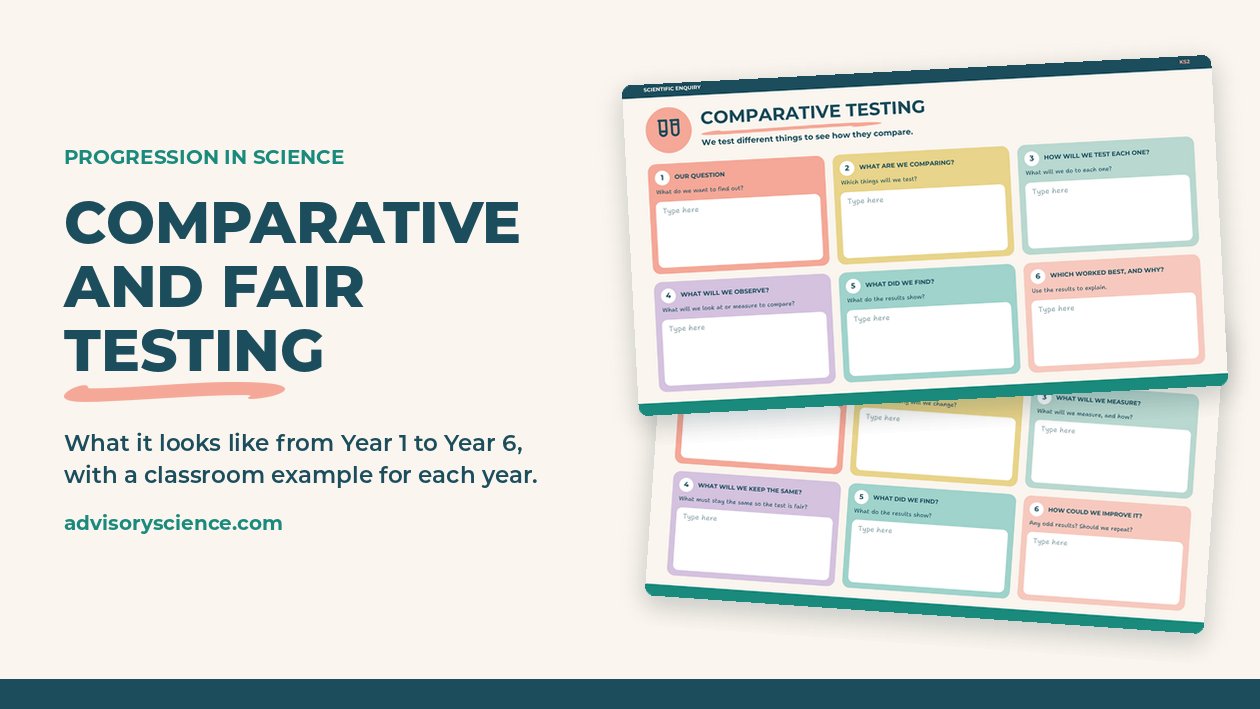
Fair testing is probably the type of scientific enquiry most familiar to primary teachers.
Change one thing. Keep other things the same. Measure what happens.
It is an important part of science, but it is only one of the types of scientific enquiry.
What the National Curriculum says
The National Curriculum describes comparative and fair testing as one of the approaches pupils should experience. In Years 3 and 4, pupils should begin to recognise when a simple fair test is necessary and help decide how to set it up. By Years 5 and 6, they should plan different types of scientific enquiry and recognise and control variables where necessary.
That gives us a clear direction for progression.
Year 1: making simple comparisons
In Year 1, children can compare objects and materials. They might ask: which material is the best for a raincoat?
They can handle the materials, describe their properties and carry out a simple test. At this stage, the teacher will usually provide considerable structure.
The learner is developing the idea that a question can be answered by doing something and comparing what happens.
Year 2: making a simple test
By Year 2, learners can carry out simple comparative tests. They might investigate which material absorbs the most water. They can make a prediction, carry out the test and record what they find.
They should begin to understand that the comparison needs to be sensible. If one piece of material is tiny and another is enormous, the comparison tells us very little.
The foundations of fair testing are therefore laid before children are formally expected to plan fair tests themselves.
Year 3: recognising when a fair test is needed
By Years 3 and 4, the National Curriculum says that pupils should recognise when a simple fair test is necessary and help decide how to set it up.
This is an important progression point. The learner is beginning to choose the enquiry rather than simply being given an investigation.
For example: which surface makes a toy car travel furthest?
The learner can identify that the surface needs to change while other relevant factors should remain the same. They might say:
"We need to use the same car and release it from the same place."
The learner is beginning to understand why a fair comparison matters.
Year 4: identifying what needs to stay the same
By Year 4, learners should become more confident at setting up simple fair tests. They can identify the factor they are changing and the result they will measure. They can also identify factors that need to be kept the same.
The quality of the investigation now depends on their understanding of the science. For example, if they are investigating the effect of surface on the distance travelled by a car, they need to understand why the ramp height, starting point and car matter.
The list of "things to keep the same" should never become a ritual. Learners need to understand why those factors could affect the result.
Year 5: planning a fair test
By Years 5 and 6, pupils should be planning different types of scientific enquiry and recognising and controlling variables where necessary.
A Year 5 learner might plan an investigation into the effect of the length of a wire on a circuit. They need to identify:
- the variable they will change
- what they will measure
- what they will keep the same
- the equipment required
- how measurements will be recorded
- whether measurements should be repeated
The planning is becoming more independent.
Year 6: explaining why the test is fair
By Year 6, the learner should be able to explain the decisions made when planning the investigation. They should understand that controlling variables is what makes the comparison meaningful.
If the question is "How does the length of a wire affect the brightness of a bulb?", then changing the wire length while also changing the battery or bulb means that any difference cannot confidently be attributed to wire length. The learner should be able to explain this.
They should also be able to use their results to draw conclusions, consider the quality of the evidence and suggest improvements.
What should progression look like?
A useful progression is:
compare → carry out a simple test → recognise when a fair test is appropriate → identify variables → plan a fair test → explain and evaluate the decisions made
The important thing is that fair testing should become increasingly reasoned as children move through the school.
We also need to remember that not every scientific question should become a fair test. Sometimes the right approach is observing over time. Sometimes it is pattern seeking. Sometimes it is classification. Sometimes it is research. Choosing the right enquiry is itself part of progression.
A useful subject leader check
Look through your investigations. Ask:
- Who chose the type of enquiry?
- Who decided what to change?
- Who decided what to measure?
- Who decided what needed to be controlled?
If the answer is "the teacher" in every year group, the investigation may be developing in complexity without developing in independence.
The next article looks at research using secondary sources, for the questions children cannot answer by investigating first-hand.
Free for your school: the working scientifically progression displays show six skills from Year 1 to Year 6, including setting up tests, ready to print for a whole-school display. Download all six free.
Plan it with your class: the Scientific Enquiry Planning Pack gives you a planning slide for each type of enquiry, with a model answer after each one, for KS1 and KS2. See the planning pack