

Scientific enquiry begins with a question, but asking a scientific question is a skill that develops considerably during primary school. Planning is where that question turns into something a child can actually investigate, and it is one of the clearest places to see increasing independence in working scientifically.
What the National Curriculum says
In Years 1 and 2, children should be "asking simple questions and recognising that they can be answered in different ways". In Years 3 and 4, they should be "asking relevant questions and using different types of scientific enquiries to answer them" and "setting up simple practical enquiries, comparative and fair tests". In Years 5 and 6, they should be "planning different types of scientific enquiries to answer questions, including recognising and controlling variables where necessary".
Key Stage 1: questions that can be answered in different ways
In Year 1, children are naturally curious about the world around them. They notice things and ask questions because something has caught their attention. A child investigating materials might ask, "Why does the metal feel cold?" or wonder what will happen to ice left in the sun. At this stage, children need plenty of opportunities to ask their own questions. The step to celebrate is a child who asks a question, as well as describing what they see.
By Year 2, children know that different questions get answered in different ways. This is an important early distinction. A question might be interesting without being something that can be answered through an observation, comparison, test or research. Which material keeps teddy driest needs a test. What an owl eats needs a book or an expert. "We can test the teddy one. The owl one needs a book," shows a child connecting the question to a way of answering it. The teacher still provides much of the structure, but children are beginning to recognise that different questions require different approaches.
Lower Key Stage 2: turning a question into a plan
As children move into Years 3 and 4, the question becomes more closely connected to the process of investigation. In Year 3, children turn their question into a plan they can test. "Which surface is fastest?" becomes a plan with the same ramp, the same car and different surfaces. A child who says, "We'll keep the car and the ramp the same and just change the surface," is planning for themselves.
By Year 4, children choose the right type of enquiry for their question. They decide whether to test, observe over time or look for a pattern, and they can explain why that method fits. "It changes over time, so we need to check it every day." Planning is now more than following a method that has already been provided. Children are beginning to think about how a question could be answered.
Upper Key Stage 2: planning their own enquiries
By Years 5 and 6, children should be able to ask different kinds of questions and make decisions about the most appropriate way of answering them. In Year 5, they plan a fair test and say what they are controlling. Planning an investigation into the stretchiest fabric, they list the equipment and name the variable that changes and the ones that stay the same: "We're changing the fabric. The weight and the length stay the same."
By Year 6, children plan different types of enquiry to answer their own questions. They might plan a fair test for "Does exercise change heart rate?" and a pattern-seeking enquiry for "Do taller people have longer arms?", explaining why each approach suits its question.
The progression is therefore from "simple questions" to "useful questions". Children are developing an understanding of what makes a question scientifically useful. They become better at narrowing a broad idea into something that can be investigated, recognising what information they need and considering how that evidence could be obtained.
The progression on one display
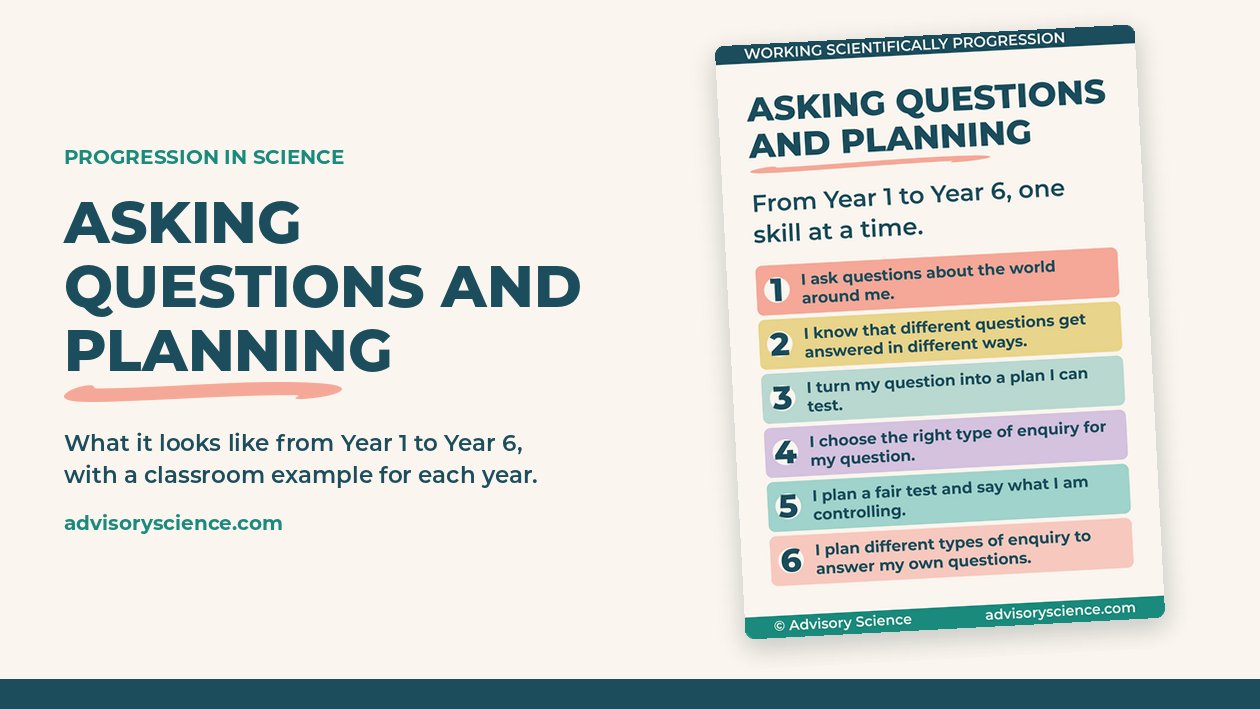
- Year 1: I ask questions about the world around me.
- Year 2: I know that different questions get answered in different ways.
- Year 3: I turn my question into a plan I can test.
- Year 4: I choose the right type of enquiry for my question.
- Year 5: I plan a fair test and say what I am controlling.
- Year 6: I plan different types of enquiry to answer my own questions.
The broad movement is from teacher models, to child helps decide, to child makes decisions, to child plans.
A useful subject leader check
A useful question for a subject leader is: how much of the plan belongs to the child?
If a Year 1 child follows a teacher's carefully prepared instructions, that may be entirely appropriate. If a Year 6 child is still given the question, equipment, variables, method, table and conclusion sentence, there is very little opportunity for them to show the planning skills expected at the end of primary school. Equally, if every investigation begins with a question supplied by the teacher, children may be learning how to answer scientific questions without ever learning how to generate and refine them.
That does not mean every Year 6 investigation needs a completely blank page. Good progression gradually transfers responsibility. The teacher still provides the scientific context, knowledge and appropriate boundaries, while pupils increasingly make the decisions that matter within that context.
By the end of Year 6, we want children who can look at a scientific situation and think: what could I find out here? What would count as evidence? How could I answer it?
The next article looks at setting up tests.
Free display: Asking Questions and Planning from Year 1 to Year 6, one A3 panel per year group plus a one-page summary, ready to print. Download it free.
Teach it with your class: the Working Scientifically Skills Pack gives you a slide for each of the six skills, with a model answer after each one, for KS1 and KS2. See the skills pack