

There is an important difference between knowing how to carry out an investigation and being able to make sensible decisions while doing it. Setting up tests is where children learn to do both.
What the National Curriculum says
In Years 1 and 2, children should be "performing simple tests". In Years 3 and 4, they should be "setting up simple practical enquiries, comparative and fair tests". In Years 5 and 6, they should be "using test results to make predictions to set up further comparative and fair tests".
Key Stage 1: a simple test, carried out safely
In the early years of primary school, children need opportunities to carry out simple tests and practical activities safely and successfully. A Year 1 child might test which objects float and which sink, with an adult guiding each step. The teacher will probably organise the equipment, explain what to do and help children notice what happens. The child's role is to take part, observe and begin to talk about what they have found: "The apple floated and the key sank."
By Year 2, children carry out a simple test and say what happened. Launching paper rockets and telling a partner which one travelled furthest, a child describes the result using what they saw or measured: "The blue rocket went the furthest. It went past the cone." Children are becoming familiar with the idea that a test involves a sequence of actions, simple equipment and a result worth reporting.
Lower Key Stage 2: giving each thing the same chance
By Year 3, children set up a test to compare two or more things. Comparing how well different shoe soles grip on the same slope, they give each thing being compared the same chance: "We put every shoe on the same slope, so it's fair." The practical work now requires more than following instructions. Children need to understand what they are doing and why particular steps matter.
By Year 4, children set up a fair test and change only one thing. Testing where paper towels dry fastest, they use the same towel and the same amount of water each time: "We only changed where we put the towel. Everything else stayed the same." They can identify the factor they are changing, the result they will measure and the factors they need to keep the same, and they understand why those factors could affect the result.
Upper Key Stage 2: results that lead somewhere
By Years 5 and 6, children carry out planned tests with increasing independence, and their results begin to drive what happens next. In Year 5, they use their results to predict what will happen next. Having tested spinners with short wings, a child predicts how a spinner with longer wings will fall: "Longer wings made it fall slower, so even longer wings will be slower again." The prediction comes from a pattern in their own results.
By Year 6, children use their results to plan a further test. Finding that more cells make a bulb brighter, they set up a new test on the length of the wire: "More cells made it brighter. Now we want to test if a longer wire makes it dimmer." One test now leads into the next, which is how science actually works.
This matters because scientific investigations do not always proceed exactly as expected. A measurement may seem unusual. An observation may prompt another question. A practical problem may mean that a method needs to be adjusted. The goal is for children to understand the purpose of the procedure well enough to carry it out thoughtfully and respond sensibly to what they find.
The progression on one display
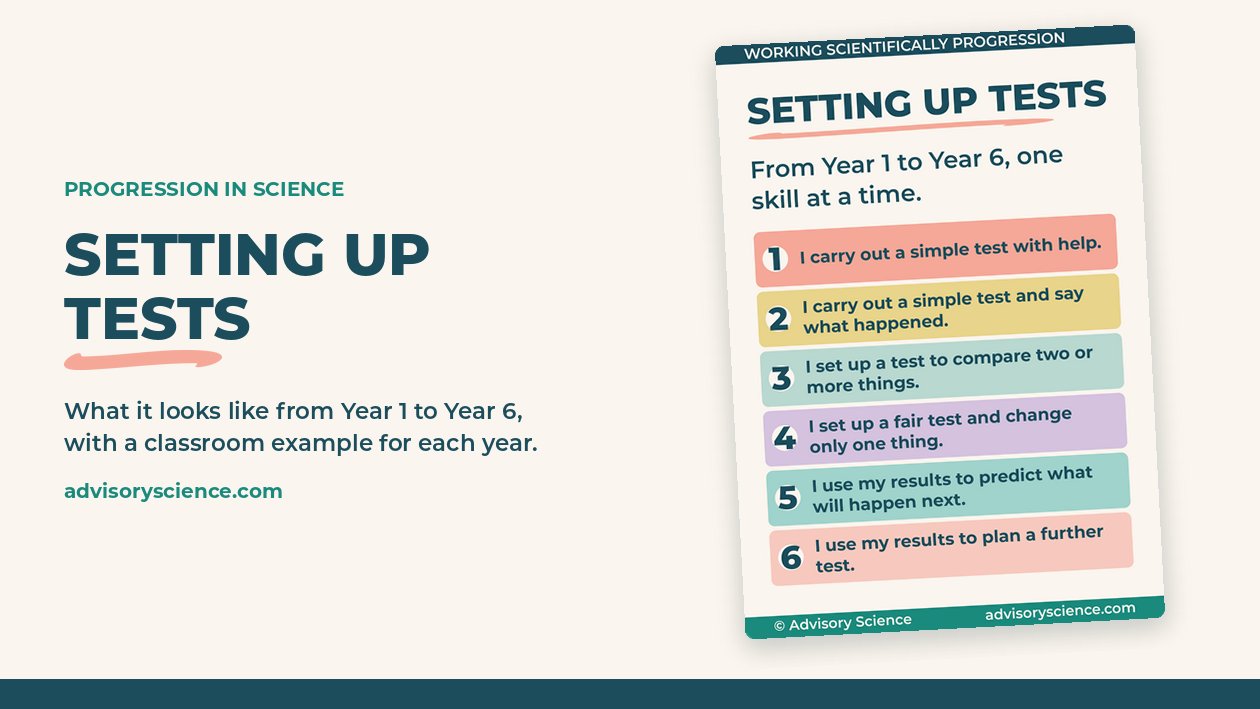
- Year 1: I carry out a simple test with help.
- Year 2: I carry out a simple test and say what happened.
- Year 3: I set up a test to compare two or more things.
- Year 4: I set up a fair test and change only one thing.
- Year 5: I use my results to predict what will happen next.
- Year 6: I use my results to plan a further test.
A useful subject leader check
When looking at progression, it is worth watching the children as well as the worksheet. Who is making decisions? Who notices when something has gone wrong? Who knows what to do next? Who understands why a particular measurement is being taken?
Those behaviours tell you much more about progression in scientific practice than the complexity of the investigation itself. For more on the fair test as a type of enquiry, see comparative and fair testing from Year 1 to Year 6.
The next article looks at recording and presenting data.
Free display: Setting Up Tests from Year 1 to Year 6, one A3 panel per year group plus a one-page summary, ready to print. Download it free.
Teach it with your class: the Working Scientifically Skills Pack gives you a slide for each of the six skills, with a model answer after each one, for KS1 and KS2. See the skills pack