
Atomic Structure and the Periodic Table Lessons PowerPoint | AQA GCSE Chemistry C1 8462, 12 Lessons
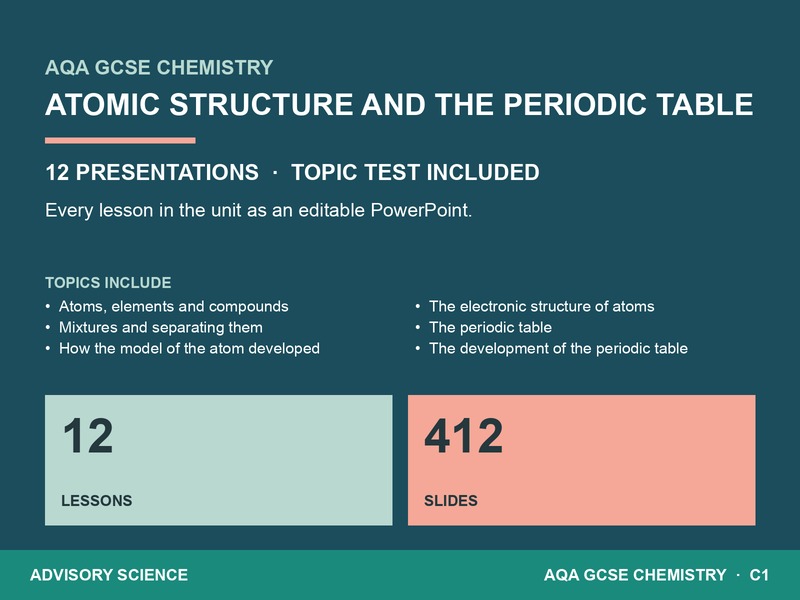
AQA GCSE Chemistry C1 Atomic Structure and the Periodic Table: 12 lessons ready to teach, with a topic test
You get every lesson for AQA GCSE Chemistry C1 Atomic Structure and the Periodic Table, planned and ready to teach. There are 12 teaching lessons. Each one is editable PowerPoint and matched to the AQA 8462 specification.
What your classes work through
- Atoms, elements and compounds. Pupils balance the symbol equation for aluminium burning in oxygen to form aluminium oxide, Al2O3, by writing the correct number in each blank.
- Mixtures and separating them. Pupils describe how to separate a mixture of sand, salt and water to get pure dry sand and pure dry salt, naming each technique.
- How the model of the atom developed. Pupils describe what was observed when alpha particles were fired at thin gold foil and explain what this revealed about the structure of the atom.
- Charges of subatomic particles and atomic number. Pupils evaluate a student's claim that a fluorine atom with more neutrons than protons must carry an overall negative charge.
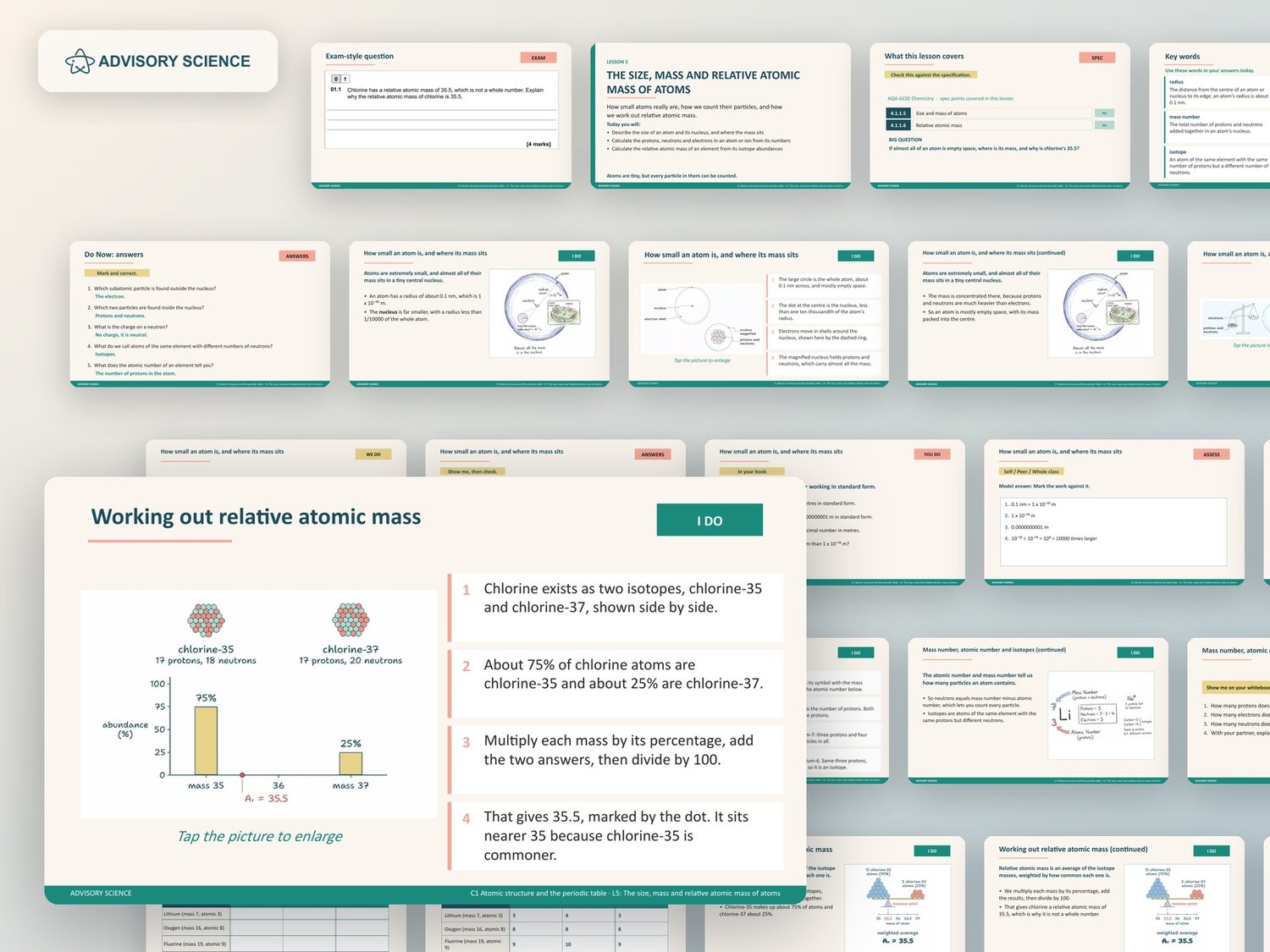
- The size, mass and relative atomic mass of atoms. Pupils explain why chlorine has a relative atomic mass of 35.5 when it is not a whole number.
- The electronic structure of atoms. Pupils use a table of Period 3 elements to predict the electronic structure and outer electrons of phosphorus, then justify their prediction.
- The periodic table. Pupils compare the reactivity of lithium and potassium from a table and explain the difference using their positions in Group 1.
- The development of the periodic table. Pupils choose the statement that explains why the modern periodic table places tellurium before iodine despite its larger atomic weight.
- Metals and non-metals. Pupils complete a chain of reasoning about an unknown element that forms an X2+ ion, deciding whether it is a metal and where it appears in the table.
- Group 0 and Group 1. Pupils write a 6-mark answer weighing up the claim that every element gets more reactive down its group, using the noble gases and alkali metals.
- Group 7: the halogens. Pupils calculate the relative molecular masses of F2 and Br2 from given atomic masses and work out the increase between them.
- Transition metals compared with Group 1. Pupils decide whether an unknown hard metal with a green compound is a Group 1 or transition metal, justifying the choice with two properties.
Who it is for
Use it to teach AQA GCSE Chemistry Atomic Structure and the Periodic Table lessons in Year 10 and Year 11, from atoms, mixtures and the history of the atomic model through to electronic structure. It also works for GCSE Chemistry revision on Group 0, Group 1, the halogens and transition metals.
How each lesson runs
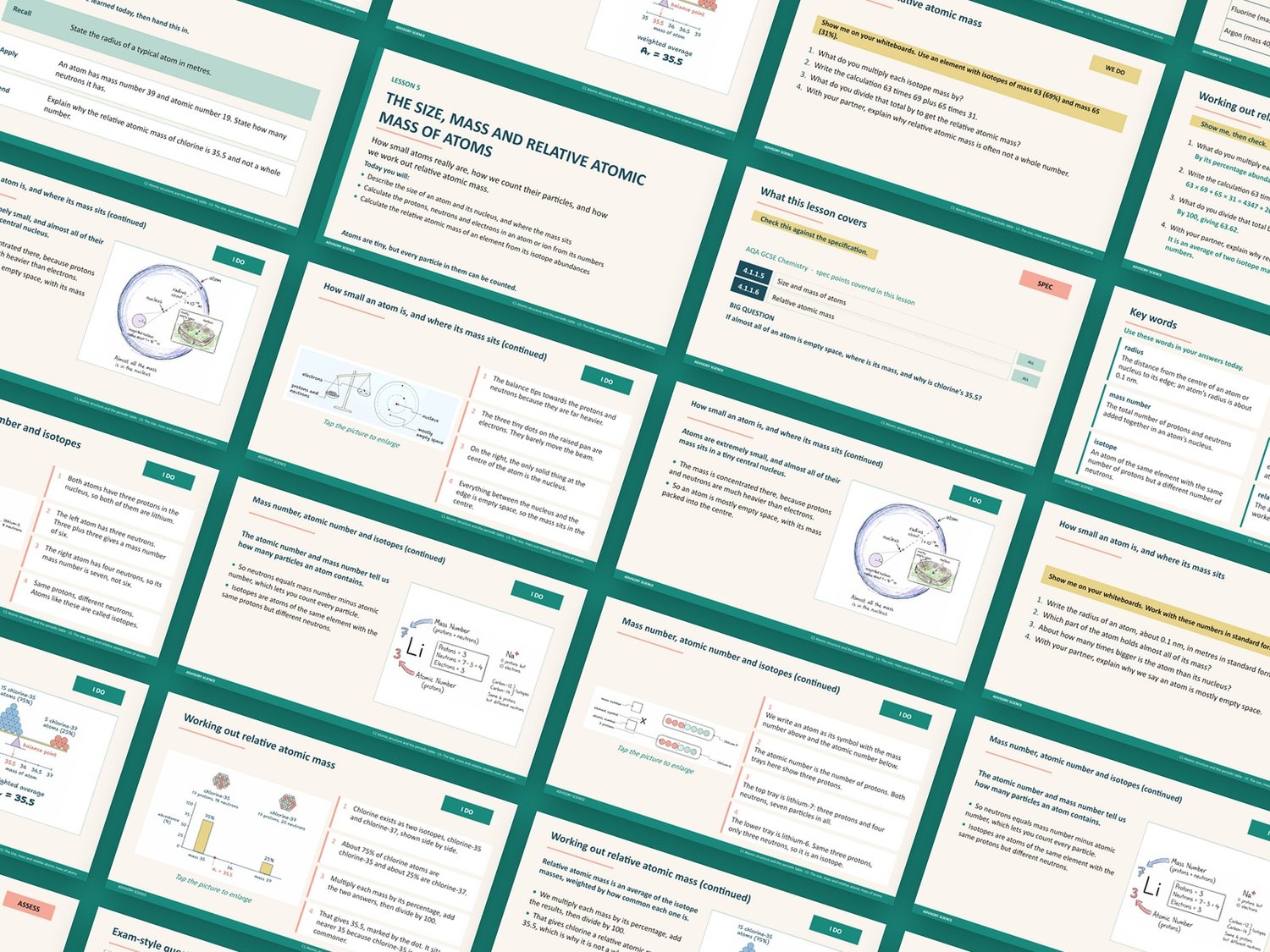
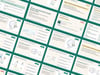
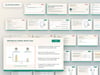
Each C1 Atomic Structure and the Periodic Table lesson starts with a Do Now that recalls earlier learning, with the answers on the next slide. It then moves through I Do, We Do and You Do, with a model answer after each task. It finishes with the AQA-style question listed above, its mark scheme and an exit ticket. A specification slide names the AQA points the lesson covers, so you can check it against your scheme of work.
Topic test
The C1 Atomic Structure and the Periodic Table topic test covers the whole unit with AQA-style questions and comes with its mark scheme, both in Word and PDF.
Free revision videos for this unit