


Bonding, Structure and Properties Lessons PowerPoint | AQA GCSE Combined Science Chemistry C2, 10 Lessons
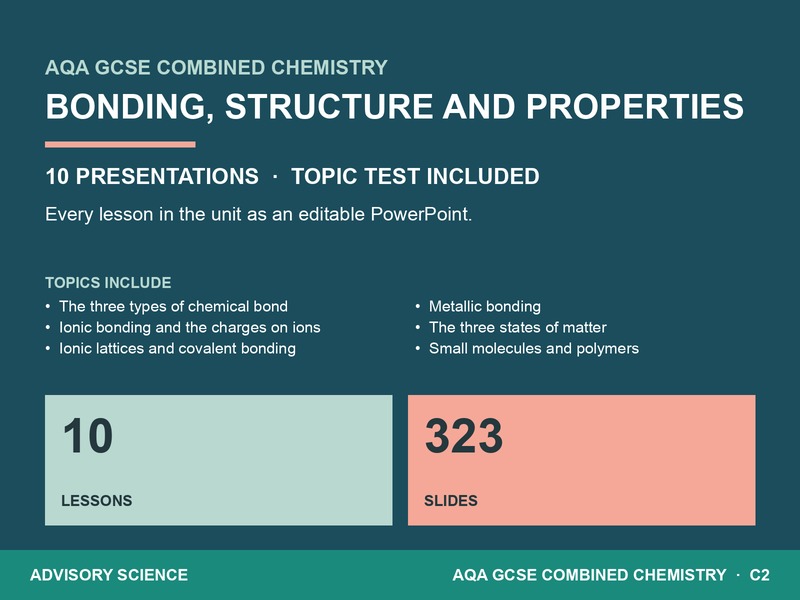
AQA GCSE Combined Science Chemistry C2 Bonding, Structure and Properties: 10 lessons ready to teach, with a topic test
This is the Combined Science Trilogy version of C2 Bonding, Structure and Properties, matched to the AQA 8464 specification. You get 10 teaching lessons, all planned and ready to teach in editable PowerPoint.
What your classes work through
- The three types of chemical bond. Pupils work out how far apart two substances' melting points are using a bar chart, then decide whether each is ionic, metallic or covalent.
- Ionic bonding and the charges on ions. Pupils show how one magnesium atom gives two electrons to two chlorine atoms, forming Mg2+ and Cl- ions in a 1:2 ratio.
- Ionic lattices and covalent bonding. Pupils say what a shared pair of electrons is, then set small separate H2O molecules against the huge lattice of carbon atoms in diamond.
- Metallic bonding. Pupils link the delocalised electrons in copper's metallic structure to its ability to carry an electric current.
- The three states of matter. Pupils subtract melting point from boiling point to find bromine's liquid range, then place 25°C on that range to name its state.
- State symbols and the properties of ionic compounds. Pupils describe ions breaking free of the sodium chloride lattice on heating and link the high temperature to strong electrostatic forces.
- Small molecules and polymers. Pupils test a student's claim about stronger covalent bonds against boiling point data for four alkanes, weighing up intermolecular forces.
- Giant covalent structures, metals and alloys. Pupils link the many strong covalent bonds in the giant lattice of silicon dioxide to furnace linings that do not melt.
- Diamond and graphite. Pupils fill the gaps for graphite in a carbon table by reasoning from four outer electrons and three bonds per atom.
- Graphene, fullerenes and carbon nanotubes. Pupils set the flat sheet structure of graphene against the hollow spherical C60 molecule and link each shape to how it is used.
Who it is for
Use it to teach C2 Bonding, Structure and Properties for GCSE Combined Science Trilogy: ionic, covalent and metallic bonding, states of matter, small molecules, giant structures, alloys and the forms of carbon. It is also ready for Combined Science Chemistry revision in KS4.
How each lesson runs
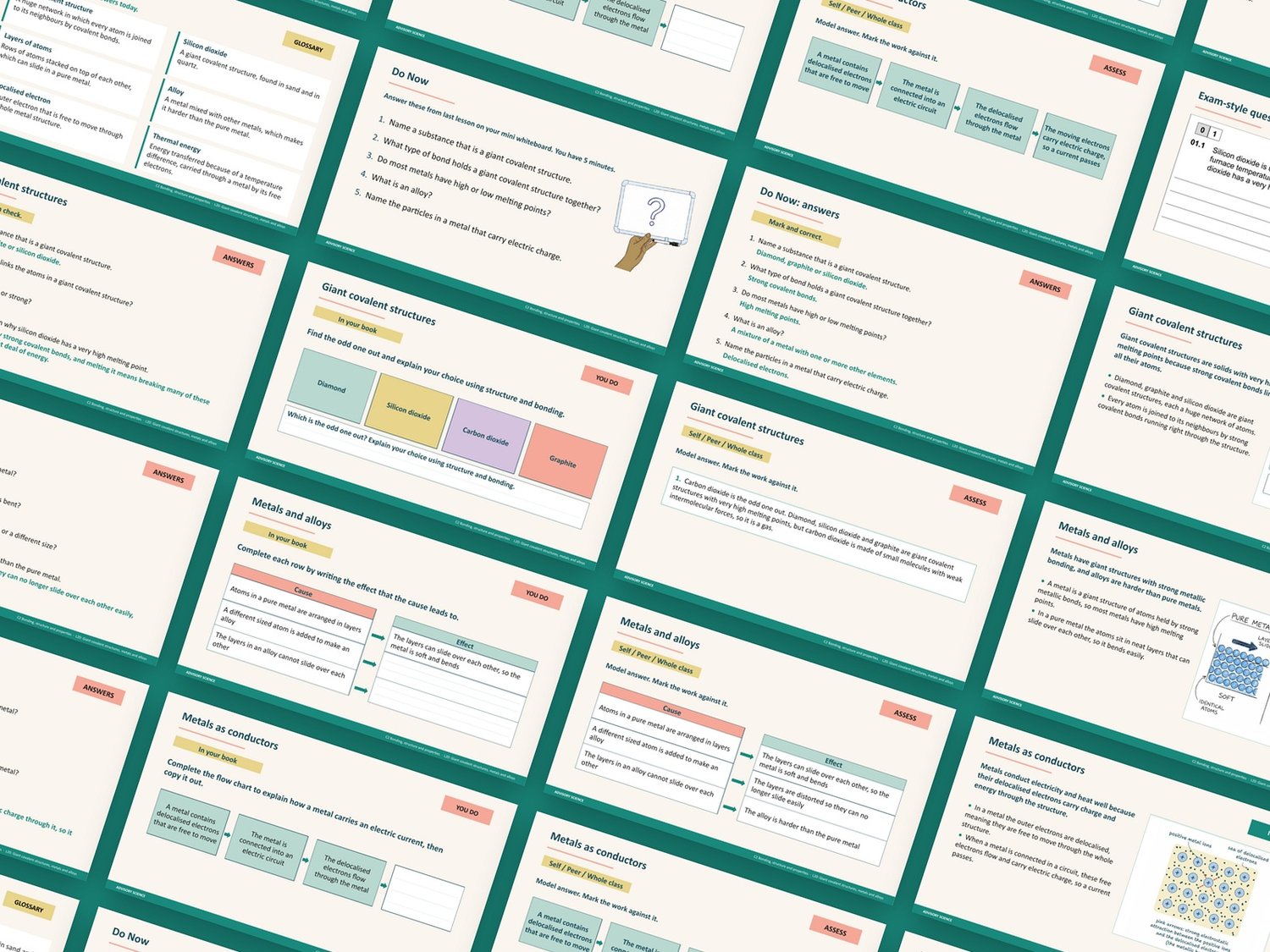
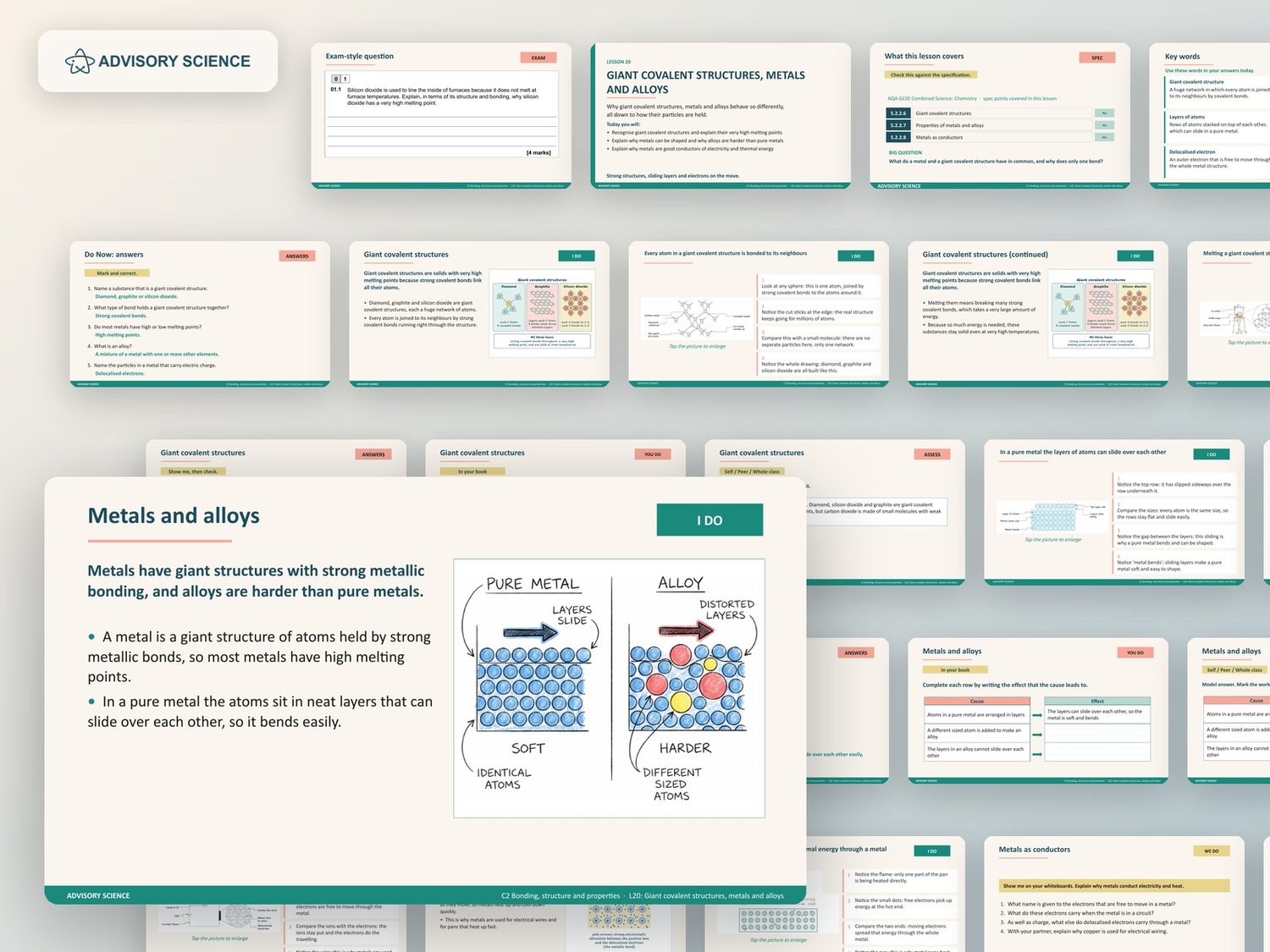
Each C2 Bonding, Structure and Properties lesson starts with a Do Now that recalls earlier learning, with the answers on the next slide. It then moves through I Do, We Do and You Do, with a model answer after each task. It finishes with the AQA-style question listed above, its mark scheme and an exit ticket. A specification slide names the AQA points the lesson covers, so you can check it against your scheme of work.
Topic test
The C2 Bonding, Structure and Properties topic test covers the whole unit with AQA-style questions and comes with its mark scheme, both in Word and PDF.
Free revision videos for this unit