

AQA GCSE Physics P5 Forces | 16 Lesson Presentations and Topic Test
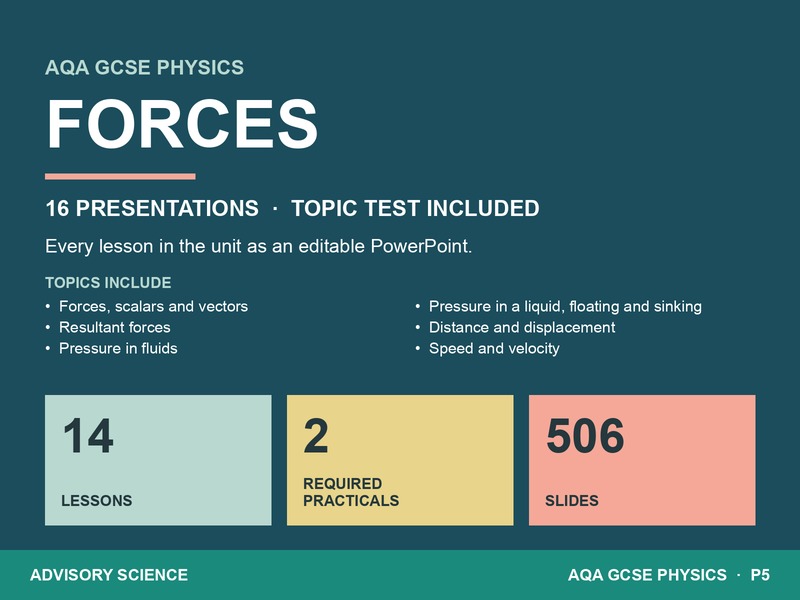
AQA GCSE Physics P5 Forces: 16 lessons ready to teach, with a topic test
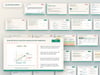
You get every lesson for AQA GCSE Physics P5 Forces, planned and ready to teach. There are 14 teaching lessons and the 2 required practicals as full lessons. Each one is editable PowerPoint and matched to the AQA 8463 specification.
What your classes work through
- Forces, scalars and vectors. Pupils explain why a rock keeps its mass on the Moon but weighs less, then calculate its weight there.
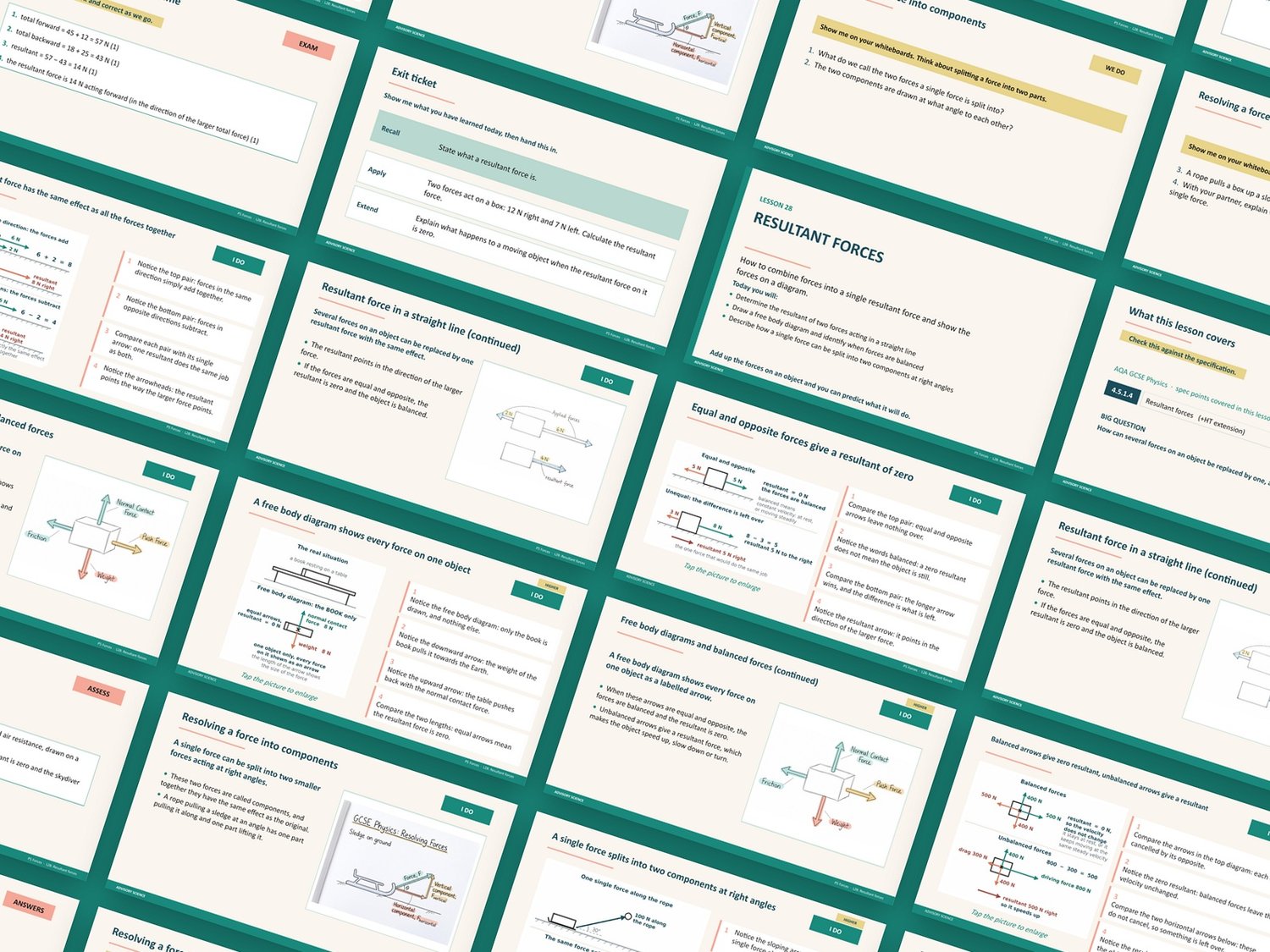
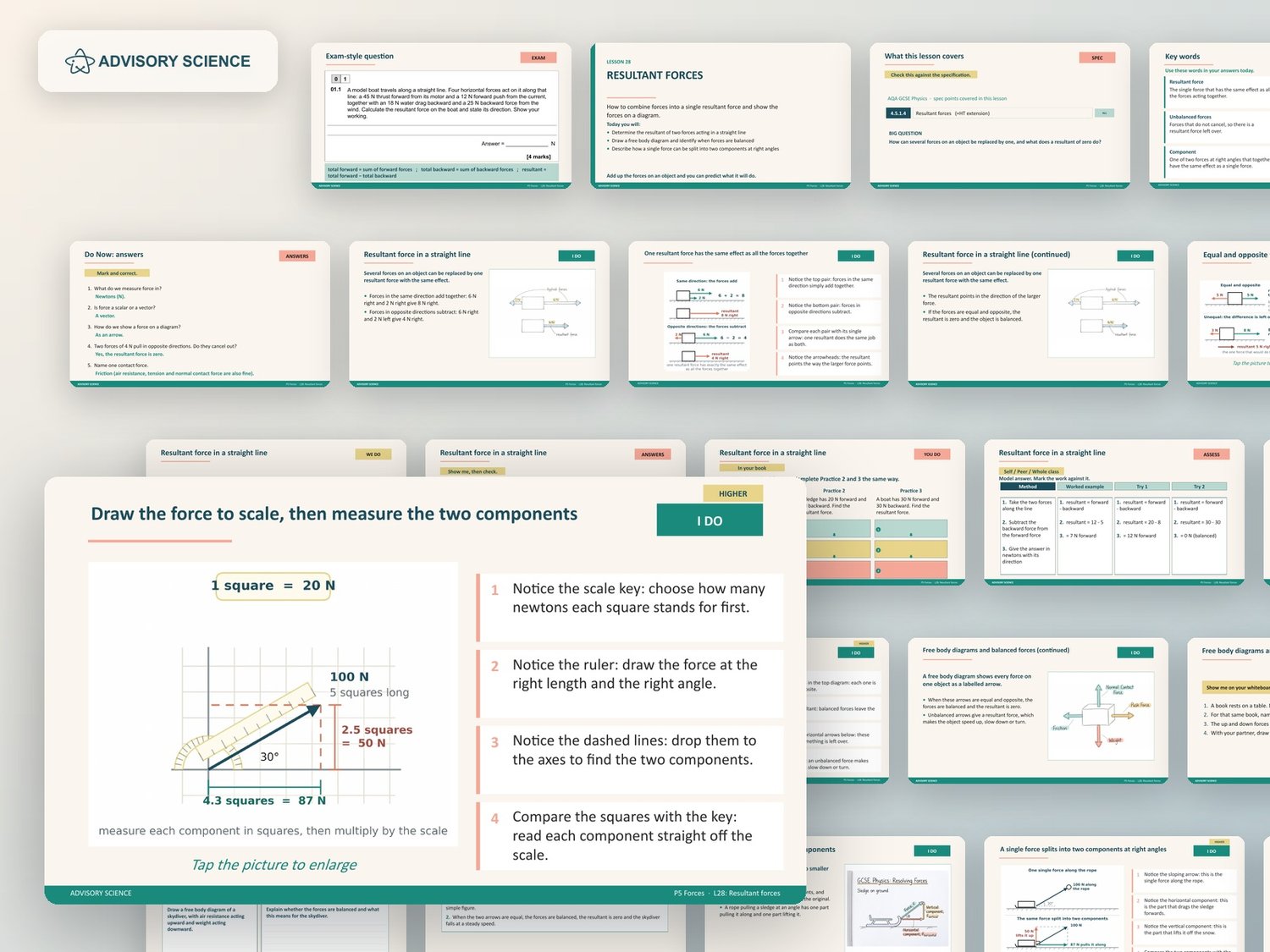
- Resultant forces. Pupils add the forward and backward forces on a model boat to calculate the resultant force and state its direction.
- Pressure in fluids. Pupils read atmospheric pressure at two heights from a graph and calculate how quickly it decreases per kilometre.
- Pressure in a liquid, floating and sinking. Pupils calculate the sea water pressure on a submarine 60 m down and explain how it changes as the submarine dives deeper.
- Distance and displacement. Pupils explain why a delivery drone that flies out and back travels 600 m in total yet has zero displacement.
- Speed and velocity. Pupils calculate how long a walk to the bus stop takes, then work out the velocity of the bus including its direction.
- Distance-time graphs. Pupils describe each section of a cyclist's distance-time graph and calculate the speed during the first section.
- Acceleration and velocity-time graphs. Pupils use the forces acting on a skydiver to explain why she accelerates at first and later falls at a constant velocity.
- Newton's laws and braking. Pupils match Newton's first and second laws, thinking distance and braking distance to their correct meanings.
- Newton's Third Law. Pupils apply Newton's Third Law to a student throwing a ball from a skateboard and explain why the paired forces do not cancel.
- Momentum and collisions. Pupils find the change in momentum of a rebounding cricket ball and use the contact time to calculate the average force from the bat.
- Work done and energy transfer. Pupils calculate the work done by a cleaner pushing a floor polisher across the floor and give the correct unit.
- Forces and elasticity. Pupils complete reasoning about a spring's force against extension graph, naming the point where the line curves and what happens beyond it.
- Moments, levers and gears. Pupils work out the moment of a child's push on a see-saw about its central pivot and give the unit.
The 2 required practicals
- RP6 Force and Extension. Pupils describe a force against extension graph for a spring, read the force at 0.15 m and calculate the spring constant.
- RP7 Acceleration and Force. Pupils rearrange Newton's second law to calculate the inertial mass of a trolley from its acceleration and the resultant force.
Who it is for
Use it to teach AQA GCSE Physics P5 Forces lessons on resultant forces, pressure, motion graphs, Newton's laws, momentum, elasticity and moments in Year 10 and Year 11. It also covers the force and extension and acceleration required practicals, so it works well for GCSE Physics revision or intervention.
How each lesson runs
Each P5 Forces lesson starts with a Do Now that recalls earlier learning, with the answers on the next slide. It then moves through I Do, We Do and You Do, with a model answer after each task. It finishes with the AQA-style question listed above, its mark scheme and an exit ticket. A specification slide names the AQA points the lesson covers, so you can check it against your scheme of work.
Topic test
The P5 Forces topic test covers the whole unit with AQA-style questions and comes with its mark scheme, both in Word and PDF.
Free revision videos for this unit