

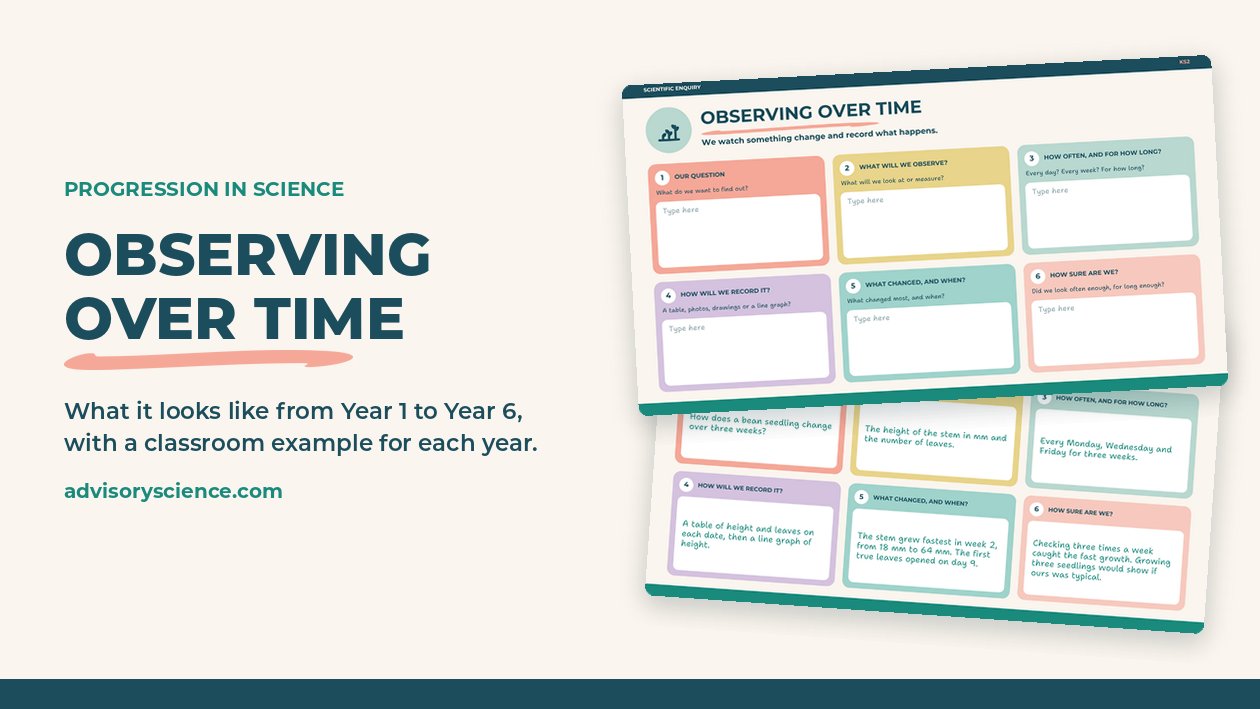
How does a child move from noticing that something has changed to using observations over time to answer a scientific question?
This is an important part of primary science because the world doesn't always give us an answer immediately. Some changes happen in seconds. Others take hours, days, months or even years.
A seed germinates. A plant grows. A shadow changes during the day. The Moon appears to change shape. A habitat changes with the seasons.
To understand these things, children need to learn how to observe change over time.
What the National Curriculum says
The National Curriculum includes observing over time as one of the types of scientific enquiry pupils should experience. In Years 1 and 2, pupils should observe changes over time. By Years 3 and 4, they should begin to make decisions about what observations to make, how long to make them for and what equipment to use. By Years 5 and 6, they should make their own decisions about observations, measurements, duration and whether observations should be repeated.
That gives us a useful progression.
Year 1: noticing change
In Year 1, observation is closely connected to looking carefully at the world around them.
Learners might observe plants in the school grounds, changes in the weather or changes in daylight across the seasons. The important step here is learning to notice and describe change.
A learner might say:
"There are more leaves on the tree now."
Or:
"The flower was a bud and now it is open."
They need plenty of opportunities to look at the same thing more than once. If we only show learners a photograph of a plant at the beginning and another at the end, we have shown them change. We haven't necessarily taught them how to observe change, and that is why regular observation matters.
Year 2: recording change
By Year 2, learners can begin to make their observations more systematic.
They might observe how a seed develops into a plant or measure how an animal changes as it grows. Now there is a record of the change. The learner might draw what they see, make a simple table or take a measurement.
The question is beginning to shift from "What has changed?" towards "How has it changed?"
That is an important development because the record allows learners to compare what they observed at different points in time.
Year 3: making observations systematically
In Years 3 and 4, the National Curriculum expects pupils to make systematic and careful observations and, where appropriate, take accurate measurements using standard units.
This is a significant step. Learners are no longer simply observing because the teacher has told them to look. They are beginning to understand that the way they collect observations affects the evidence they have at the end.
For example, if learners are observing how a plant grows, they need to think about what they will record. Height? Number of leaves? Number of flowers?
They also need to think about when they will make the observations. A learner might begin to understand that measuring a plant every day at roughly the same time gives them a more useful record than measuring it whenever they happen to remember.
Year 4: deciding what to observe
By Year 4, learners can begin to take more responsibility for deciding what observations will help answer the question.
Suppose the question is: How does a shadow change during the day?
The learner needs to think about what evidence would help. They might decide to measure the length of the shadow at regular intervals. They need to consider where the object is placed, where the light source is and how the measurements will be recorded.
The scientific knowledge matters here. A learner who understands that the position of the Sun appears to change across the sky has a reason for expecting the shadow to change. Their observation is connected to an idea.
Year 5: choosing measurements and timescales
By Years 5 and 6, the National Curriculum expects learners to make their own decisions about what observations to make, what measurements to use, how long to make them for and whether to repeat them.
This is where the planning becomes much more deliberate. Consider a question about plant growth. A Year 5 learner might decide:
- what feature of growth to measure
- what equipment is appropriate
- how frequently measurements should be taken
- how long the investigation needs to continue
- how the measurements will be recorded
They are beginning to understand that the quality of the evidence depends on the decisions made when collecting it.
Year 6: using observations to answer a question
By Year 6, learners should be able to bring the whole process together. They can identify what needs to be observed, select appropriate measurements and decide on a suitable timescale. They can record the evidence and use it to answer the original question.
They should also be able to recognise limitations. For example:
"We measured the plant every three days, but the growth between measurements could have been different."
That is a much more sophisticated understanding of observation. The learner is beginning to think about what the evidence can and cannot tell them.
What should progression look like across the school?
When looking at observing over time, I would expect to see a gradual increase in:
- the length and complexity of the period being observed
- the precision of observations and measurements
- the range of equipment used
- the learner's ability to decide what to observe
- the learner's ability to decide when observations should be made
- the way observations are recorded
- the use of observations to identify change and answer questions
The scientific content will change from year to year, but the underlying enquiry should develop alongside it.
A useful subject leader check
Choose one example of observing over time from each year group. Put them in order. Then ask: could I explain what the learner has learned about observing between each stage?
If the answer is simply "the investigation gets harder", the progression probably needs more thought.
The next article looks at pattern seeking, another type of enquiry that is easily confused with fair testing, but requires learners to think about evidence in a rather different way.
Free for your school: the working scientifically progression displays show six skills from Year 1 to Year 6, including observing and measuring, ready to print for a whole-school display. Download all six free.
Plan it with your class: the Scientific Enquiry Planning Pack gives you a planning slide for each type of enquiry, with a model answer after each one, for KS1 and KS2. See the planning pack