

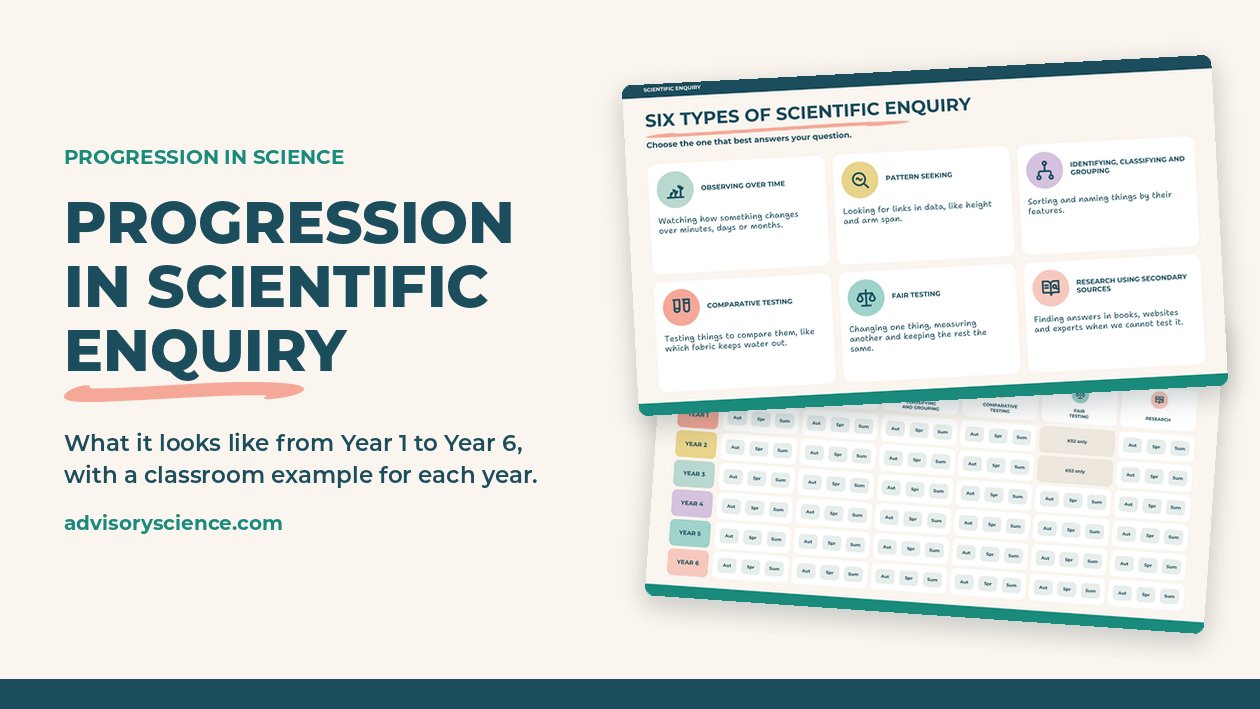
A clear picture of progression lets a subject leader explain how science develops across a primary school. It also helps teachers answer two important questions: what do my learners already know, and what do they need to learn next?
These questions matter for scientific knowledge, but they matter just as much for working scientifically.
The five types of scientific enquiry
The National Curriculum says that pupils should develop their understanding of the nature, processes and methods of science through different types of scientific enquiry. It identifies five:
- observing over time
- pattern seeking
- identifying, classifying and grouping
- comparative and fair testing
- researching using secondary sources
What the National Curriculum expects in each phase
The expectation changes as pupils move through the school.
In Years 1 and 2, pupils should experience different types of scientific enquiry and begin to recognise ways in which questions might be answered.
In Years 3 and 4, they should begin to make decisions about which type of enquiry is most appropriate.
By Years 5 and 6, they should select and plan the most appropriate type of enquiry to answer scientific questions.
That gives us the broad direction of travel. But it doesn't tell a teacher exactly what progression should look like in Year 1, Year 2, Year 3, Year 4, Year 5 and Year 6. That is something the school curriculum needs to make clear.
Progression is more than doing the same investigation with harder equipment
If we want to see progression in working scientifically, we need to look carefully at what learners are actually doing.
Take observing over time.
A Year 1 learner might notice that the leaves on a tree have changed.
A Year 3 learner might make regular observations of a plant and record changes using measurements and a table.
A Year 6 learner might decide what observations are needed, how often they should be made and how the evidence could be used to answer a question.
The Year 6 learner may well use a more complicated table, but that is the smaller change. They have greater knowledge, greater independence and a better understanding of what makes an observation useful for answering a scientific question.
That is the kind of progression we need to make visible.
Five types of enquiry, five articles
Over the next five articles, I am going to look at each type of scientific enquiry separately.
1. Observing over time How does a learner move from noticing and describing change to deciding what to observe, how long to observe it and what measurements will provide useful evidence?
2. Pattern seeking How do learners move from noticing a simple pattern to deliberately collecting data to look for a relationship and using that pattern to make predictions?
3. Identifying, classifying and grouping How does sorting objects according to visible features develop into using classification systems, keys and scientific characteristics to identify and justify groups?
4. Comparative and fair testing How does a learner move from carrying out a simple comparison to planning a fair test, identifying variables and explaining why particular variables need to be controlled?
5. Research using secondary sources How does a learner move from finding an answer in a book or video to identifying what information is needed, selecting appropriate sources and using evidence from those sources to answer a scientific question?
Different questions need different enquiries
These are different types of enquiry because they answer different kinds of questions.
A question about how something changes over time needs a different approach from a question about whether two things are related. A question about identifying an unknown plant does not need a fair test. A question about an animal that cannot be safely observed first-hand may need research using secondary sources.
Children therefore need experience of different ways of finding things out. They also need to become increasingly able to recognise which approach will help them answer a particular question.
What should a subject leader look for?
Choose one type of enquiry and follow it through the curriculum. Look at what learners are expected to do in Year 1, then Year 2, then Year 3 and so on.
Ask:
- What has changed?
- What does the learner now know that allows them to do something they couldn't do before?
- What decisions are they making for themselves?
- What will this learning prepare them to do later?
That gives you a much clearer picture of progression than simply listing the investigations children complete each year.
In the next article, we will start with observing over time and look at how this develops from the earliest observations in Year 1 to the more deliberate planning and interpretation of observations in Years 5 and 6.
Free for your school: the working scientifically progression displays show six skills from Year 1 to Year 6, ready to print for a whole-school display. Download all six free.
Plan it with your class: the Scientific Enquiry Planning Pack gives you a planning slide for each type of enquiry, with a model answer after each one, for KS1 and KS2. See the planning pack