

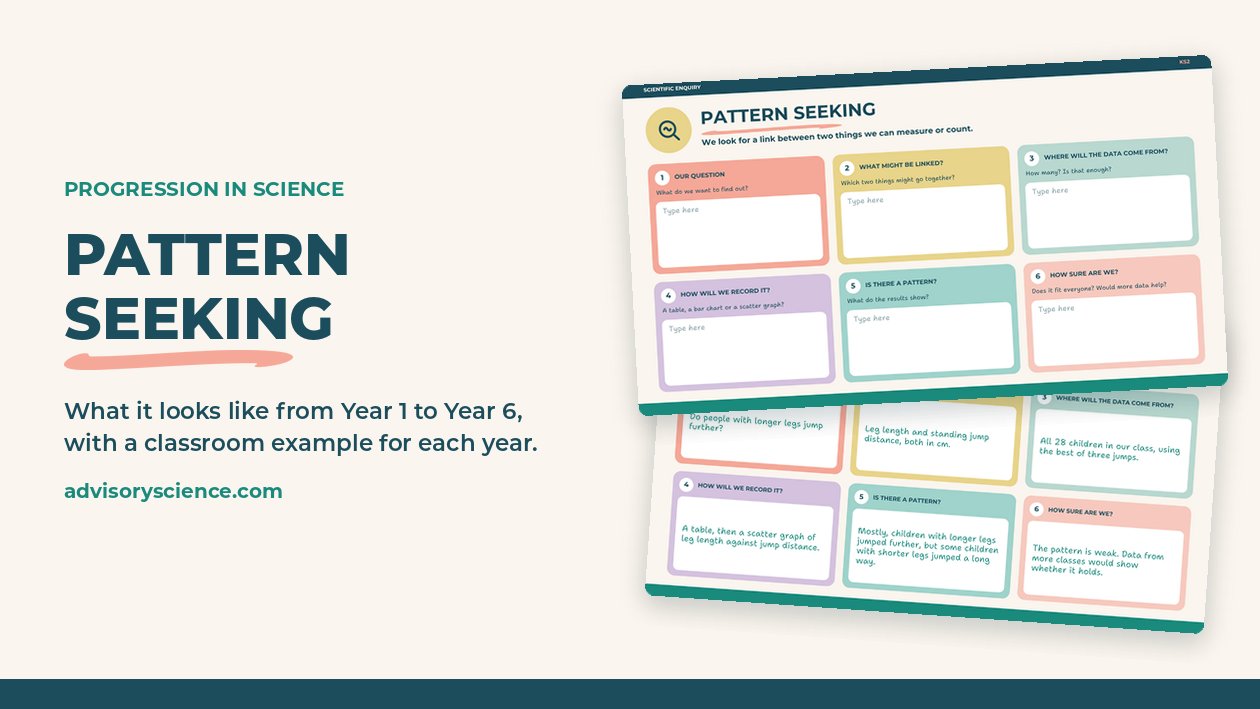
A pattern is something children notice all the time.
The days get longer in summer. Some materials feel colder than others. Tall plants might have more leaves. The further a light source moves from an object, the smaller its shadow may become.
Noticing a pattern and investigating a pattern are two different things, and that distinction matters when we teach pattern seeking.
What the National Curriculum says
The National Curriculum expects pupils to experience different types of scientific enquiry, including noticing patterns. By Years 3 and 4, pupils should begin to look for naturally occurring patterns and relationships and decide what data to collect to identify them. By Years 5 and 6, they should select and plan appropriate enquiries and use evidence to support their ideas.
So what does that look like across the primary years?
Year 1: noticing similarities and differences
In Year 1, learners are beginning to notice what is the same and what is different. They might notice that shadows are longer at one time of day than another, or that some animals have similar features.
At this stage, the pattern may be obvious. The important learning is developing the habit of looking for relationships rather than looking at one object or one event in isolation.
A learner might notice:
"The shadow is longer now."
The teacher can help them notice more:
"What else have you noticed about the shadow at different times?"
The learner begins to compare observations.
Year 2: describing a simple pattern
By Year 2, learners can begin to describe patterns using their observations. For example:
"The shadow is longer in the morning and shorter at lunchtime."
They might collect simple data to help them describe what they have noticed. The important progression is from simply spotting something interesting to using more than one observation to describe a relationship.
Year 3: collecting data to look for a pattern
In Years 3 and 4, the National Curriculum expects learners to begin looking for naturally occurring patterns and relationships and to decide what data to collect to identify them.
This is a significant change. The learner now needs to think about what evidence would allow them to see the pattern.
For example, if they want to investigate whether hand span is related to height, they need measurements from a number of people. One person's measurements cannot show a pattern across a group.
They might record:
- Height 120 cm, Hand span 15 cm
- Height 128 cm, Hand span 16 cm
- Height 135 cm, Hand span 17 cm
The learner can begin to look across the data rather than focusing on individual results.
Year 4: describing relationships
By Year 4, learners should be becoming more confident at identifying patterns and relationships in data. They might notice that as one measurement increases, another tends to increase too.
This is also where careful teaching matters. A pattern does not automatically mean that one thing causes another. If taller children tend to have larger hand spans, the data show a relationship. They do not show that increasing height causes hand span to increase.
That distinction becomes increasingly important as learners move through the school.
Year 5: planning how to investigate a pattern
By Year 5, learners can begin to make more deliberate decisions about pattern-seeking enquiries. They need to think about:
- what measurements to collect
- how many measurements are needed
- how the data should be recorded
- which variables might be related
- how the results could be presented
A scatter graph may now help them see a relationship that is difficult to see in a list of numbers.
The learner is moving beyond simply saying, "I noticed a pattern." They are thinking about how to collect evidence that will allow the pattern to be investigated.
Year 6: interpreting patterns and using them to make predictions
By Year 6, learners should be able to use evidence from a pattern-seeking enquiry to support conclusions and make predictions. They might identify a relationship in their data and use it to predict what might happen for another value.
They also need to recognise that real scientific data rarely form a perfect pattern. There may be variation. There may be results that do not fit the overall trend.
A mature response therefore moves away from "The results prove that…" towards something more like "The data suggest that…". That is an important development in scientific thinking.
What should progression look like?
Across the school, pattern seeking should develop from:
noticing → describing → collecting data → identifying relationships → interpreting relationships → making predictions
The content will vary from year to year, but the underlying thinking should keep developing in the same direction. A Year 6 learner should be able to explain what pattern they found and how the evidence supports it.
A useful subject leader check
Look at the data children collect in different year groups. Ask: are they being given a pattern to find, or are they learning how to collect evidence that allows them to look for one?
That distinction is worth checking.
The next article looks at identifying, classifying and grouping, and how sorting develops into scientific classification.
Free for your school: the working scientifically progression displays show six skills from Year 1 to Year 6, ready to print for a whole-school display. Download all six free.
Plan it with your class: the Scientific Enquiry Planning Pack gives you a planning slide for each type of enquiry, with a model answer after each one, for KS1 and KS2. See the planning pack