

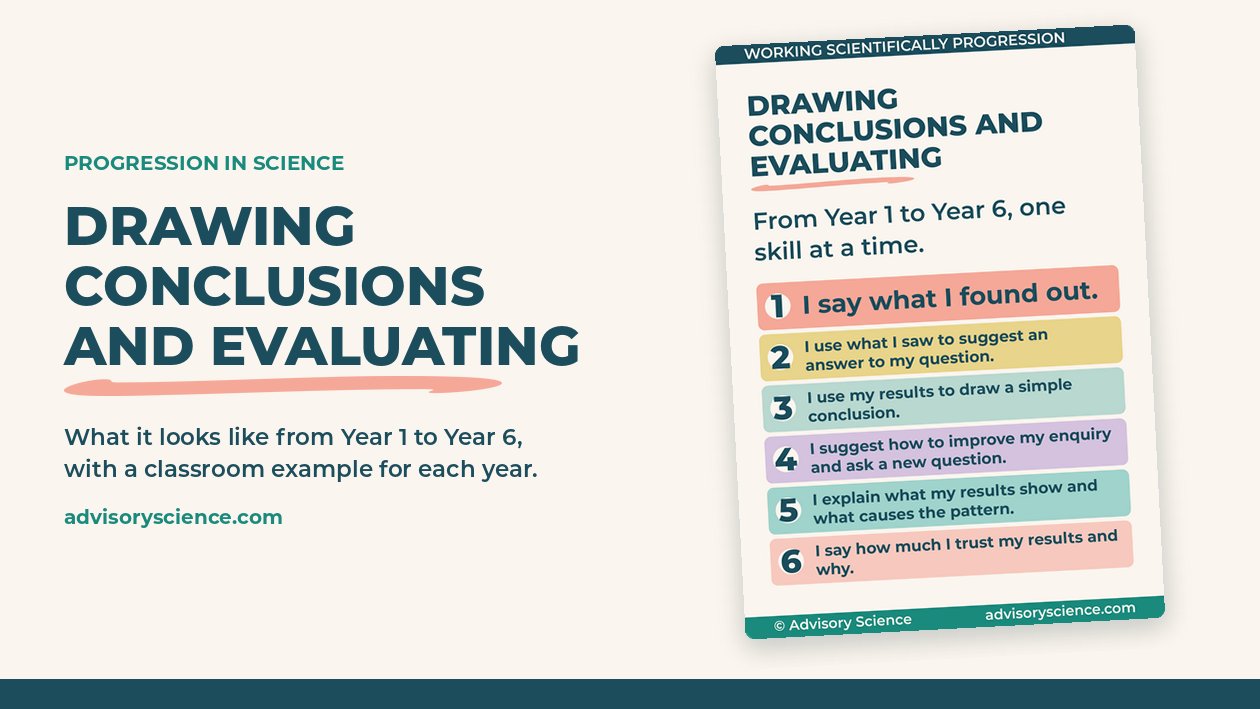
A conclusion connects the evidence to the question. "The answer was 25 cm" is a result. A conclusion says what that result tells us, and evaluating asks how far we can trust it.
What the National Curriculum says
In Years 1 and 2, children should be "using their observations and ideas to suggest answers to questions". In Years 3 and 4, they should be "using results to draw simple conclusions, make predictions for new values, suggest improvements and raise further questions". In Years 5 and 6, they should be "reporting and presenting findings from enquiries, including conclusions, causal relationships and explanations of and degree of trust in results".
The curriculum does not set out a neat, standalone evaluation ladder for primary school. Evaluation grows through the statutory expectations around improvements, accuracy, repeat readings, controlling variables and the degree of trust in results.
Key Stage 1: answering the question
In Year 1, children say what they found out. After testing which ball bounced the highest, a child tells the class: "The red ball bounced the highest." The important step is that they are answering the question using what they saw.
By Year 2, children use what they saw to suggest an answer to their question. Looking back at photos of plants grown on a windowsill and in a cupboard, they link their answer to something they observed: "The one on the windowsill got bigger. I think plants need light." The word "think" matters. The child is suggesting an answer and backing it with evidence.
Lower Key Stage 2: conclusions from results
In Year 3, children use their results to draw a simple conclusion. Saying which magnet is strongest because it picked up the most paper clips, a child gives the results as the reason: "Magnet B is the strongest because it picked up 12 paper clips." The conclusion now rests on data.
By Year 4, evaluation begins in earnest. Children suggest how to improve their enquiry and ask a new question. After testing which biscuit lasts longest in tea, a child might suggest a timer for each dunk and ask whether hotter tea makes a difference: "Next time we should use a timer. Does hot tea make it break faster?" A useful improvement names one real change that would make the test better, which is far more valuable than "Next time I would make it more accurate."
Upper Key Stage 2: explaining and judging the evidence
In Year 5, children explain what their results show and what causes the pattern. "The bigger the parachute, the slower it falls, because more air pushes on it." The child describes the pattern and gives a scientific reason for it, drawing on their knowledge of forces.
By Year 6, children say how much they trust their results and why. Spotting an odd reading in a heart rate test, a child explains how repeat readings would change the conclusion: "One reading was way higher than the others, so we should do it again." They are asking the questions scientists ask. Was our method suitable? Were our measurements accurate enough? Should we repeat them? How much confidence can we have in the result?
The progression runs from suggesting, to describing, to concluding, to explaining, to judging the evidence behind the conclusion.
The progression on one display
- Year 1: I say what I found out.
- Year 2: I use what I saw to suggest an answer to my question.
- Year 3: I use my results to draw a simple conclusion.
- Year 4: I suggest how to improve my enquiry and ask a new question.
- Year 5: I explain what my results show and what causes the pattern.
- Year 6: I say how much I trust my results and why.
A useful subject leader check
Read the last lines of investigations in books across the school. Ask: does the conclusion answer the original question, and does it use the evidence?
If Year 6 conclusions read like Year 2 conclusions with longer sentences, or every evaluation ends with the same stock phrase, the skill may not be developing. By the end of Year 6, a child should be able to say what they found, why it happened and how far they trust it.
This is the final article in the series. To see how all six skills fit together, return to what progression in working scientifically looks like from Year 1 to Year 6.
Free display: Drawing Conclusions and Evaluating from Year 1 to Year 6, one A3 panel per year group plus a one-page summary, ready to print. Download it free.
Teach it with your class: the Working Scientifically Skills Pack gives you a slide for each of the six skills, with a model answer after each one, for KS1 and KS2. See the skills pack