

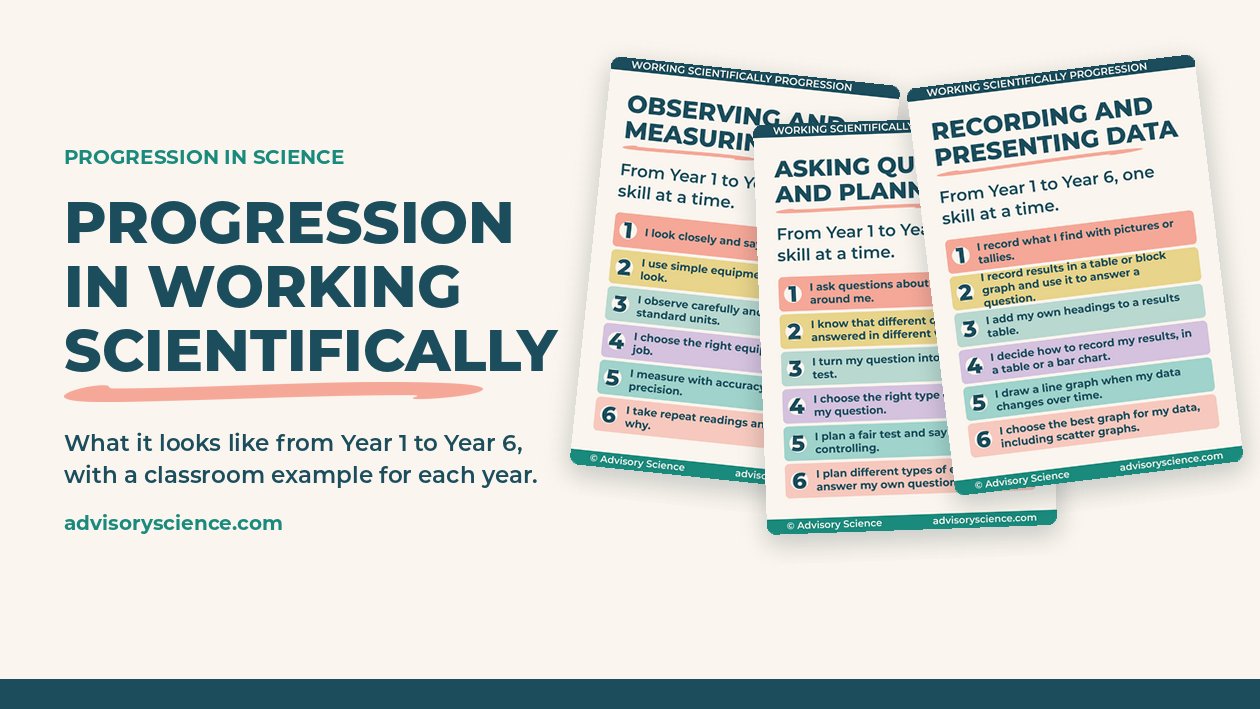
A clear picture of progression lets a subject leader explain, in a few minutes, how science builds from Year 1 to Year 6. It also shows teachers what their class already knows and where the learning is heading.
Working scientifically is one of the easiest parts of primary science to say is progressing and one of the hardest to demonstrate. A school may have children observing, measuring, recording results and carrying out investigations in every year group. The books may look increasingly sophisticated. There may be more equipment, more graphs and more elaborate investigations as children get older. None of those things, on their own, tell us whether children are actually becoming better at working scientifically.
The more useful question is: what are children becoming able to do independently that they could not do before?
That is where progression becomes visible.
Working scientifically is taught through the science
The National Curriculum makes clear that working scientifically should be taught through biology, chemistry and physics. Children develop their understanding of the processes and methods scientists use while they are learning scientific knowledge. That means progression needs to be visible within the science children are actually doing.
In Year 1, a child might observe a plant carefully because the teacher has directed their attention to particular features. By Year 3, that child should be making more systematic observations and taking measurements using standard units. By Year 6, they should be able to decide what needs to be observed or measured, choose appropriate equipment, consider the accuracy of their measurements and repeat readings when this is appropriate.
The scientific content has changed, and so has the child's role in the process.
The thread that runs through every skill
This is the thread that runs through working scientifically from Year 1 to Year 6. Children gradually take greater responsibility for the scientific decisions involved in answering a question. They move from participating in enquiries that are largely structured for them towards selecting, planning, carrying out and evaluating enquiries with increasing independence.
That does not happen in one jump in Year 5. It needs to be built deliberately across the primary years.
The National Curriculum gives us the statutory expectations for Years 1 and 2, Years 3 and 4, and Years 5 and 6. It gives one expectation for each pair of years. The finer, year-by-year progression for each skill is the work of the school curriculum: deciding what children need to learn first, what that learning enables them to do next, and how independence should increase over time.
Skills and types of enquiry
The skills in this series work alongside the five types of scientific enquiry, and the two are closely connected.
The five types of scientific enquiry describe different ways of answering scientific questions: observing over time, pattern seeking, identifying, classifying and grouping, comparative and fair testing, and research using secondary sources. Working scientifically describes the processes and skills children develop as they carry out those enquiries.
Take the question: which material would make the best waterproof coat? The learner needs to ask a question, decide that a comparative test is appropriate, plan it, measure the results, record the data, draw a conclusion using evidence and perhaps evaluate the test. That is working scientifically. The enquiry type is the comparative test.
The six skills in this series
Each article takes one skill and traces how it develops from Year 1 to Year 6, looking beyond the activity itself to the scientific thinking underneath it.
- Observing and measuring: from noticing carefully to choosing measurements and repeating readings.
- Identifying and classifying: from sorting by what children can see to classifying living things and giving reasons.
- Asking questions and planning: from questions about the world to planning different enquiries for their own questions.
- Setting up tests: from a simple test with help to using results to plan a further test.
- Recording and presenting data: from pictures and tallies to choosing the best graph for the data.
- Drawing conclusions and evaluating: from saying what they found to saying how much they trust their results.
I have shown each skill as a separate strand so that you can see clearly how it develops from Year 1 to Year 6. In the classroom, the strands are intended to be taught through the science content. Ofsted's science subject report, Finding the optimum (2023), makes the same point: pupils learn disciplinary knowledge best when it is taught alongside the substantive knowledge it depends on. A child plans a better test of which material keeps a drink warm when they know what makes a good thermal insulator, and draws a stronger conclusion about plant growth when they know what plants need to grow.
For each skill, the important question goes beyond "What does the National Curriculum say?" It is:
- What does this look like when a child is doing it?
- What should change as that child moves through the school?
- What learning needs to happen now so that the child is ready for the next stage?
A useful subject leader check
Choose one working scientifically skill and follow it from Year 1 to Year 6. Look at what children are actually expected to do. Then ask two questions: what has changed, and what has the child become able to decide for themselves?
If the answer is simply that the children are doing the same activity with harder scientific content, there may not be much progression in working scientifically at all.
Progression in working scientifically means giving children increasingly sophisticated control over the scientific process.
Free for your school: each of the six skills has its own whole-school display, one A3 panel per year group, ready to print. Download all six free.
Teach it with your class: the Working Scientifically Skills Pack gives you a slide for each of the six skills, with a model answer after each one, for KS1 and KS2. See the skills pack