

Identifying and classifying is both a working scientifically skill and one of the five types of scientific enquiry. The enquiry article looks at when classification is the right way to answer a question. This article looks at the skill itself: what a child is actually doing when they sort, compare, name and group, and how that becomes more scientific across the school.
What the National Curriculum says
In Years 1 and 2, children should be "identifying and classifying". In Years 3 and 4, they should be "gathering, recording, classifying and presenting data in a variety of ways", and they should recognise that living things can be grouped in a variety of ways and use classification keys. In Years 5 and 6, they should be "using and developing keys and other information records to identify, classify and describe living things and materials".
Key Stage 1: sorting with a reason
In Year 1, children sort things into groups because of what they can see. They might sort a tray of materials into shiny and not shiny, or into things that bend and things that do not bend. What matters most is whether the child can say the reason for their group. A child who points at a pile has sorted. A child who says, "These ones are shiny, so they go together," has begun to classify.
By Year 2, children compare things and say exactly how they differ. They might compare two habitats or two materials and name one thing that is the same and one thing that is different. The development here is precision. "They are different" is an observation. "They are both hard, but this one is bendy" names the specific difference, and that is the evidence a classification needs.
Lower Key Stage 2: scientific words and keys
In Year 3, children group living things and materials using the right scientific word. They might group everyday materials into magnetic and non-magnetic, or rocks by whether they have grains or crystals. The child who says, "The paper clip is magnetic because it stuck to the magnet," is using the scientific name for the group and giving the evidence for it. Classification now depends on scientific knowledge as well as careful looking.
Year 4 is an important step because children follow a key to work out what something is. A yes or no branching key for a minibeast or a leaf asks one question at a time. The skill is to follow the key in order, answering each question from what they can observe, instead of guessing the answer and working backwards. "It has eight legs, so the key says it's a spider" shows a child letting the evidence lead them to the name.
Upper Key Stage 2: building keys and giving reasons
In Year 5, children build their own key so someone else could use it. Writing a classification key for a set of living things, then testing it on a partner, is a demanding task. The child has to choose questions that split the group cleanly and put them in a sensible order. A good key gets a partner to the right answer without any help. You can hear the thinking when a child says, "I asked 'Does it have fur?' first, because that splits them in half."
By Year 6, children classify living things by their features and give their reasons. They might sort vertebrates, invertebrates, plants and micro-organisms, explaining the feature used to place each one. The reasoning is now the heart of the skill. "A bat is a mammal because it has fur and feeds its babies milk" names the specific features that put the animal in its group, including one that a quick look would never reveal.
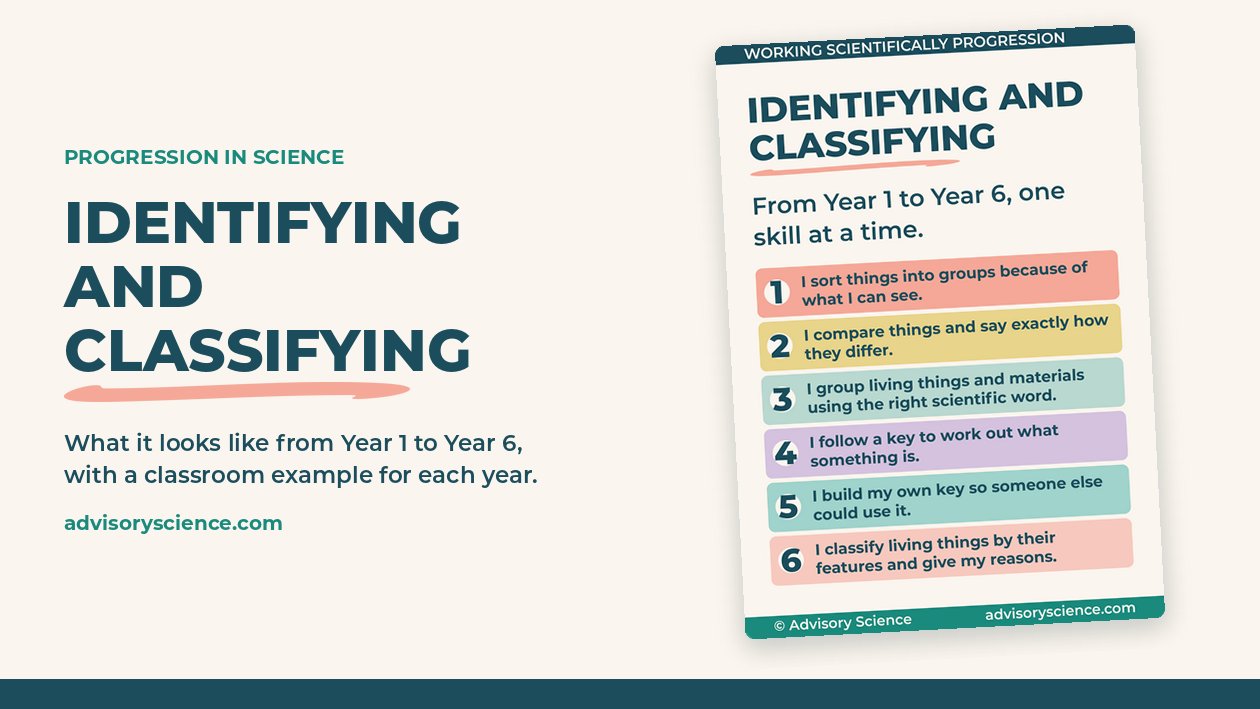
The progression on one display
- Year 1: I sort things into groups because of what I can see.
- Year 2: I compare things and say exactly how they differ.
- Year 3: I group living things and materials using the right scientific word.
- Year 4: I follow a key to work out what something is.
- Year 5: I build my own key so someone else could use it.
- Year 6: I classify living things by their features and give my reasons.
Across the six years, children move from grouping by what they can see, to naming the scientific group, to using and building keys, to justifying a classification with features they have learned.
A useful subject leader check
Look at a classification task from each year group and ask two questions. Who chose the groups? And can the child explain the feature that put each thing in its group?
If the teacher always supplies the categories and the children always place the objects, the sorting may be getting harder without the classifying getting more scientific.
The next article looks at asking questions and planning.
Free display: Identifying and Classifying from Year 1 to Year 6, one A3 panel per year group plus a one-page summary, ready to print. Download it free.
Teach it with your class: the Working Scientifically Skills Pack gives you a slide for each of the six skills, with a model answer after each one, for KS1 and KS2. See the skills pack