

Observation is one of the first scientific skills children develop. Young children are naturally observant, but scientific observation requires them to become increasingly deliberate about what they notice, how they record it and what they do with the information.
What the National Curriculum says
The National Curriculum gives us a particularly useful progression here. In Years 1 and 2, children should be "observing closely, using simple equipment". In Years 3 and 4, they should be "making systematic and careful observations and, where appropriate, taking accurate measurements using standard units, using a range of equipment". In Years 5 and 6, they should be "taking measurements, using a range of scientific equipment, with increasing accuracy and precision, taking repeat readings when appropriate."
Key Stage 1: looking closely
A child in Year 1 might look closely at a leaf and tell you what they can see. They may notice that one leaf is bigger than another, that some are smooth and some are rough, or that the leaves on a plant have different shapes. At this stage, the important thing is that children are learning to look carefully and talk about what they notice. The teacher is likely to provide the equipment, guide the observation and help children decide what is worth noticing. "What do you notice about this leaf?" encourages children to look more carefully than simply asking them what a leaf is.
By Year 2, children begin to use simple equipment to help them look, such as a hand lens, and to make simple measurements. The important development is that observation starts to produce evidence. Children are beginning to collect information that can help them answer a question, as well as describing what is in front of them.
Lower Key Stage 2: observing systematically
By Year 3, observation has become more deliberate. Children are expected to make systematic and careful observations and take accurate measurements using standard units. That changes the nature of the task. A child investigating shadows, for example, might measure the shadow's length at different times of the day, record the measurements in a table and begin to identify a pattern. The observation now produces evidence that can be used to answer a question.
A child measuring the temperature of water needs to know what they are measuring, use the thermometer appropriately and record the result using the correct unit. By Year 4, children begin to choose the right equipment for the job themselves.
Upper Key Stage 2: accuracy, precision and repeat readings
By Years 5 and 6, children should be making increasingly independent decisions about how observations and measurements will be collected. They need to consider what measurements are appropriate, which equipment will give them the information they need, how accurate those measurements need to be and whether repeating a measurement would make their results more trustworthy.
That changes the role of the child. They need to consider what evidence will be useful and how they can collect it reliably, where before they carried out a measurement because the teacher told them to. The skill has developed well beyond "observing carefully". Children are beginning to make decisions about how evidence should be collected.
The progression on one display
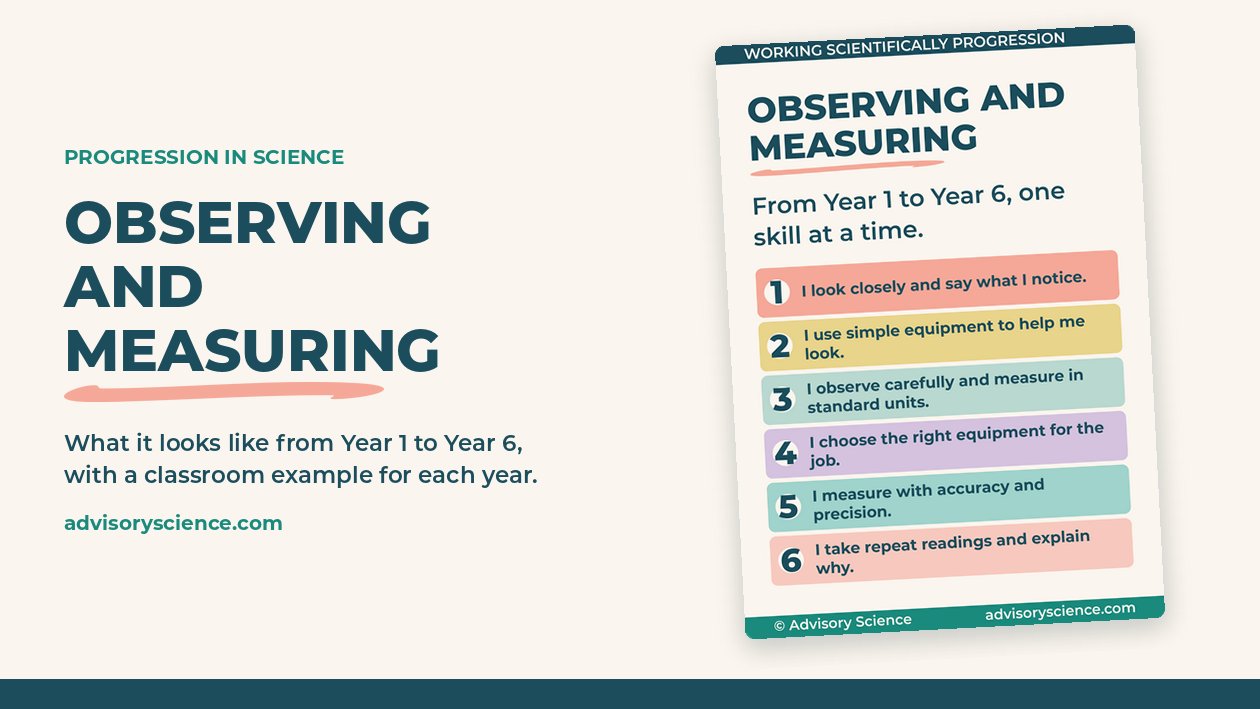
The whole-school display sets out one statement for each year group:
- Year 1: I look closely and say what I notice.
- Year 2: I use simple equipment to help me look.
- Year 3: I observe carefully and measure in standard units.
- Year 4: I choose the right equipment for the job.
- Year 5: I measure with accuracy and precision.
- Year 6: I take repeat readings and explain why.
Underneath the statements, the development runs from teacher-directed observation towards increasingly deliberate, systematic and independent collection of evidence.
A useful subject leader check
This is why observing and measuring is worth tracing through a curriculum. A Year 1 child might be learning to notice carefully. A Year 3 child is learning to observe systematically and measure using standard units. A Year 6 child should be thinking about the quality of the measurements they are collecting and whether repeating them would strengthen their evidence.
The equipment may look similar across the years, but the thinking behind its use should be changing. When you look at books or lessons, ask: who chose what to measure, and who decided whether to repeat it?
The next article looks at identifying and classifying.
Free display: Observing and Measuring from Year 1 to Year 6, one A3 panel per year group plus a one-page summary, ready to print. Download it free.
Teach it with your class: the Working Scientifically Skills Pack gives you a slide for each of the six skills, with a model answer after each one, for KS1 and KS2. See the skills pack