

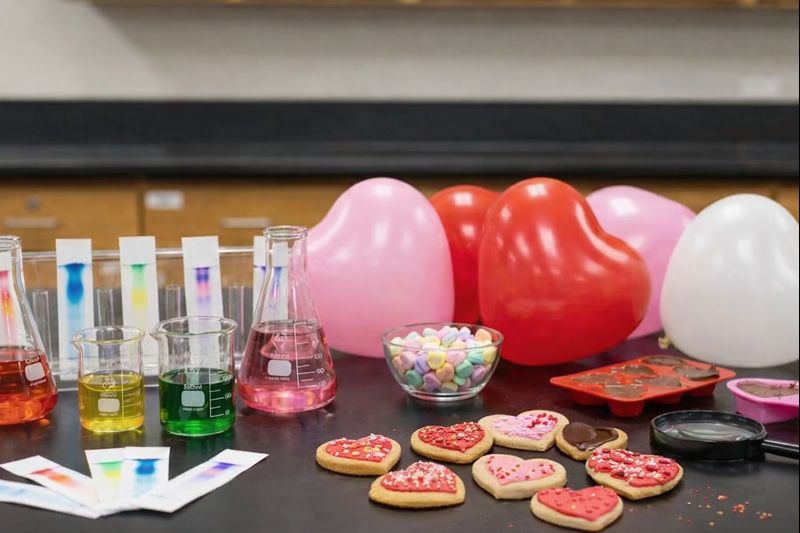
February doesn't have to mean Valentine's cards and colouring sheets. Why not bring the theme into your science lessons with investigations that actually teach the curriculum?
I've created 10 Valentine's-themed science investigations that cover everything from dissolving and particle theory to static electricity and calorimetry. Each one uses the romantic theme as a hook, but delivers real science with proper variables, fair testing and curriculum-linked outcomes.
Here's what's in the collection:
1. Which Valentine's Candy Heart Dissolves Fastest? Test different coloured candy hearts to explore dissolving and the particle model. Perfect for KS2 States of Matter or KS3 particles. Read more about this investigation here
2. How Does Dancing Make Your Heart Beat? Get pupils moving and measuring their pulse rates. Links to KS2 Animals Including Humans, KS3 gas exchange, and GCSE Biology and PE. Read more about this investigation here
3. Which Valentine's Paper is the Strongest? Cupid needs the strongest card! Test different papers with pennies to explore material properties and forces. Read more about this investigation here
4. The Acidity of Common Valentine's Gifts Which treats are worst for teeth? A pH investigation using chocolate, strawberries and sour sweets. Includes a home-friendly red cabbage indicator method. Read more about this investigation here
5. Effect of Temperature on Dissolving Time How does water temperature affect how fast candy hearts dissolve? Teaches rates, particle theory and leads nicely into collision theory at GCSE. Read more about this investigation here
6. Energy Content of Valentine's Chocolates A calorimetry classic with a Valentine's twist. Which chocolate releases the most energy? Links to the GCSE required practical. Read more about this investigation here
7. Which Material Makes the Best Valentine Insulator? Keep Cupid's hot chocolate warm! Test bubble wrap, foil, felt and tissue paper to explore heat transfer and insulation. Read more about this investigation here
8. Do Heart-Shaped Cookies Absorb More Milk? The ultimate dunking experiment! Explore absorption, capillary action and surface area with biscuits and milk. Read more about this investigation here
9. Which Ink Colour Travels Furthest? Cupid's love notes have smudged! Use chromatography to separate ink colours. Links to the GCSE required practical and Rf values. Read more about this investigation here
10. Balloon Cupid: Static Attraction Test Why do Cupid's decorations keep sticking? Charge balloons and test which materials are attracted from the greatest distance. Read more about this investigation here
What's included in each investigation?
Every investigation comes with:
- Editable Canva template (variables worksheet, recording sheet, risk assessment, group role cards)
- Comprehensive teacher guide with curriculum links, expected results, science explanations and differentiation
Two investigations (pH and Calorimetry) include separate methods for schools AND home/homeschoolers.
Who are these for?
These work brilliantly for:
- Primary teachers (KS2) wanting engaging science
- Secondary science teachers looking for themed practicals
- Homeschooling families wanting structured investigations
- Science clubs and STEM activities
Get the complete bundle
You can buy each investigation individually, but the bundle saves you over 50% and gives you a full February's worth of science sorted.
👉 Get the Valentine's Day Science Bundle
Comments ()