


Ecology Lessons PowerPoint | AQA GCSE Biology B7 8461, 15 Lessons
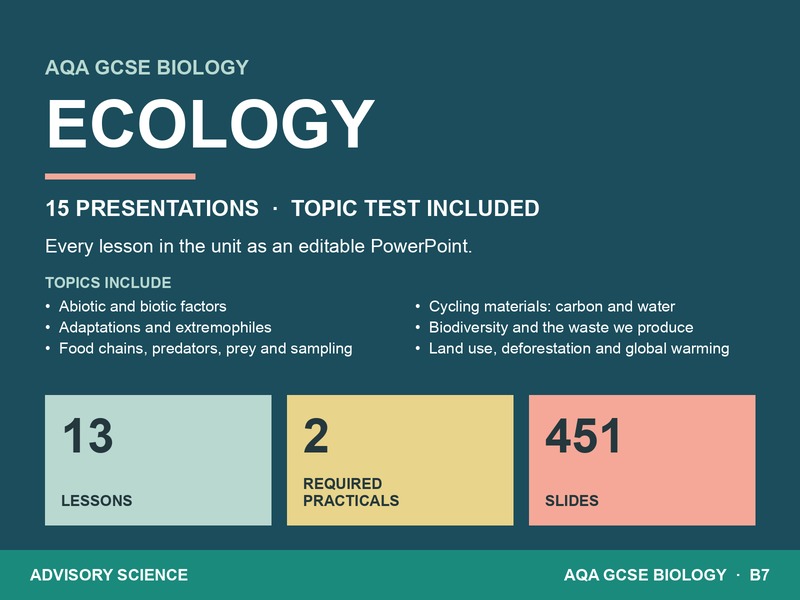
AQA GCSE Biology B7 Ecology: 15 lessons ready to teach, with a topic test
You get every lesson for AQA GCSE Biology B7 Ecology, planned and ready to teach. There are 13 teaching lessons and the 2 required practicals as full lessons. Each one is editable PowerPoint and matched to the AQA 8461 specification.
What your classes work through
- Communities, competition and interdependence. Pupils describe what two woodland floor plants compete for and explain why the taller species may cause numbers of the shorter one to fall.
- Abiotic and biotic factors. Pupils use abiotic factors to explain why heavy shading from trees around a pond leads to fewer fish over the following years.
- Adaptations and extremophiles. Pupils evaluate a conclusion that a camel's large flat feet, resting in the shade and concentrated urine are all structural adaptations.
- Food chains, predators, prey and sampling. Pupils compare quadrats with transects in a table, then explain which method suits an ecologist studying plant change from a path to a pond.
- Cycling materials: carbon and water. Pupils predict how cutting down and burning a forest affects carbon dioxide in the air, justifying their answer with the carbon cycle.
- Decay, compost, biogas and environmental change. Pupils write a 6-mark evaluation of a gardener's claim that a biogas generator is always better than an open compost heap for her waste.
- Biodiversity and the waste we produce. Pupils choose the best explanation for finding far fewer species in a river just below a factory outflow than just above it.
- Land use, deforestation and global warming. Pupils read carbon dioxide values for 2000 and 2020 from a graph and work out the mean rate of increase per year.
- Maintaining biodiversity. Pupils complete a passage giving reasons why breeding programmes and protected habitats maintain biodiversity, and why such decisions can be hard to agree.
- Trophic levels and pyramids of biomass. Pupils describe the shape of a pyramid of biomass for three trophic levels and explain why the bars narrow towards the top.
- Transfer of biomass between trophic levels. Pupils build a step-by-step chain explaining why feeding wheat to cattle first means far fewer people can be fed from the same field.
- Food security and farming techniques. Pupils weigh up a student's conclusion from two chicken farms that intensive farming is always the best method for every farm animal.
- Sustainable fisheries and biotechnology. Pupils compare how fishing quotas and larger net mesh sizes protect fish stocks and explain why using both together works better.
The 2 required practicals
- RP9 Field Investigations. Pupils estimate the daisy population of a 250 m² field from counts in ten randomly placed 1 m² quadrats.
- RP10 Rate of Decay. Pupils describe the pattern in a graph of milk decay rate against temperature and identify the optimum temperature.
Who it is for
Use it for AQA GCSE Biology Ecology lessons on interdependence, adaptations, sampling, the carbon and water cycles, decay, biodiversity, pyramids of biomass and food security with Year 10 and Year 11. It also covers the field investigations and rate of decay required practicals, so it works for GCSE Biology revision too.
How each lesson runs
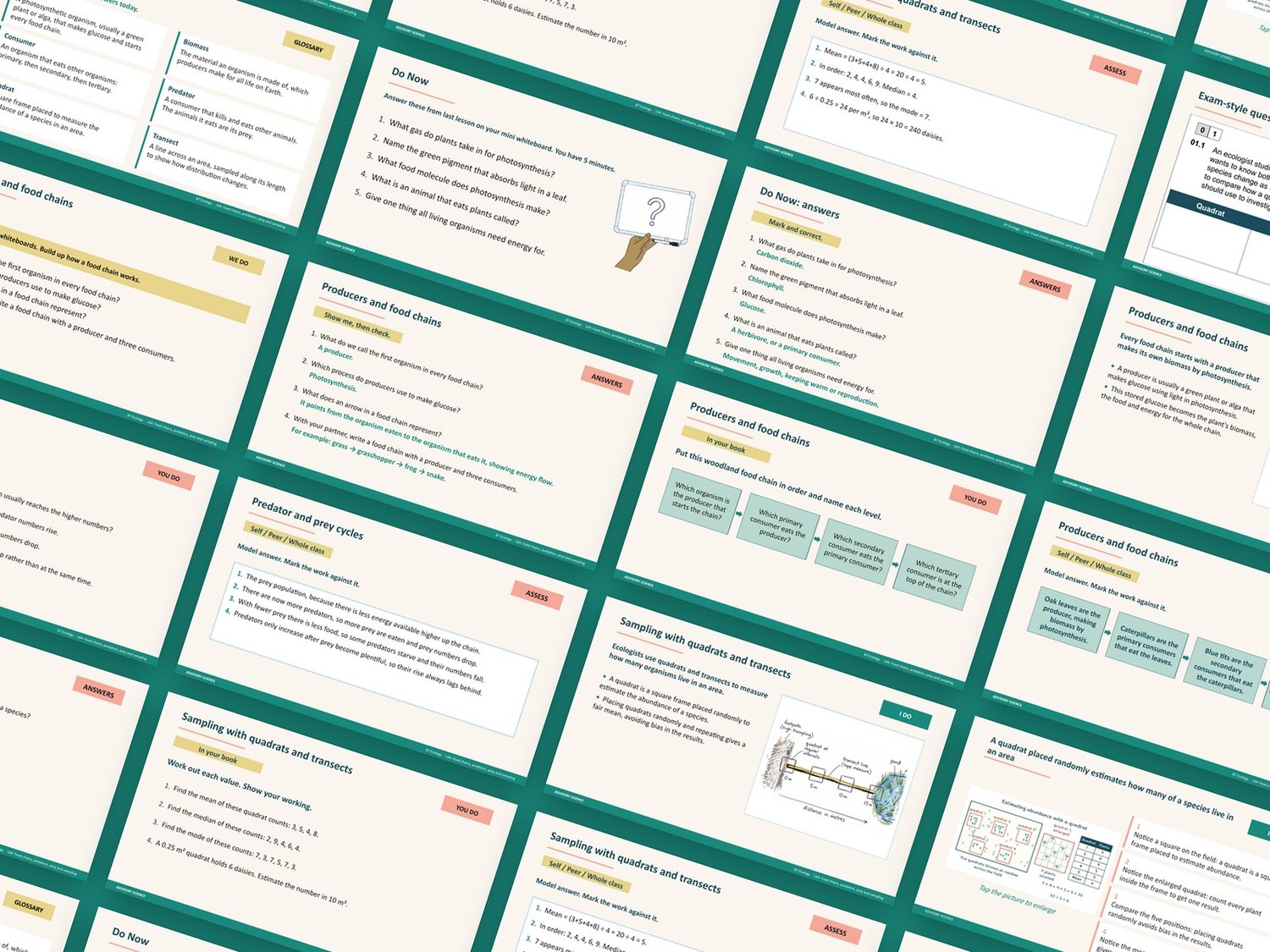
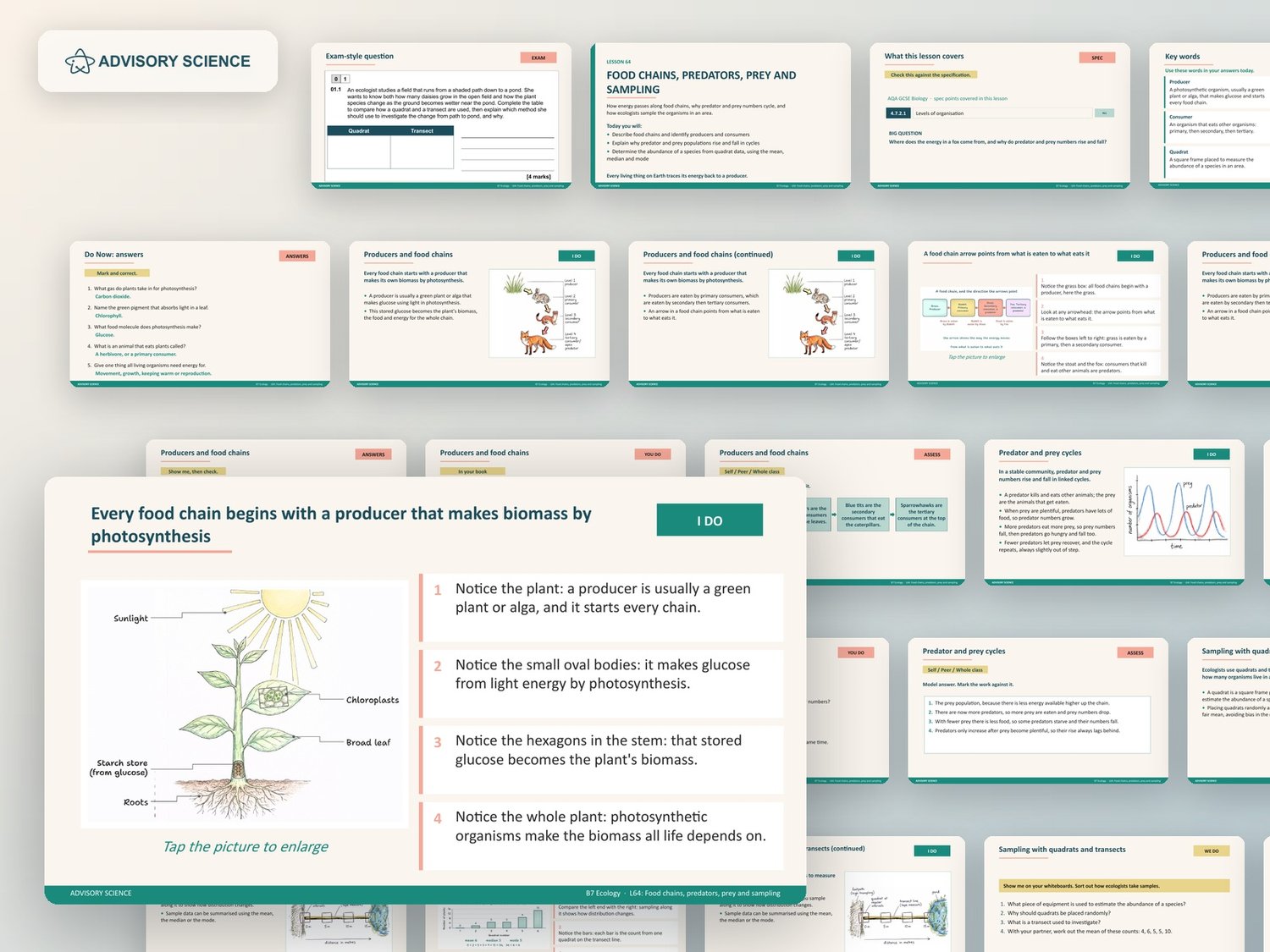
Each B7 Ecology lesson starts with a Do Now that recalls earlier learning, with the answers on the next slide. It then moves through I Do, We Do and You Do, with a model answer after each task. It finishes with the AQA-style question listed above, its mark scheme and an exit ticket. A specification slide names the AQA points the lesson covers, so you can check it against your scheme of work.
Topic test
The B7 Ecology topic test covers the whole unit with AQA-style questions and comes with its mark scheme, both in Word and PDF.
Free revision videos for this unit