

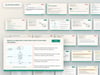
Inheritance, Variation and Evolution Lessons PowerPoint | AQA GCSE Biology B6 8461, 17 Lessons
AQA GCSE Biology B6 Inheritance, Variation and Evolution: 17 lessons ready to teach, with a topic test
You get every lesson for AQA GCSE Biology B6 Inheritance, Variation and Evolution, planned and ready to teach. There are 17 teaching lessons. Each one is editable PowerPoint and matched to the AQA 8461 specification.
What your classes work through
- Sexual and asexual reproduction and meiosis. Pupils use a table of body cell and gamete chromosome numbers to predict the number in a dog gamete and justify their answer.
- Comparing sexual and asexual reproduction. Pupils describe one advantage of asexual reproduction and explain why sexual reproduction helps a plant species survive when its environment changes.
- DNA and the genome. Pupils explain how a gene leads to a protein being made and how that protein gives a person their eye colour.
- The structure of DNA. Pupils evaluate a student's conclusion that because DNA has only four bases it can only code for four different proteins.
- Genetic inheritance and genetic crosses. Pupils compare the brown to white fur ratios expected from two mouse crosses and explain why the proportion of white offspring differs.
- Inherited disorders and sex determination. Pupils predict the probability that a Dd father and dd mother will have a child with polydactyly and justify their answer.
- Variation and mutation. Pupils write a 6-mark evaluation of the claim that continuous mutation means every species must be changing rapidly all of the time.
- Evolution by natural selection. Pupils tick the statement that best explains, by natural selection, why a lizard population living on pale grey rocks becomes mostly grey.
- Selective breeding. Pupils read a graph of milk yield in a selectively bred herd and determine the mean increase per generation between generations 2 and 8.
- Genetic engineering. Pupils give full reasons why bacteria carrying the human insulin gene make insulin that is suitable for treating diabetes in large amounts.
- Cloning. Pupils describe how tissue culture could produce thousands of copies of a rare orchid and explain why every plant is genetically identical.
- Darwin and the theory of evolution. Pupils apply natural selection to explain why rabbits gradually come to have thicker fur as their climate becomes colder over hundreds of years.
- Wallace and speciation. Pupils judge whether two snail groups separated by a new lake for 50 years have really become separate species.
- The story of genetics and the evidence for evolution. Pupils compare what scientists could observe about inheritance in the 1850s and the early 1900s, then explain why Mendel's work was accepted late.
- Fossils and extinction. Pupils match three ways fossils form, including preservation without decay and trace fossils, to the correct description of each.
- Antibiotic resistant bacteria. Pupils predict the 2022 percentage of infections caused by a resistant strain from hospital data and justify it using natural selection.
- Classification of living organisms. Pupils describe the three-domain system and explain why classification systems have changed since Linnaeus.
Who it is for
Use it for AQA GCSE Biology Inheritance, Variation and Evolution lessons on meiosis, DNA, genetic crosses, inherited disorders, natural selection, selective breeding, genetic engineering, fossils and classification. It fits KS4 teaching in Year 10 and Year 11 and GCSE Biology revision.
How each lesson runs
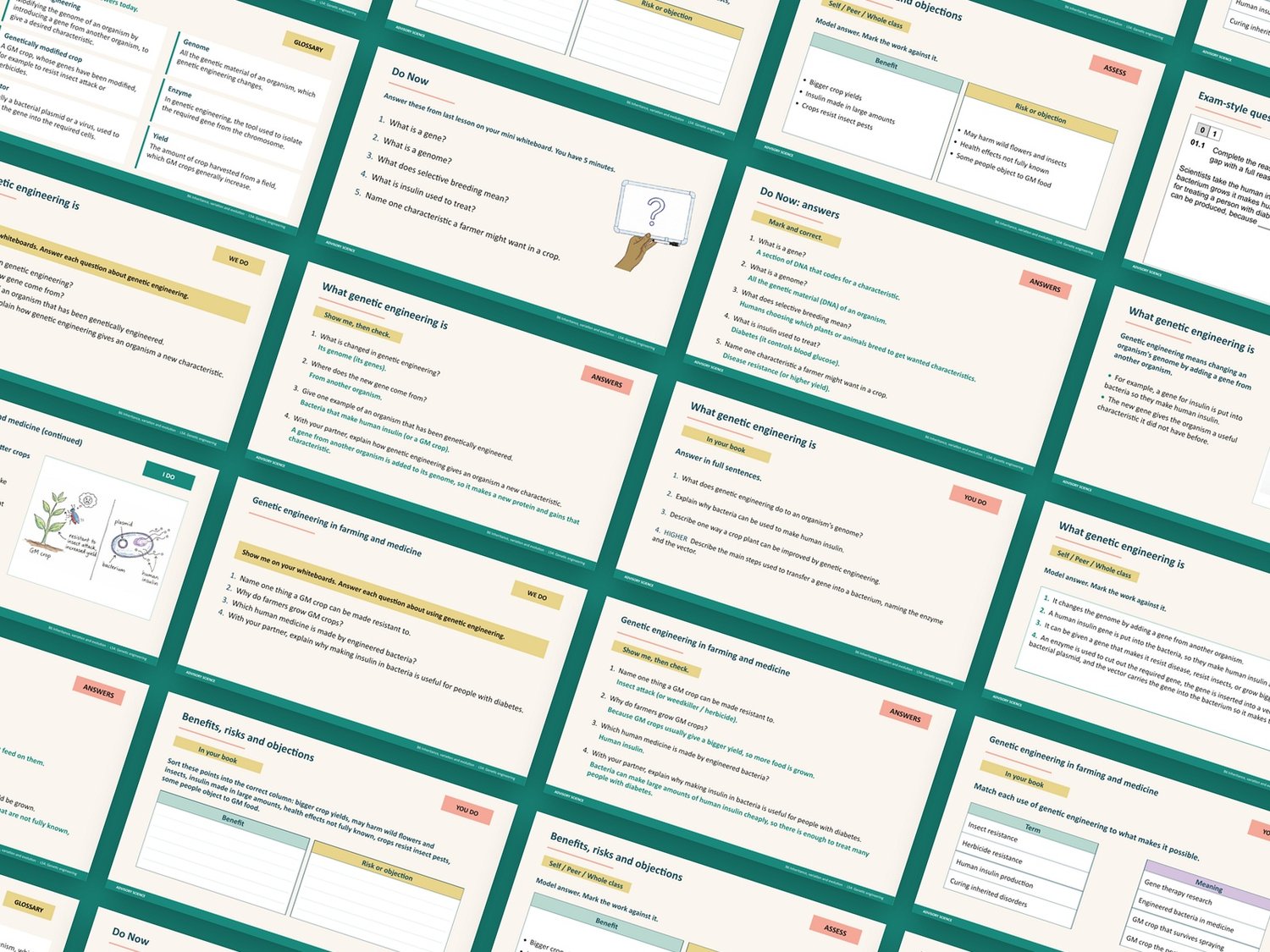
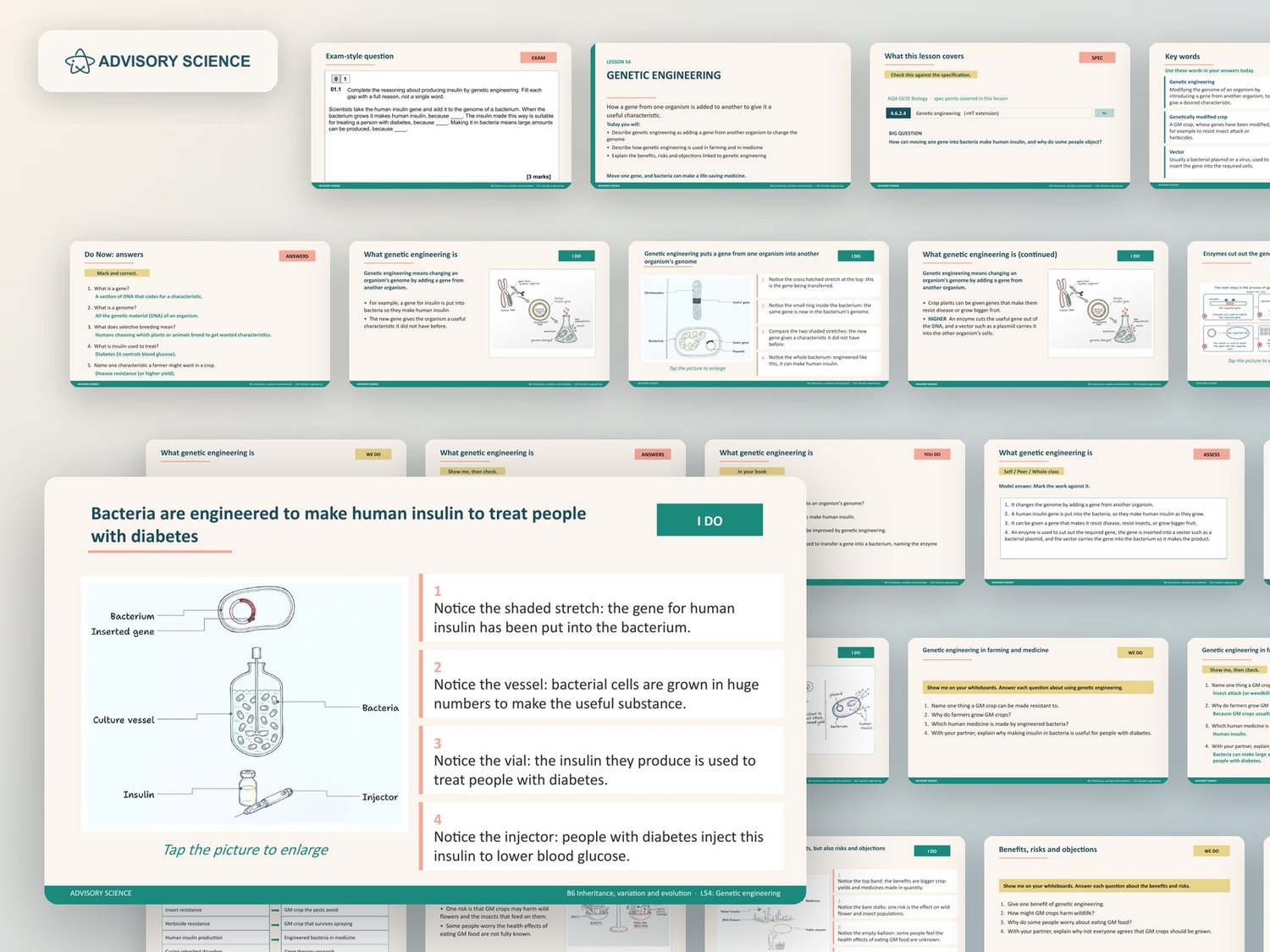
Each B6 Inheritance, Variation and Evolution lesson starts with a Do Now that recalls earlier learning, with the answers on the next slide. It then moves through I Do, We Do and You Do, with a model answer after each task. It finishes with the AQA-style question listed above, its mark scheme and an exit ticket. A specification slide names the AQA points the lesson covers, so you can check it against your scheme of work.
Topic test
The B6 Inheritance, Variation and Evolution topic test covers the whole unit with AQA-style questions and comes with its mark scheme, both in Word and PDF.
Free revision videos for this unit