


AQA GCSE Physics P2 Electricity | 12 Lesson Presentations and Topic Test
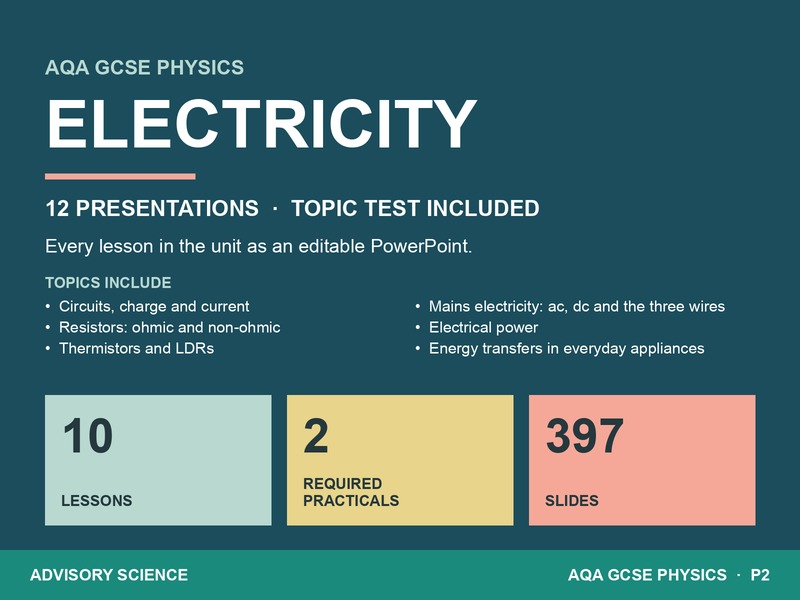
AQA GCSE Physics P2 Electricity: 12 lessons ready to teach, with a topic test
You get every lesson for AQA GCSE Physics P2 Electricity, planned and ready to teach. There are 10 teaching lessons and the 2 required practicals as full lessons. Each one is editable PowerPoint and matched to the AQA 8463 specification.
What your classes work through
- Circuits, charge and current. Pupils combine charge, time and potential difference to find the resistance of a resistor in a multiple choice question.
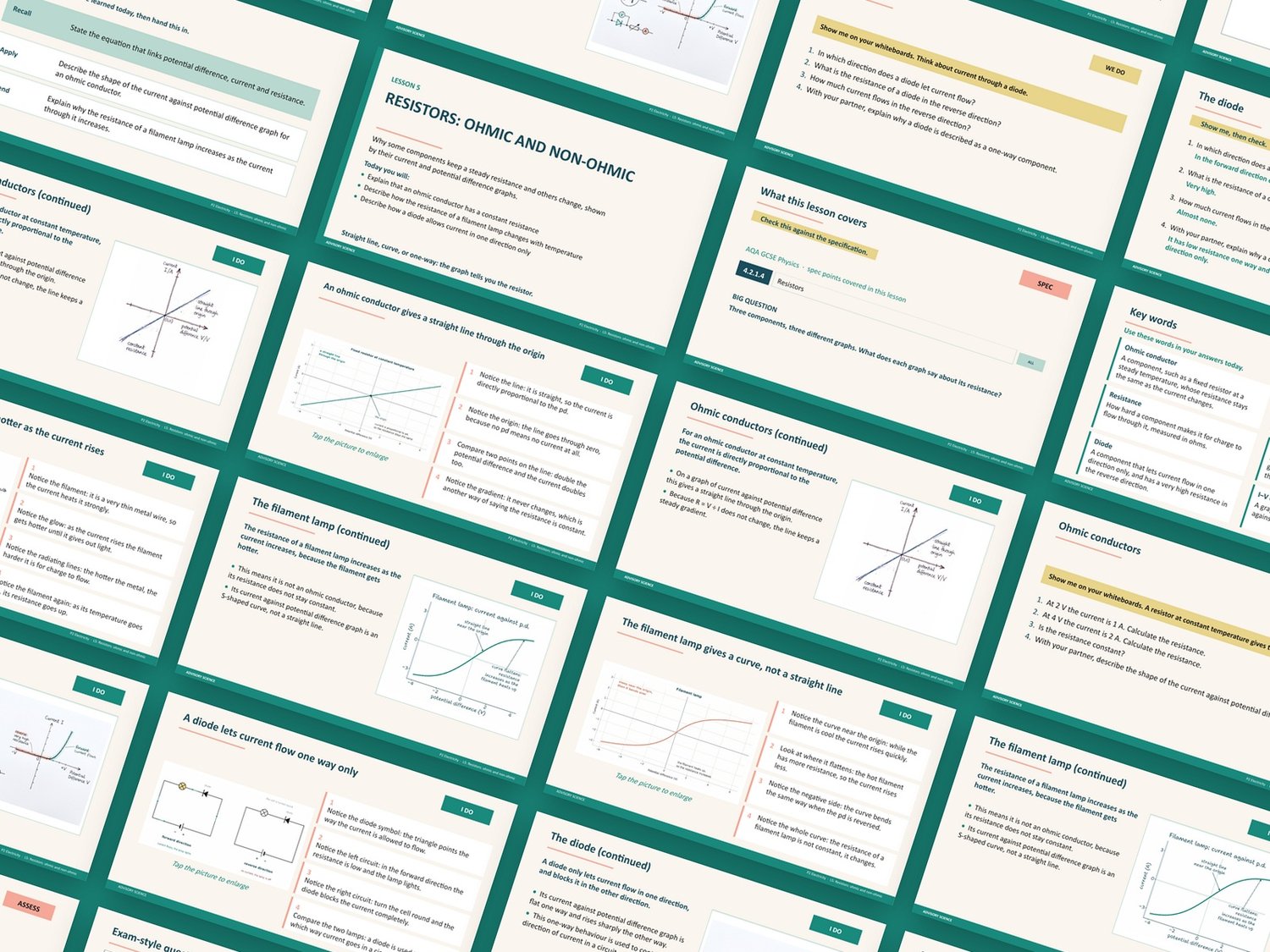
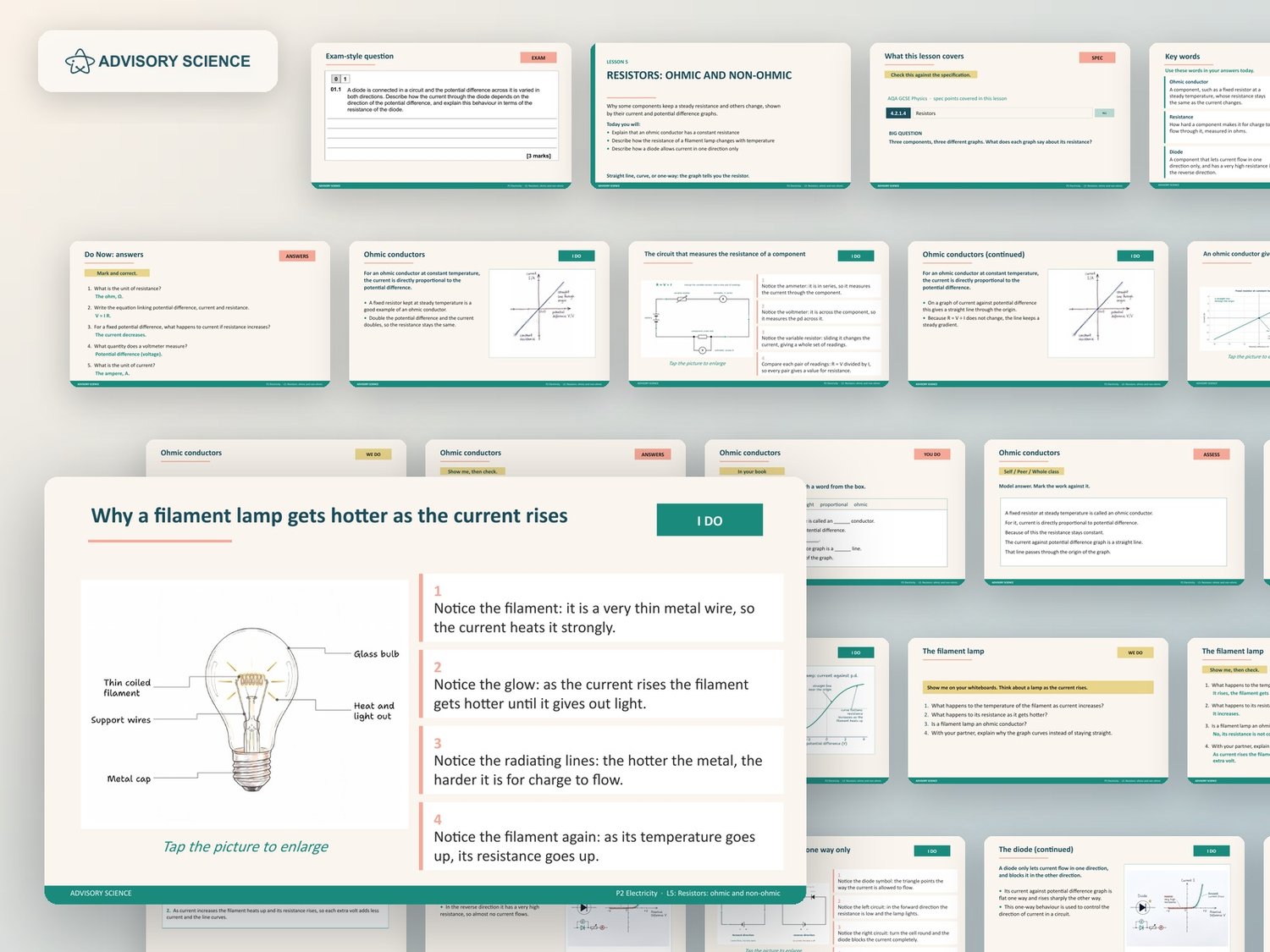
- Resistors: ohmic and non-ohmic. Pupils describe how current through a diode depends on the direction of the potential difference and explain it using resistance.
- Thermistors and LDRs. Pupils explain how a thermistor circuit switches a greenhouse fan on automatically as the greenhouse warms up.
- Mains electricity: ac, dc and the three wires. Pupils write a 6-mark evaluation of a claim that an appliance switched off at the wall is safe, using the live, neutral and earth wires.
- Electrical power. Pupils use two power equations in sequence to calculate the resistance of a mains heater element and give the unit.
- Energy transfers in everyday appliances. Pupils complete a table of energy transferred by a kettle and a toaster, then compare the values and explain which transfers more.
- The National Grid. Pupils predict whether an offshore wind farm needs a step-up or step-down transformer before the transmission cables and justify the choice.
- Static charge and the forces between charged objects. Pupils evaluate a student's conclusion that a duster charged a polythene rod by transferring protons, using what they know about electron transfer.
- Electric fields around charged objects. Pupils complete a passage explaining how the field and force change near a charged dome and why a spark jumps to an earthed object.
- Series and parallel circuits. Pupils fill gaps with full explanations of why two lamps wired in parallel to the mains each get 230 V and stay lit independently.
The 2 required practicals
- RP3 Resistance of a Wire. Pupils describe the relationship shown on a resistance against length graph and read off the resistance of a 60 cm wire.
- RP4 I-V Characteristics. Pupils compare the I-V graph shapes for a fixed resistor and a filament lamp in a table, then explain why they differ.
Who it is for
Use it to teach AQA GCSE Physics P2 Electricity lessons on circuits, resistance, thermistors and LDRs, mains electricity, power, the National Grid and static electricity in Year 10 and Year 11. It suits GCSE Physics revision and covers the resistance of a wire and I-V characteristics required practicals.
How each lesson runs
Each P2 Electricity lesson starts with a Do Now that recalls earlier learning, with the answers on the next slide. It then moves through I Do, We Do and You Do, with a model answer after each task. It finishes with the AQA-style question listed above, its mark scheme and an exit ticket. A specification slide names the AQA points the lesson covers, so you can check it against your scheme of work.
Topic test
The P2 Electricity topic test covers the whole unit with AQA-style questions and comes with its mark scheme, both in Word and PDF.
Free revision videos for this unit
- Electricity revision (P2)
- Series and Parallel Circuits
- Triple-only Paper 1 topics (static electricity)
- Paper 1 Triple whole paper walkthrough