


Organisation Lessons PowerPoint | AQA GCSE Combined Science Biology B2, 12 Lessons
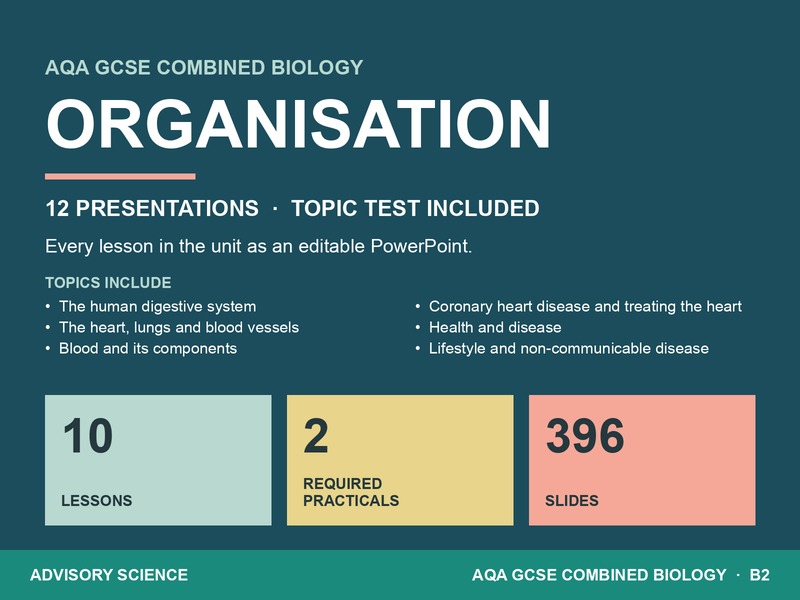
AQA GCSE Combined Science Biology B2 Organisation: 12 lessons ready to teach, with a topic test
This is the Combined Science Trilogy version of B2 Organisation, matched to the AQA 8464 specification. You get 10 teaching lessons and the 2 required practicals as full lessons, all planned and ready to teach in editable PowerPoint.
What your classes work through
- The human digestive system. Pupils write reasons in place of single words to show why an enzyme from the small intestine speeds up, peaks at 37 °C and then slows.
- The heart, lungs and blood vessels. Pupils name three alveoli adaptations, such as a large surface area, and link each one to oxygen and carbon dioxide diffusing faster.
- Blood and its components. Pupils link heavy blood loss to fewer red blood cells, less haemoglobin and too little oxygen reaching the patient's body cells.
- Coronary heart disease and treating the heart. Pupils judge whether data from a statin trial against a dummy pill supports a student's sweeping conclusion about treating coronary heart disease.
- Health and disease. Pupils set measles beside coronary heart disease in a table, showing why a pathogen lets one pass on while the other never can.
- Lifestyle and non-communicable disease. Pupils draw lines from four lifestyle risk factors to type 2 diabetes, cardiovascular disease, lung cancer and liver damage.
- Cancer. Pupils extend the trend in lung cancer cases per 100 000 people to estimate the rate for someone smoking 40 a day.
- Plant tissues and the leaf. Pupils locate the palisade layer near the upper surface of a leaf and link that placing to absorbing more light.
- Transport in plants: transpiration and translocation. Pupils link fast transpiration in hot, windy weather to water leaving the leaves faster than moist soil can replace it.
- Levels of organisation. Pupils trace the digestive system from cells to tissues, organs and a full organ system to show how an organism is organised.
The 2 required practicals
- RP3 Food Tests. Pupils draw lines connecting four food tests with their positive results, from brick red with Benedict's to blue-black with iodine.
- RP4 Effect of pH on Enzymes. Pupils use the trend in starch breakdown times across pH values to fill the gap in an amylase table, explaining their reasoning.
Who it is for
Use it for AQA GCSE Combined Science Trilogy B2 Organisation lessons on enzymes, digestion, the heart and blood, non-communicable disease, cancer and plant transport. It suits Combined Science Biology revision for Year 10 and Year 11 and includes the food tests and pH and enzymes required practicals.
How each lesson runs
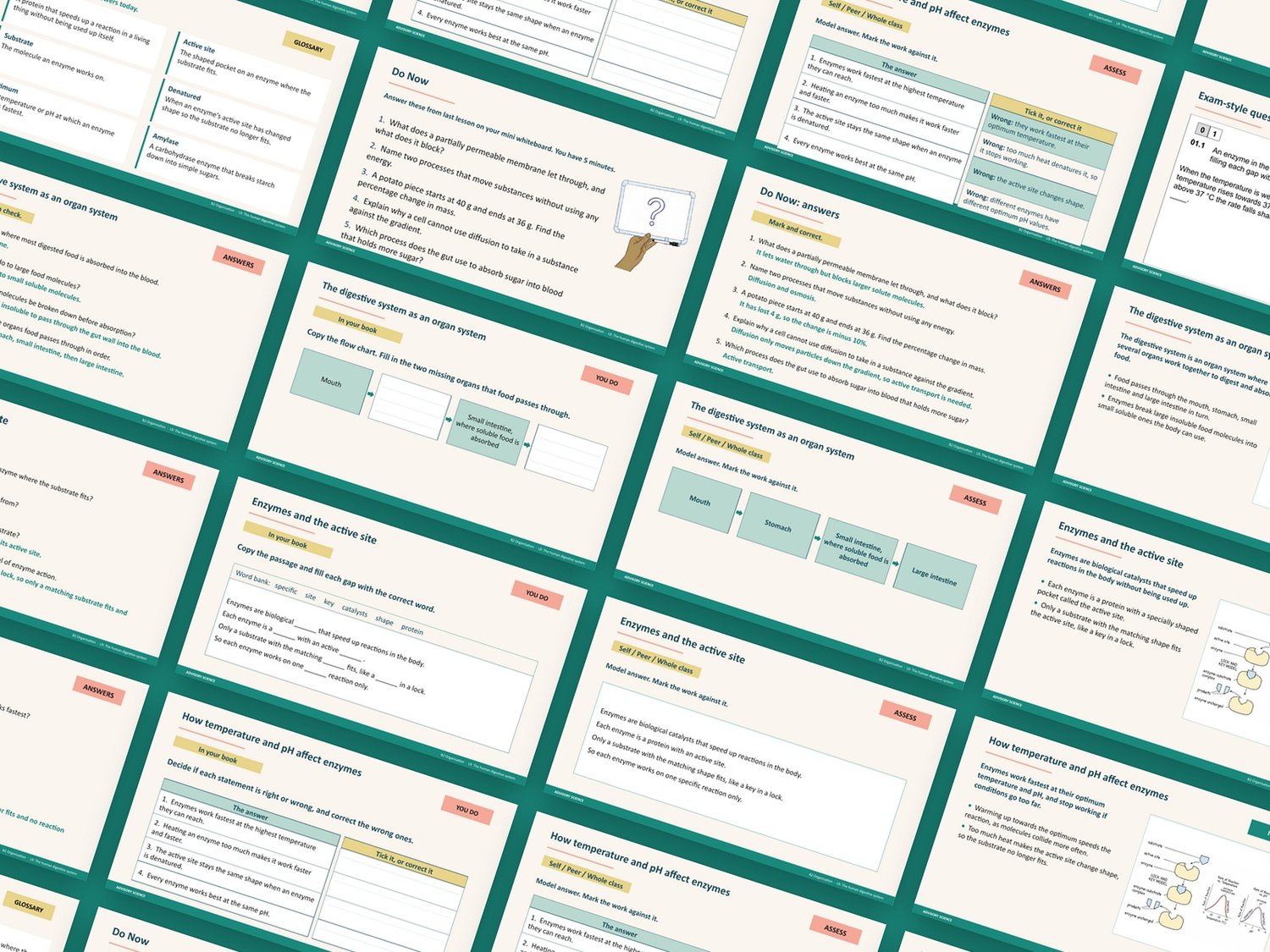
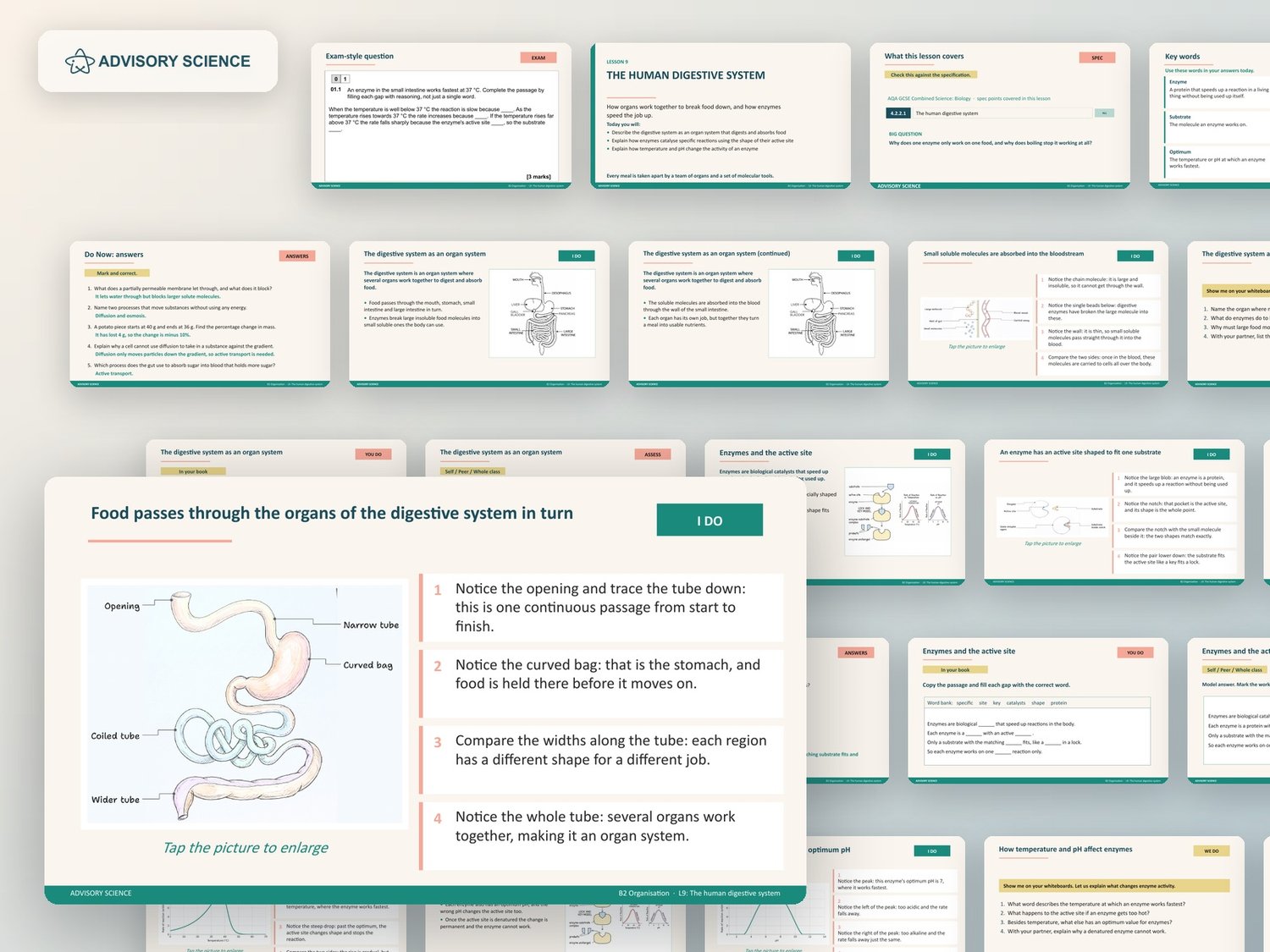
Each B2 Organisation lesson starts with a Do Now that recalls earlier learning, with the answers on the next slide. It then moves through I Do, We Do and You Do, with a model answer after each task. It finishes with the AQA-style question listed above, its mark scheme and an exit ticket. A specification slide names the AQA points the lesson covers, so you can check it against your scheme of work.
Topic test
The B2 Organisation topic test covers the whole unit with AQA-style questions and comes with its mark scheme, both in Word and PDF.
Free revision videos for this unit