

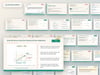
AQA GCSE Combined Science Physics P5 Forces | 12 Lesson Presentations and Topic Test
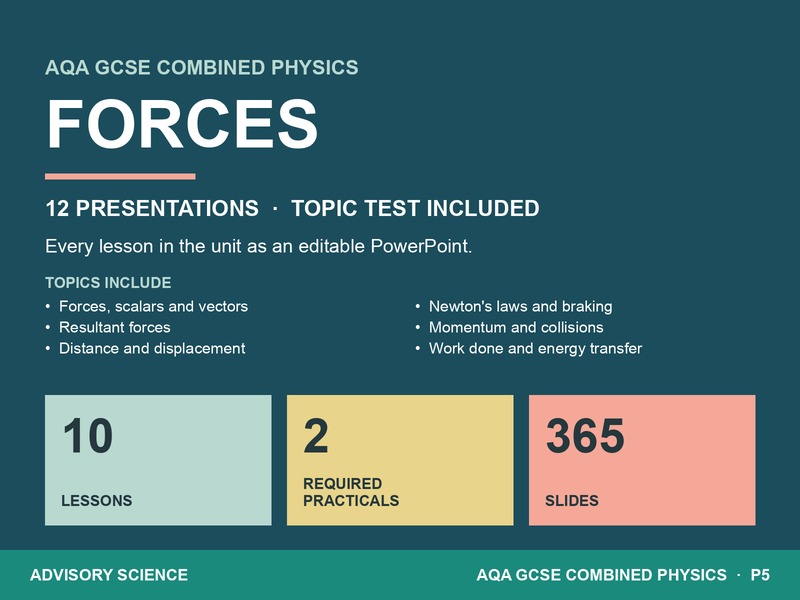
AQA GCSE Combined Science Physics P5 Forces: 12 lessons ready to teach, with a topic test
This is the Combined Science Trilogy version of P5 Forces, matched to the AQA 8464 specification. You get 10 teaching lessons and the 2 required practicals as full lessons, all planned and ready to teach in editable PowerPoint.
What your classes work through
- Forces, scalars and vectors. Pupils fill reasoning gaps on why a 6 kg rock on the Moon has unchanged mass but feels lighter where g is only 1.6 N/kg.
- Resultant forces. Pupils calculate the resultant force on a model boat from two forward forces and two backward forces acting along a straight line.
- Distance and displacement. Pupils separate the 600 m a drone covers on its round trip from its zero displacement, explaining the difference between scalar and vector.
- Newton's laws and braking. Pupils link four terms, from Newton's First Law to braking distance, with definitions about resultant force and stopping.
- Momentum and collisions. Pupils calculate the common velocity of two trolleys that stick together after a collision, using conservation of momentum.
- Work done and energy transfer. Pupils multiply 25 N by 12 m to get the energy transferred moving a polisher, naming joules as the unit.
- Forces and elasticity. Pupils give full reasons for the straight section and the curved section of a spring's force against extension graph.
- Speed and velocity. Pupils calculate a cyclist's average speed for a there and back ride and explain why her average velocity is 0 m/s.
- The distance-time relationship. Pupils interpret the three sections of a delivery driver's distance-time graph, including the stationary part, and work out the speed.
- Acceleration. Pupils calculate a bus's acceleration as it pulls away and as it brakes, then describe how a velocity-time graph shows each stage.
The 2 required practicals
- RP18 Force and Extension. Pupils find the spring constant from a force and extension graph after taking a reading at 0.15 m and describing the trend.
- RP19 Acceleration and Force. Pupils divide a resultant force of 5 N by an acceleration of 2.5 m/s² to find a trolley's inertial mass.
Who it is for
Use it for AQA GCSE Combined Science Trilogy P5 Forces lessons on scalars and vectors, resultant forces, work done, elasticity, speed, velocity, acceleration, Newton's laws, stopping distance and momentum. It also gives Combined Science Physics revision for Year 10 and Year 11, with the force and extension and acceleration required practicals.
How each lesson runs
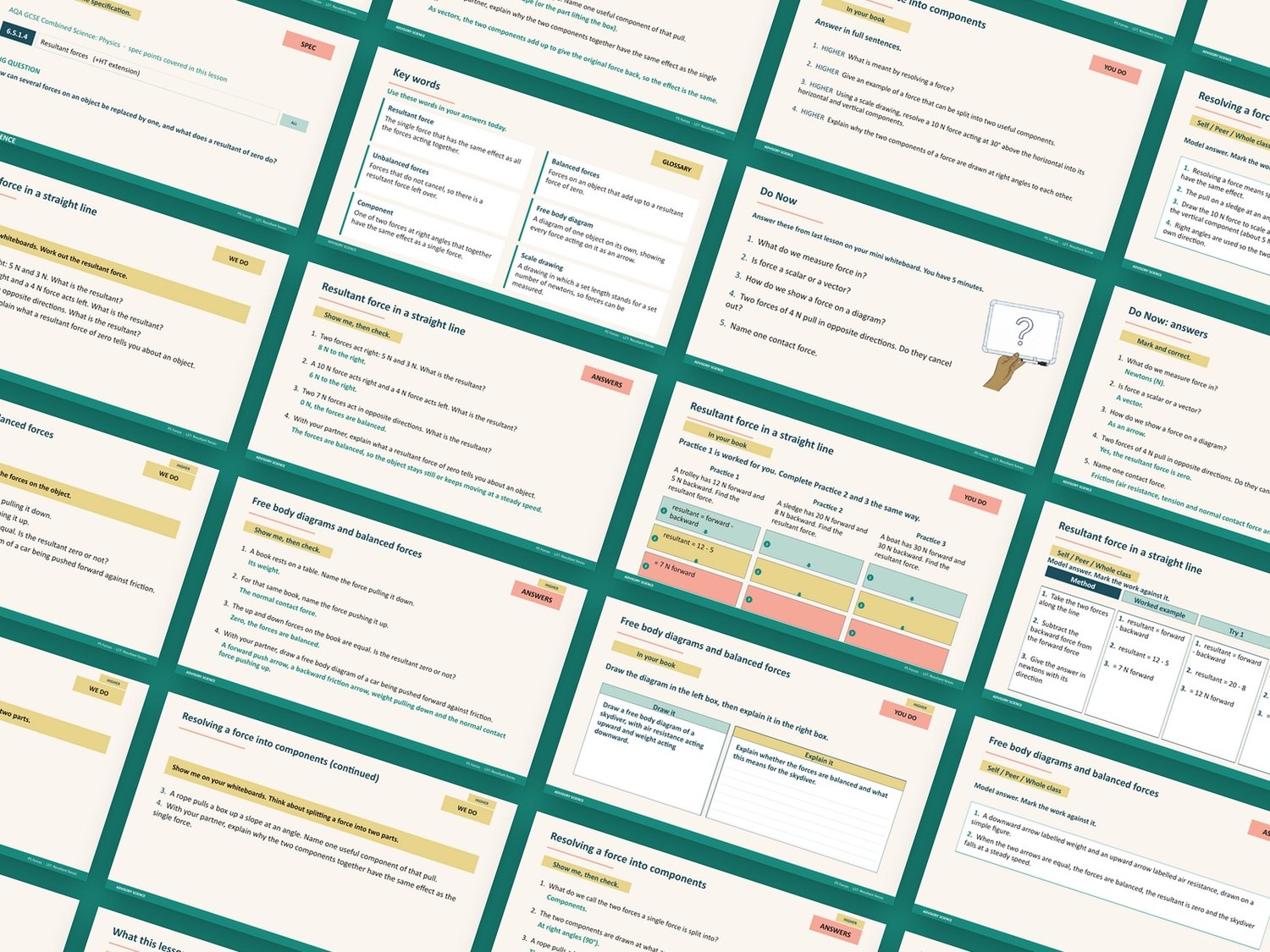
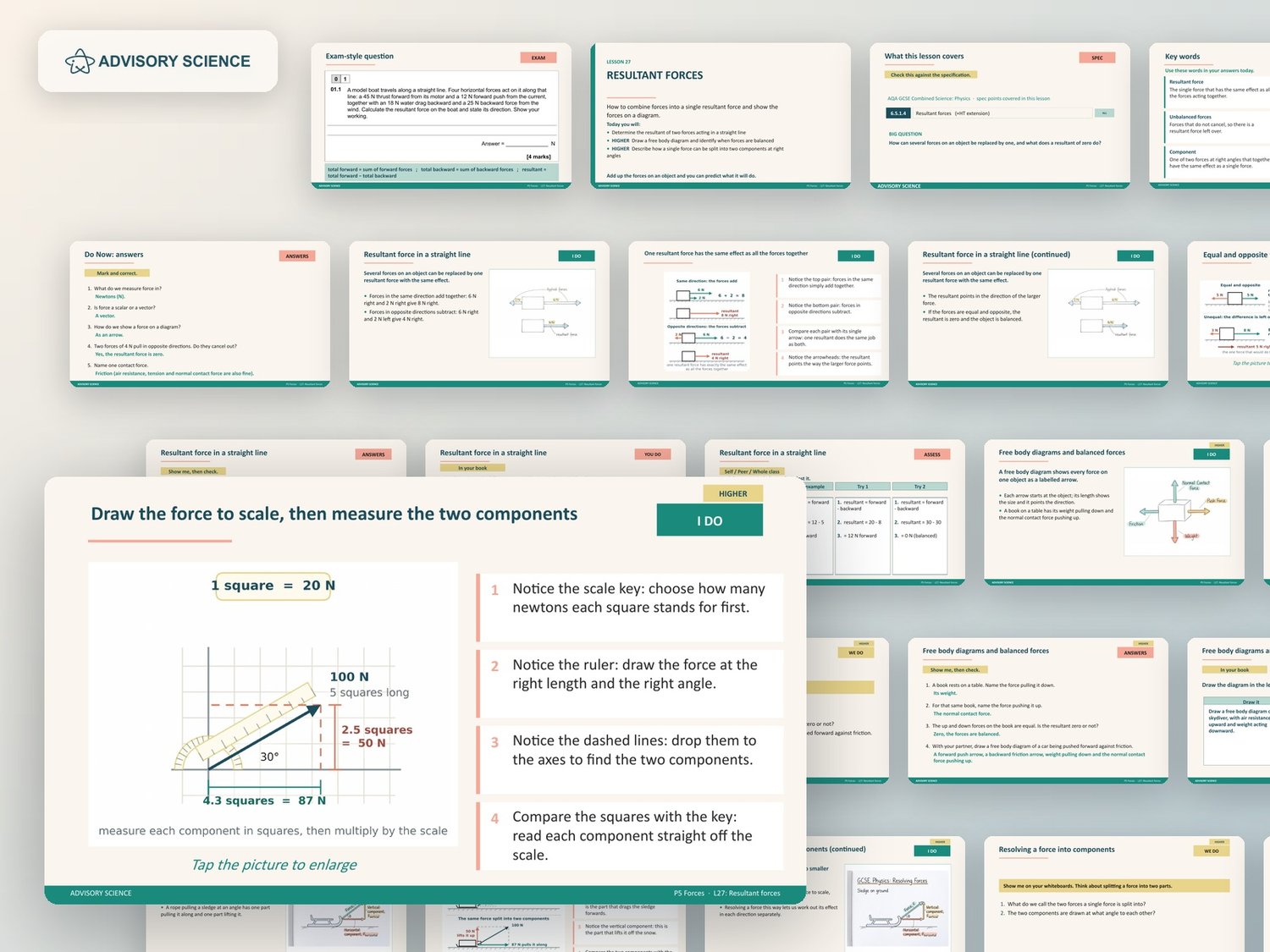
Each P5 Forces lesson starts with a Do Now that recalls earlier learning, with the answers on the next slide. It then moves through I Do, We Do and You Do, with a model answer after each task. It finishes with the AQA-style question listed above, its mark scheme and an exit ticket. A specification slide names the AQA points the lesson covers, so you can check it against your scheme of work.
Topic test
The P5 Forces topic test covers the whole unit with AQA-style questions and comes with its mark scheme, both in Word and PDF.
Free revision videos for this unit
- Forces, whole topic (Higher)
- Forces, whole topic (Foundation)
- Physics Paper 2 Higher whole paper walkthrough (Combined)