

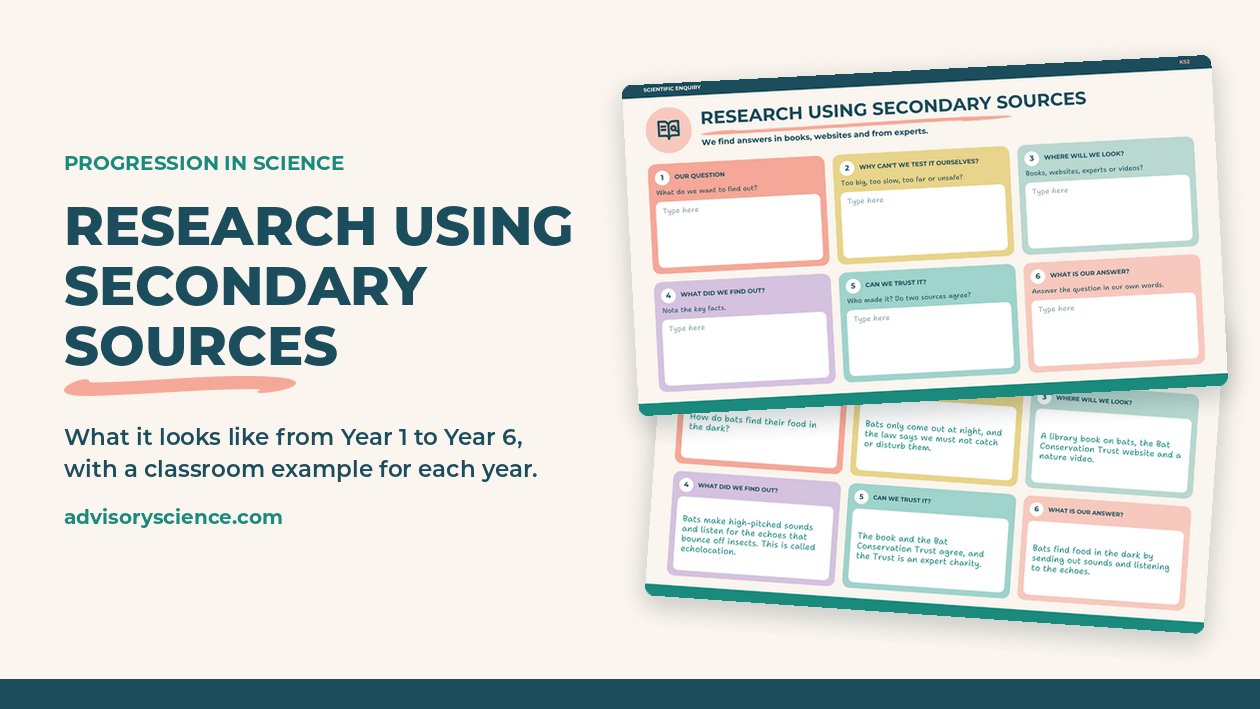
There are some scientific questions that children cannot answer by carrying out a practical investigation themselves.
They cannot safely observe a blue whale in the classroom. They cannot travel back in time to observe a dinosaur. They cannot watch the development of the telescope by carrying out an experiment. And sometimes the information they need already exists.
That is where research using secondary sources comes in.
What the National Curriculum says
The National Curriculum identifies researching using secondary sources as one of the types of scientific enquiry. In Years 1 and 2, pupils should ask people questions and use simple secondary sources to find answers. In Years 3 and 4, they should recognise when secondary sources can help answer questions that cannot be answered through practical investigations. By Years 5 and 6, they should use a wider range of secondary sources and identify scientific evidence used to support or refute ideas.
Year 1: finding information
In Year 1, research is very closely supported. Learners might look at a photograph, book or video to find out about an animal they cannot observe directly. They might ask an adult a question.
The important learning is understanding that information can be obtained from sources other than first-hand observation.
Year 2: asking questions and finding answers
By Year 2, learners can begin with their own questions. For example:
- Where do penguins live?
- What do they eat?
- How do they keep warm?
They can use an appropriate book, photograph, video or website with support to find answers.
The progression is in the connection between the question and the information they seek. They are finding information to answer a question.
Year 3: deciding when research is appropriate
In Years 3 and 4, pupils should begin to recognise when secondary sources are useful. This is an important scientific decision.
Suppose a class wants to know: how did people first discover that fossils could tell us about organisms that lived in the past?
A practical investigation cannot answer that question. Research is appropriate because the evidence is found in historical records, scientific accounts and other secondary sources. Learners need to understand why research is the appropriate enquiry.
Year 4: finding relevant information
By Year 4, learners can begin to search for information more deliberately. They need to identify the information that answers their question rather than copying everything they find.
For example, researching how fossils form requires information about the process. A page containing ten interesting facts about dinosaurs may be interesting, but it may not answer the question.
This is where reading and scientific vocabulary become increasingly important.
Year 5: selecting and comparing sources
By Year 5, learners should be able to use a wider range of secondary sources. They might use:
- books
- scientific websites
- videos
- museum resources
- photographs
- interviews
- information from scientific organisations
They need to think about whether the source actually provides the information they need. They can also compare information from more than one source. If two sources give different explanations, that difference becomes something to investigate.
Year 6: using evidence from sources
By Year 6, research can become a much more critical form of enquiry. Learners should be able to identify scientific evidence used to support or refute ideas.
For example, if they are researching whether a particular material is suitable for a purpose, they need to distinguish between:
"This website says it is strong."
and
"The evidence described by this source shows that the material can withstand a particular force."
That is a significant difference. The learner is beginning to think about the evidence behind the information.
What should progression look like?
Research can develop from:
finding information → using information to answer a question → deciding when research is appropriate → locating relevant information → comparing sources → evaluating evidence
The progression lies in what learners do with the information they find, and that matters far more than how difficult the websites are.
A useful subject leader check
Take a research task from different year groups. Ask:
- What is the question?
- How does the learner know what information they need?
- Who selected the source?
- What does the learner do with the information once they have found it?
If the task is essentially "Find five facts about…", there may be an opportunity to develop the enquiry further. Research is much more powerful when learners have a question they genuinely need information to answer.
Bringing the five enquiries together
Across primary science, learners should experience all five types of enquiry: observing over time, pattern seeking, identifying and classifying, comparative and fair testing, and research.
The progression is that learners become increasingly able to understand what each type of enquiry can help them find out, choose an appropriate approach, carry it out carefully and use the evidence to answer their question.
That is why progression in working scientifically needs to be considered across the whole curriculum.
The next step for a subject leader is to look at each type of enquiry across the six years and ask whether learners are becoming increasingly independent in making those decisions.
Free for your school: the working scientifically progression displays show six skills from Year 1 to Year 6, ready to print for a whole-school display. Download all six free.
Plan it with your class: the Scientific Enquiry Planning Pack gives you a planning slide for each type of enquiry, with a model answer after each one, for KS1 and KS2. See the planning pack